🌰 Fiber in Almonds Calculator
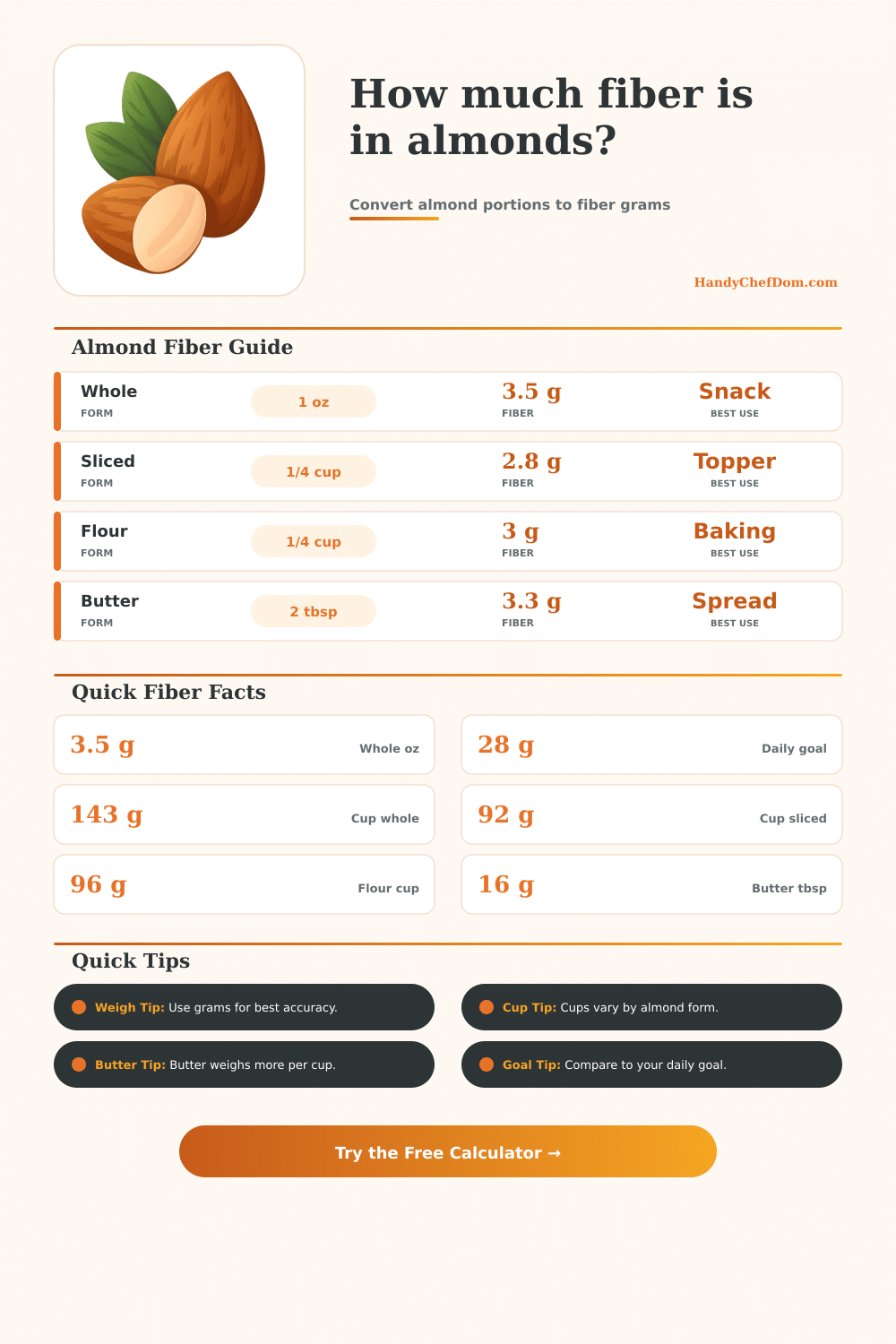
Convert whole almonds, sliced almonds, almond flour, almond meal, or almond butter into fiber grams by weight, cup measure, recipe serving, and daily fiber target.
Use grams for the most accurate fiber estimate, or use cups when you are measuring sliced almonds, almond flour, or almond butter for a recipe.
| Almond form | Fiber per 100 g | Approx g per cup | Best calculator mode |
|---|---|---|---|
| Whole almonds | 12.5 g | 143 g | Weight or snack servings |
| Sliced almonds | 12.0 g | 92 g | Cup measure for toppings |
| Slivered almonds | 12.1 g | 108 g | Cup measure or recipe weight |
| Chopped almonds | 12.3 g | 118 g | Recipe cup conversion |
| Almond flour | 10.7 g | 96 g | Baking cup conversion |
| Almond meal | 11.0 g | 112 g | Coarser baking mixes |
| Almond butter | 10.3 g | 256 g | Tablespoons or grams |
| Blanched almonds | 11.7 g | 142 g | Weight for snack portions |
| Common almond portion | Approx weight | Estimated fiber | Daily target share |
|---|---|---|---|
| 1 oz whole almonds | 28 g | 3.5 g | 13% of 28 g |
| 1/4 cup sliced almonds | 23 g | 2.8 g | 10% of 28 g |
| 1/4 cup almond flour | 24 g | 2.6 g | 9% of 28 g |
| 2 tbsp almond butter | 32 g | 3.3 g | 12% of 28 g |
| 1/2 cup chopped almonds | 59 g | 7.3 g | 26% of 28 g |
| 1 cup almond meal | 112 g | 12.3 g | 44% of 28 g |
| Almond form | Calories per 28 g | Protein per 28 g | Fat per 28 g | Carbs per 28 g |
|---|---|---|---|---|
| Whole almonds | 164 | 6.0 g | 14.2 g | 6.1 g |
| Dry roasted almonds | 169 | 6.0 g | 14.9 g | 5.5 g |
| Sliced almonds | 160 | 5.8 g | 13.8 g | 5.9 g |
| Almond flour | 161 | 6.1 g | 13.9 g | 5.6 g |
| Almond meal | 163 | 5.9 g | 14.0 g | 5.8 g |
| Almond butter | 174 | 6.0 g | 15.7 g | 5.4 g |
| Recipe or snack use | Typical almond form | Usual portion | Fiber planning note |
|---|---|---|---|
| Snack pack | Whole or roasted | 1 oz per person | Good single-serving estimate |
| Oatmeal topping | Sliced or slivered | 2 tbsp to 1/4 cup | Volume varies by scoop |
| Smoothie blend | Almond butter | 1 to 2 tbsp | Dense cup weight matters |
| Muffin batter | Almond flour | 1/4 cup per batch share | Divide fiber by servings |
| Trail mix | Whole or chopped | 1/2 oz to 1 oz | Use edible portion factor |
| Salad crunch | Sliced almonds | 1 to 2 tbsp | Some topping may remain |
Almonds is a food that contains fiber, and many people includes almonds in there diets. Almonds can be consumed in a variety of form, including whole almonds, sliced almonds, almond flour, and almond butter. Each of these forms contain a different amount of fiber due to the change in the physical structure of the almonds in each of these form.
For instance, almonds that contains the skins of the almonds will have more fiber than almond products that dont contains those skins. For instance, products like almond flour (which is ground almonds) will contain less skins than whole almonds, and almond butter (which is ground almonds with added butter) will contain fewer skins than whole almonds. Thus, the fiber content of almond butter will be less then the fiber content of whole almonds of the same weight due to the loss of skins during the grinding of the almonds.
Fiber in Different Almond Forms
Thus, individuals who consumes almonds of different forms should track the form of the almonds that they consume. For instance, individuals may believe that different volumes of sliced almonds and almond butter will contain the same amount of fiber; however, the volume of sliced almonds and almond butter will not provide the same amount of fiber to the individual. Because many individuals has set goals regarding the amount of fiber that they wish to consume each day, individuals will benefit from being able to use a calculator that can determine the amount of fiber that the different forms of almonds that are consumed will provide.
Such a calculator could prompt the individual to enter the form of almonds that they are consuming, as well as the weight of the almonds that are consumed. The calculator would then be able to display information about the total fiber content of the almonds that were consumed, the amount of fiber per serving of the almonds, and the percentage of the individual’s daily fiber goal that those almonds fulfill. The way in which people prepare almonds can also impact the fiber content of those almonds.
For instance, almonds that are dry roasted may lose some of their fiber during the roasting process. Additionally, almonds that are roasted in oil will contain more weight than almonds that are dry roasted, but the additional weight from the oil will not contain any fiber. While these changes to the fiber content of almonds may be small, they are still important for individuals who wish to precise control the amount of fiber that enters their bodies.
Furthermore, the amount of almonds that an individual consumes may change based on how they are serve. For instance, if an individual shares a bowl of almonds with a variety of other individuals, they will consume less of the almonds than individuals who consume entire bowl of almonds. Thus, the amount of fiber that they consume will also be less then those other individuals.
Thus, individuals can utilize the calculator to determine whether or not the almonds that they are consuming are helping them to achieve their fiber goal. For instance, if the calculator indicate that the almonds provide a percentage of an individuals daily fiber goal, they may not need to consume any more almonds during that day. However, if the calculator indicates that the amount of fiber that the almonds provide is relatively small, the individual may choose to consume more almonds (or foods that contains fiber, instead).
Thus, understanding the difference in the fiber content of each form of almonds can allow individuals to make consistent and informed decisions about their diets. Because almonds are a food that contains fiber, individuals can utilize it to help achieve their daily fiber goal. Therefore, by understanding the fiber content of each form of almonds, individuals can use almonds to help achieve their fiber goal.