🍚 Water for Couscous Calculator
Dial in the water amount for Moroccan, pearl, whole wheat, fine, and maftoul couscous by dry quantity, texture, altitude, fat, and servings.
Use cups or grams for the dry couscous. The calculator converts through a couscous-specific cup weight, then adjusts water for method, texture, altitude, and oil or butter.
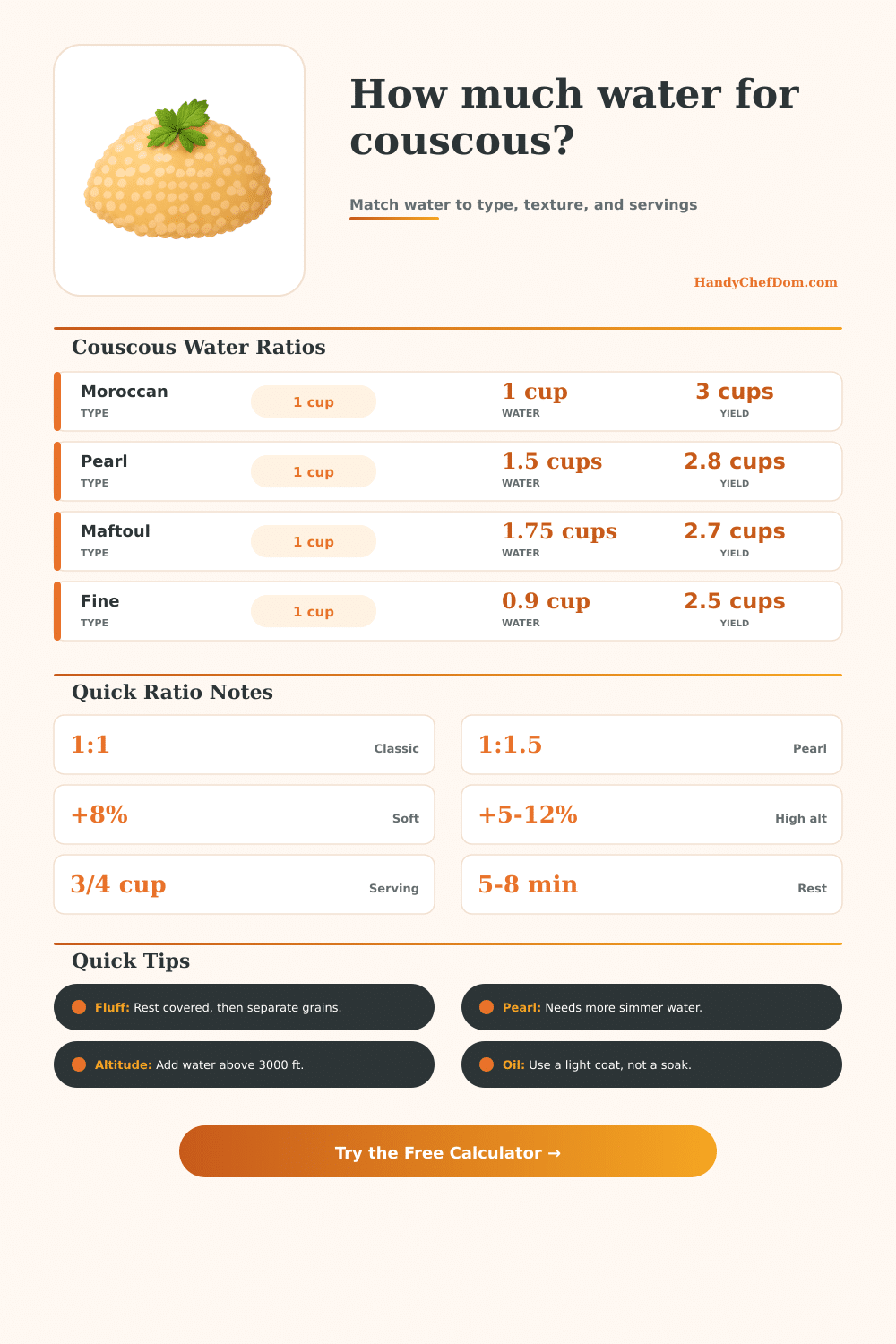
| Couscous Type | Dry Cup Weight | Water Ratio | Cooked Yield |
|---|---|---|---|
| Moroccan instant couscous | 176 g | 1 cup water per 1 cup dry | About 3 cups cooked |
| Whole wheat couscous | 180 g | 1.05 cups water per 1 cup dry | About 3 cups cooked |
| Tri-color couscous | 176 g | 1 cup water per 1 cup dry | About 3 cups cooked |
| Fine semolina couscous | 170 g | 0.9 cup water per 1 cup dry | About 2.5 cups cooked |
| Pearl Israeli couscous | 175 g | 1.5 cups water per 1 cup dry | About 2.8 cups cooked |
| Maftoul hand-rolled couscous | 165 g | 1.75 cups water per 1 cup dry | About 2.7 cups cooked |
| Texture Target | Water Change | Best Fit | Calculator Effect |
|---|---|---|---|
| Extra separate grains | Reduce slightly | Fluffy sides and salads | Minus 6% |
| Classic fluffy | Use base ratio | Everyday side dishes | No change |
| Plush and tender | Add a little | Bowl bases | Plus 8% |
| Soft saucy base | Add more | Tagines and braises | Plus 16% |
| Firm chilled salad | Reduce slightly | Make-ahead salads | Minus 4% |
| Altitude Band | Water Addition | Why It Helps | Use With |
|---|---|---|---|
| 0-1500 ft | No extra | Standard boil and steep behavior | All couscous types |
| 1500-3000 ft | Plus 2% | Slightly faster evaporation | Pearl or maftoul |
| 3000-5000 ft | Plus 5% | Lower boiling point needs more margin | Covered batches |
| 5000-7000 ft | Plus 8% | Longer hydration and more steam loss | Large pearl couscous |
| 7000 ft and above | Plus 12% | Highest evaporation allowance | Simmered couscous |
| Dry Amount | Moroccan Water | Pearl Water | Approx Servings |
|---|---|---|---|
| 1/2 cup dry | 1/2 cup | 3/4 cup | 2 side servings |
| 1 cup dry | 1 cup | 1.5 cups | 4 side servings |
| 1.5 cups dry | 1.5 cups | 2.25 cups | 6 side servings |
| 2 cups dry | 2 cups | 3 cups | 8 side servings |
| 3 cups dry | 3 cups | 4.5 cups | 12 side servings |
To prepare couscous correctly, one must use the correct amounts of water when cooking it. The amount of water used will determine teh texture of the couscous when cooked. Using too little water will result in dry couscous that dont properly hydrate.
Using too much water will result in couscous that is too soft for most individual and resembles a porridges. The ratio of water to couscous is not one that is employed for all variety of couscous; you must make adjustments to the amount of water according to the variety of couscous that is to be prepared. There are different varieties of couscous on the market.
How Much Water to Use for Couscous
Each variety of couscous require a different amount of water to cook properly. Moroccan instant couscous contain small grains that will hydrate quick with minimal contact with water. Pearl couscous contains relatively large grains that act as a form of small pasta and, therefore, require more water to cook than Moroccan couscous.
Maftoul couscous has a medium grain size that requires more time to cook than Moroccan couscous but less time than pearl couscous. Because each variety use a different sized grain, each variety requires a different amount of water to achieve the perfect texture when cooked. The desired texture of couscous will also play a role in the amount of water that must be used during the cooking process.
If you use the couscous in a salad, less water must be used so that the grains remains separate. If the couscous is to be used as the base for a stew or tagine, more water will be required so that the couscous soften and adheres to the other ingredients. The altitude at which the couscous is prepared will also impact the water requirement.
At higher altitudes, the boiling point of water is lower. Therefore, more water will be required to ensure that the couscous finishes hydrating before the water evaporate from the pot. Fat and salt are other factors in the cooking of couscous.
However, the effect of fat and salt on couscous is less important than the effect of water. Adding oil to the couscous will help the grains remains distinct from one another. Using fat will reduce the amount of water that the couscous absorb.
Salt can be added to the water to flavor the couscous but will not impact the amount of water that is required to cook couscous. The amount of dry couscous that should of been used can be calculated based off the number of people that will be feeding. A small portion of couscous contains less dry couscous than a large portion of couscous that also contain other ingredients.
A calculator can be used to determine the amount of dry couscous that should be prepared. Furthermore, the dry amount of couscous can be divided into the number of servings that are to eat the couscous. This will allow for an understanding of whether there is enough couscous for all the people who will eat it during the meal.
Running out of couscous during a meal is a problem for many people. One of the mistake that can be made when preparing couscous is to ignore the resting period of the couscous after adding water. You should cover the couscous with a lid so that the steam continues to cook the center of the couscous grains.
If couscous is not covered with a lid, the center of the couscous will be undercooked. If you cover the couscous with the lid for too long, however, the bottom portion of the couscous may clump together. The texture of couscous depend upon both the amount of water that is used to cook it and the amount of time that it rests after being cooked.
Finally, the texture of the couscous should be decided upon before measuring the amount of water that will be used. Based off the desired texture, you can measure the correct amount of water. Furthermore, a calculator will show the correct amount of water for couscous without having to perform the calculation manually in the preparation of couscous.