🍅 Tomatoes Per Pound Calculator
Estimate tomato count, pounds needed, trimming loss, seeding loss, and chopped cup yield for roma, beefsteak, cherry, grape, and mixed tomato batches.
Choose whether you have a tomato weight, a target chopped cup amount, a serving target, or a tomato count. The calculator applies variety size, trimming, seeding, cut style, and use-specific yield.
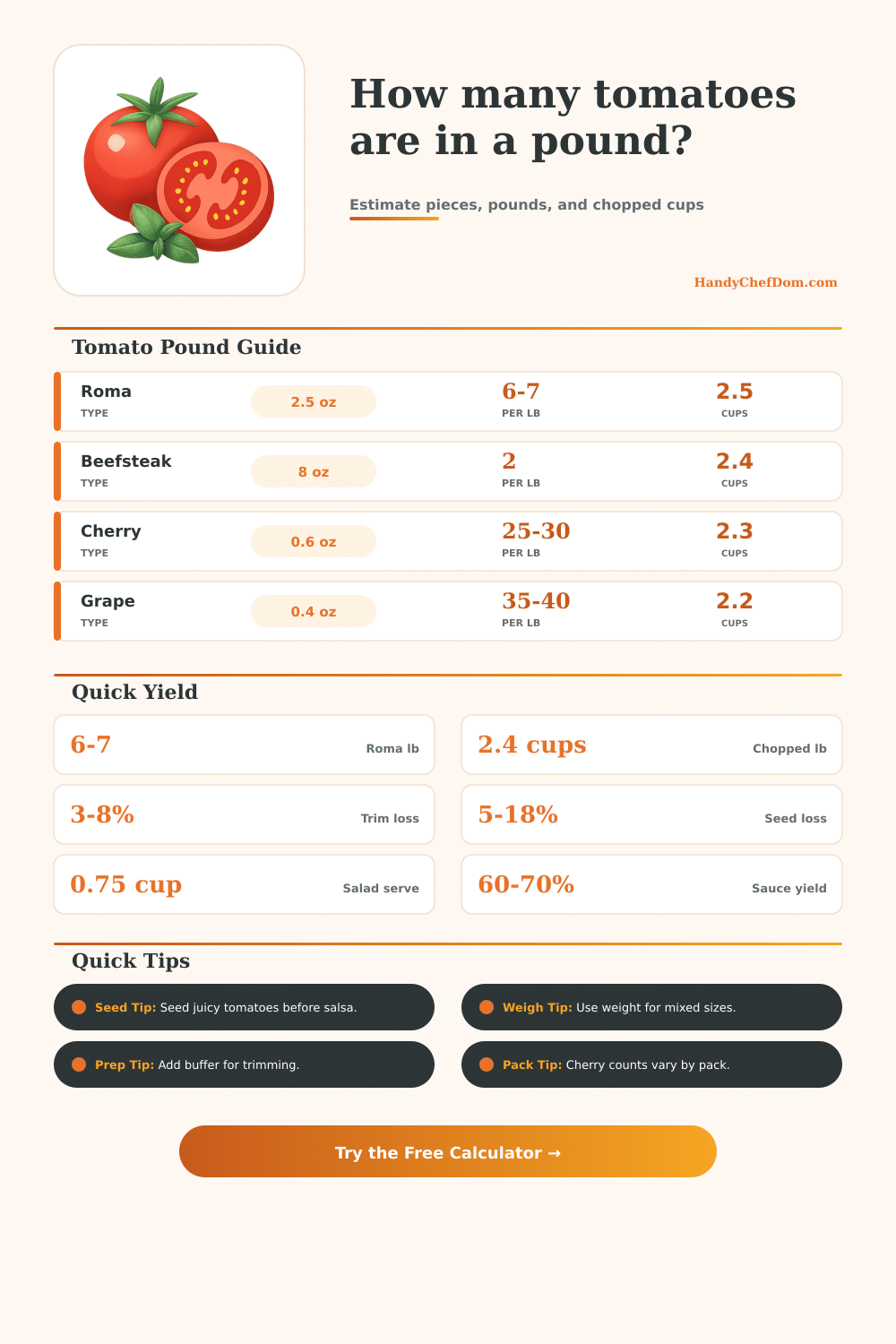
| Tomato Type | Avg Each | Tomatoes Per Pound | Raw Chopped Cups Per Pound |
|---|---|---|---|
| Roma / plum | 2.5 oz | About 6 to 7 | 2.50 cups |
| Beefsteak | 8 oz | About 2 | 2.40 cups |
| Cherry | 0.55 oz | About 29 | 2.30 cups |
| Grape | 0.40 oz | About 40 | 2.20 cups |
| Medium round | 4 oz | About 4 | 2.45 cups |
| Large heirloom | 7 oz | About 2 to 3 | 2.35 cups |
| Large plum | 3.5 oz | About 4 to 5 | 2.55 cups |
| Mixed market | 4.5 oz | About 3 to 4 | 2.40 cups |
| Use | Suggested Serving | Extra Prep Loss | Yield Note |
|---|---|---|---|
| Salsa or pico | 0.50 cup | 3% | Seed extra-juicy tomatoes for a thicker bowl. |
| Sauce base | 0.75 cup | 4% | Final sauce cups are lower than raw chopped cups. |
| Salad bowl | 0.75 cup | 0% | Wedges and chunks usually keep most tomato volume. |
| Sandwich slices | 0.25 cup | 2% | Ends and soft centers create a small trim allowance. |
| Garnish topping | 0.20 cup | 2% | Use a small buffer when the dice must look even. |
| Meal prep portions | 0.60 cup | 1% | Mixed sizes work well when planned by weight. |
| Target Chopped Cups | Roma Pounds | Beefsteak Pounds | Cherry Pounds |
|---|---|---|---|
| 2 cups | 0.8 to 1.0 lb | 0.9 to 1.1 lb | 0.9 to 1.1 lb |
| 4 cups | 1.7 to 2.0 lb | 1.8 to 2.1 lb | 1.9 to 2.2 lb |
| 6 cups | 2.5 to 3.0 lb | 2.7 to 3.2 lb | 2.8 to 3.4 lb |
| 8 cups | 3.4 to 4.0 lb | 3.6 to 4.3 lb | 3.8 to 4.5 lb |
| 12 cups | 5.0 to 6.0 lb | 5.4 to 6.4 lb | 5.7 to 6.8 lb |
| 16 cups | 6.7 to 8.0 lb | 7.2 to 8.6 lb | 7.6 to 9.1 lb |
| Prep Style | Best Tomato | Cup Factor | Typical Loss |
|---|---|---|---|
| Chopped or diced | Roma, medium, mixed | 100% | Core plus watery trim |
| Seeded dice | Roma, beefsteak, heirloom | 96% | Seed pockets and juice |
| Sliced rounds | Beefsteak, medium | 94% | Ends and uneven slices |
| Halved small tomatoes | Cherry, grape | 98% | Stem ends only |
| Crushed or mashed | Roma, large plum | 90% | Extra drained juice |
| Mixed prep tray | Mixed market | 95% | Sort by ripeness first |
Here’s how it works: You’ve got a bag of tomatoes in the produce section. It seems like plenty when you’re looking at the package but then you go to cut them up for dinner and realize there might be six large tomatoes or perhaps nine small ones. Now you’re questioning the recipe, which calls for three cups of chopped plum tomatoes, hmm, who knows? Actual weight is real; visual volume can fool you. With a tomato converter, you get the best of both worlds, a translation from the abstract “pound” into real measurements such as number of pieces, cup yield, and servings.
So what gives? Well it’s all about density vs variety. For example, a single cherry tomato may weigh the same as a beefsteak tomato, but it certainly takes up way less room in your bowl. And that’s where the variety selection comes into play with the calculator. It allows you to choose varieties like heirloom, grape, roma etc. Why? The type of tomato, whether it’s an heirloom or a roma, have a very different flesh structure and water content. This affects how much product you end up with after trimming. You could have two tomatoes that both weigh exactly one pound but the yield will be different depending on if you grabbed a juicy heirloom for a salad or a dense roma for some salsa. Choosing the right variety are important because it drastically alters the outcome.
Why You Need a Tomato Converter
The biggest miss with most estimates is that they omit trimming losses. Unless you’re eating the core, or you think those watery seed pockets is just what your heavy tomato sauce needs, you don’t eat all of the tomato. Adjusting the estimate based off the amount you trim accounts for a loss of 3-8% typically, depending on how careful you are during prepping. A small % padding give some insurance against running out halfway through dinner. I find running out halfway through dinner to be one of the more frustrating kitchen failures. Better to have two more tomatoes than nothing when company arrives.
Whole vs Chopped: Whole tomatoes, like any whole food, has space in between. When you chop them into bits they compress more and have less air. A cup of sliced tomatoes will have less mass then a cup of whole cherry tomatoes. If you go to the charts on the page, they illustrate nicely that grape tomatoes are around 2.2 cups/lb. This is compared to 2.5 cups/lb. For romas). It sounds small, but multiplies fast if you’re buying for the family, or putting up a batch for winter use. Knowing that amount will prevent you from over-or-under ordering at store.
Similarly, portion size matters when you consider what exactly to purchase. A sandwich requires a quarter cup of sliced ingredients; a side salad calls for three quarters of a cup per person). To account for this, the calculator takes serving portions into consideration. It works backwards from your expected number of guests instead of having you guess at serving portions based on people’s appetites. You don’t want to serve half a cup of pico de gallo per person if you’re expecting a dozen guests, half a cup adds up quickly! It takes the guesswork out of meal planning. No more math in my head!
Instead you just set your goal (like I want X amount of sauce base or I need enough ingredients for Y bowls), and the system will adjust for variety size, trim loss, and seeding preferences to give you a net usable yield. You might want them smashed and used in the final product. It transforms that vague “I think I’ll get so many tomatoes” feeling into a concrete plan. Control is everything when it comes to cooking. Instead of giving up, you need to understand your ingredients. If I have one pound of cherry tomatoes, I know there are approximately thirty separate component to work with. That’s no longer eye-balling; that’s measuring, and measuring help get consistent results each and every time you prepare something. In a world of different-sized tomatoes, remember that weight is the only constant the next time you grab that bag of produce.