🍰 Powdered Sugar in a Pound Calculator
Convert powdered sugar by pounds, ounces, cups, grams, and tablespoons while adjusting for sifted texture, humidity, settling, recipe type, scale, and spill buffer.
Use package pounds and ounces for bag conversions, or switch the amount source to cups or grams when you are checking a recipe line. Calculations use 1 lb = 453.592 g and 16 oz per lb.
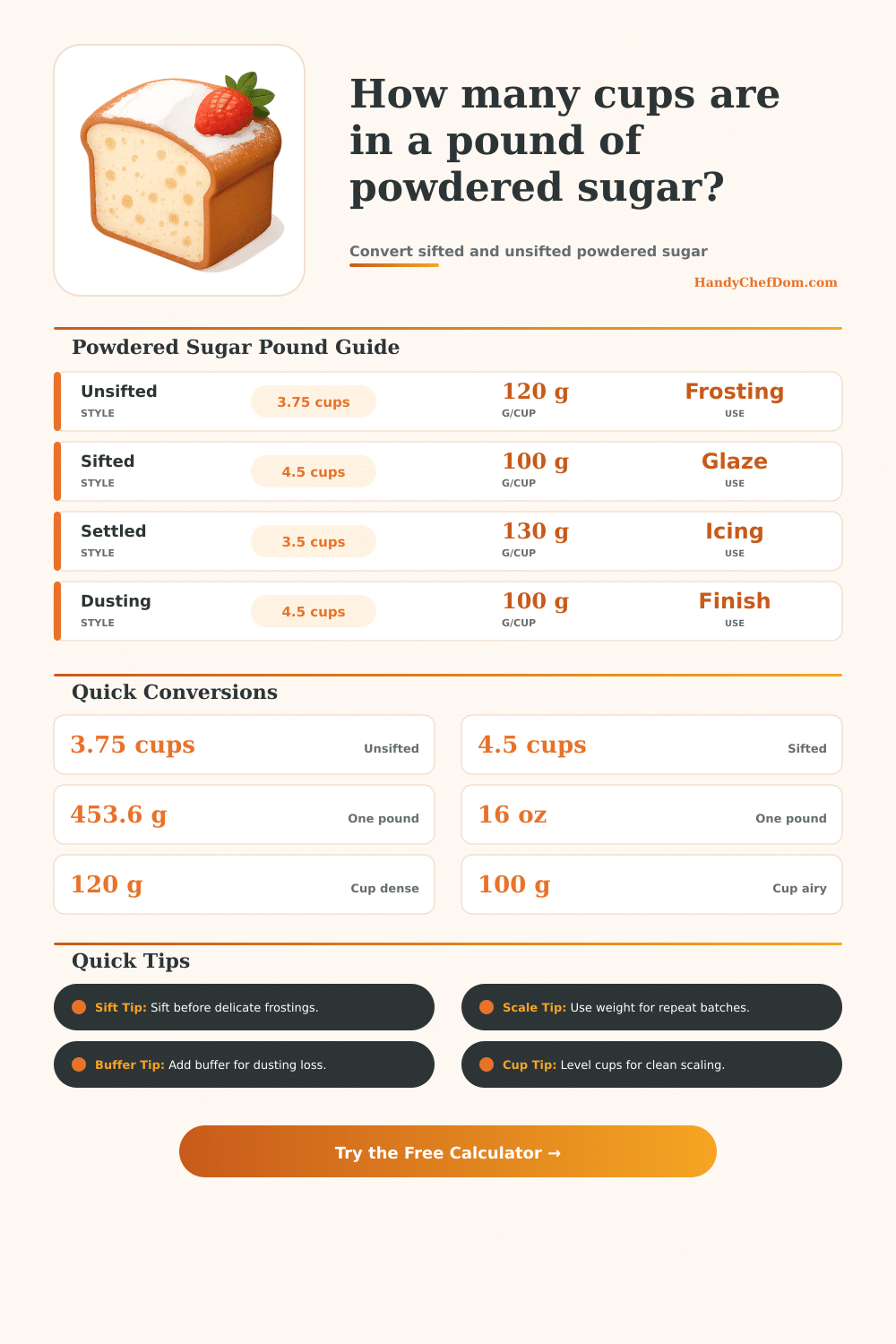
| Powdered Sugar State | Approx Cups Per Pound | Approx Grams Per Cup | Best Kitchen Use |
|---|---|---|---|
| Unsifted from bag | 3.75 cups | 120 g | Buttercream, most baking |
| Sifted after measuring | 4.5 cups | 100 g | Glazes, delicate icing |
| Lightly sifted | 4.13 cups | 110 g | Smooth frosting bowls |
| Settled or compacted | 3.49 cups | 130 g | Opened pantry bags |
| Commercial 10X average | 3.94 cups | 115 g | Bakery batch scaling |
| Custom measured cup | By input | By input | Repeat house standard |
| Recipe Type | Typical Powdered Sugar | Approx Weight | Planning Note |
|---|---|---|---|
| Buttercream frosting | 4 cups | 480 g | Often covers a 2-layer cake |
| Cream cheese frosting | 3.5 cups | 420 g | Common cake or cupcake batch |
| Thin glaze or drizzle | 1.5 cups | 180 g | Enough for loaf cakes or buns |
| Royal icing | 4 cups | 480 g | Cookie decorating base amount |
| Dusting finish | 0.25 cup | 30 g | Light finish for one tray |
| Fondant or candy work | 8 cups | 960 g | Large kneaded sugar project |
| Stabilized whipped cream | 0.5 cup | 60 g | Sweetens a large mixing bowl |
| Package Size | Weight | Unsifted Cups | Sifted Cups |
|---|---|---|---|
| Half-pound remainder | 8 oz / 227 g | 1.88 cups | 2.25 cups |
| Standard box | 1 lb / 454 g | 3.75 cups | 4.5 cups |
| Large pantry bag | 2 lb / 907 g | 7.5 cups | 9 cups |
| Bakery bag | 4 lb / 1814 g | 15 cups | 18 cups |
| Bulk prep bag | 10 lb / 4536 g | 37.5 cups | 45 cups |
| Recipe ounce line | 12 oz / 340 g | 2.81 cups | 3.38 cups |
| US Volume | Cups | Unsifted Approx | Sifted Approx |
|---|---|---|---|
| 1 tablespoon | 0.0625 cup | 7.5 g | 6.3 g |
| 2 tablespoons | 0.125 cup | 15 g | 12.5 g |
| 1/4 cup | 0.25 cup | 30 g | 25 g |
| 1/3 cup | 0.333 cup | 40 g | 33 g |
| 1/2 cup | 0.5 cup | 60 g | 50 g |
| 1 cup | 1 cup | 120 g | 100 g |
Powdered sugars can change in volume even if the weight of the powdered sugar remain the same. A person may find that a pound of powdered sugar can take up different amount of space within different situation. The volume of powdered sugar can change due to the fact that air pocket can form within the powdered sugar, which change the amount of space that the powdered sugar take up.
However, if you sift the powdered sugar, the air pockets within the powdered sugar are broken apart, which causes the same weight of powdered sugar to take up more volume. Additionally, the humidity within the air can affect the powdered sugar; the moisture within the air can cause the powdered sugar particles to settling and cling together, which decrease the volume of powdered sugar. Finally, powdered sugar that sits in the pantry for long period of time can also lead to change in the volume of the powdered sugar; the longer the powdered sugar sits in the pantry, the more the powdered sugar particles pack down and become dense.
Why Powdered Sugar Volume Changes and How to Measure It
The calculator can account for these change in volume by providing different setting for each variable that can change the volume of powdered sugar. For instance, the user can select the powdered sugar as being unsifted or sifted, which will change the density of the powdered sugar that the calculator is account for. Additionally, the humidity of the powdered sugar can be selected as either humid or freshly sifted, which will change the density of the powdered sugar that is account for.
Finally, various recipe type require different amount of powdered sugar to perform certain task (such as buttercream or glaze), so this setting account for the volume of powdered sugar that will be required for those task. In order to scale a recipe, it is important to consider how much powdered sugar will be required for the doubled recipe. When doubling a recipe, it is not necessary to double the amount of powdered sugar by the number of cups that is required; instead, the recipe may need to be adjusted for how the powdered sugar is to be sifted, and how much powdered sugar may be lost during the process.
Using the buffer percentage setting for the recipe allow for the amount of powdered sugar to be provided in a manner that ensure that there will be enough powdered sugar to complete the task (without thinning the frosting). It is common for many individual to make the mistake of assuming that a cup of powdered sugar will always weigh the same. However, due to the change in the density of the powdered sugar, a cup of powdered sugar can weigh different than another cup of powdered sugar.
The reference table provide examples of the different densities of powdered sugar, such as the density of settled versus freshly sifted powdered sugar. Additionally, by weighing a cup of powdered sugar and inputting that number in the custom density field, the individual can remove the guesswork as to how much powdered sugar is of a specific density. Many professional formula use grams to calculate the amount of powdered sugar that is need for a recipe.
This value will not change with the volume of powdered sugar, but grams and other volume measurement can be selected with the calculator. This amount can also account for waste; powdered sugar can get stuck on strainer, spatula, and other tool that are used to distribute the powdered sugar. The buffer percentage provide with the powdered sugar calculator accounts for the loss of powdered sugar, so that it will not become necessary for the powdered sugar to be obtained before the completion of the recipe.
Through experience in the kitchen, many individual may be able to identify in which situation powdered sugar will have certain effect. For instance, if the pantry is humid, using the settled setting for powdered sugar may provide the most accurately results for that situation. Additionally, if the recipe requires that all batch of powdered sugar be sifted, using the settings for powdered sugar that is sifted and including a percentage value for the buffer will provide the most accurate results.
Each of these setting accounts for variable that can impact the powdered sugar, avoiding any necessary correction to the recipe during the cooking process. Thus, the powdered sugar calculator provide an amount for powdered sugar that is readily understood and used in recipe preparation.