🍞 W Rating Flour Calculator
Estimate flour strength from W value and protein, match hydration and fermentation time, and calculate blend ratios for pizza, bread, pasta, pastry, and long-fermented doughs.
Enter the lab W value if you know it. If not, protein percentage gives a practical estimate. The blend section estimates the strong and weak flour ratio needed to hit a target W.
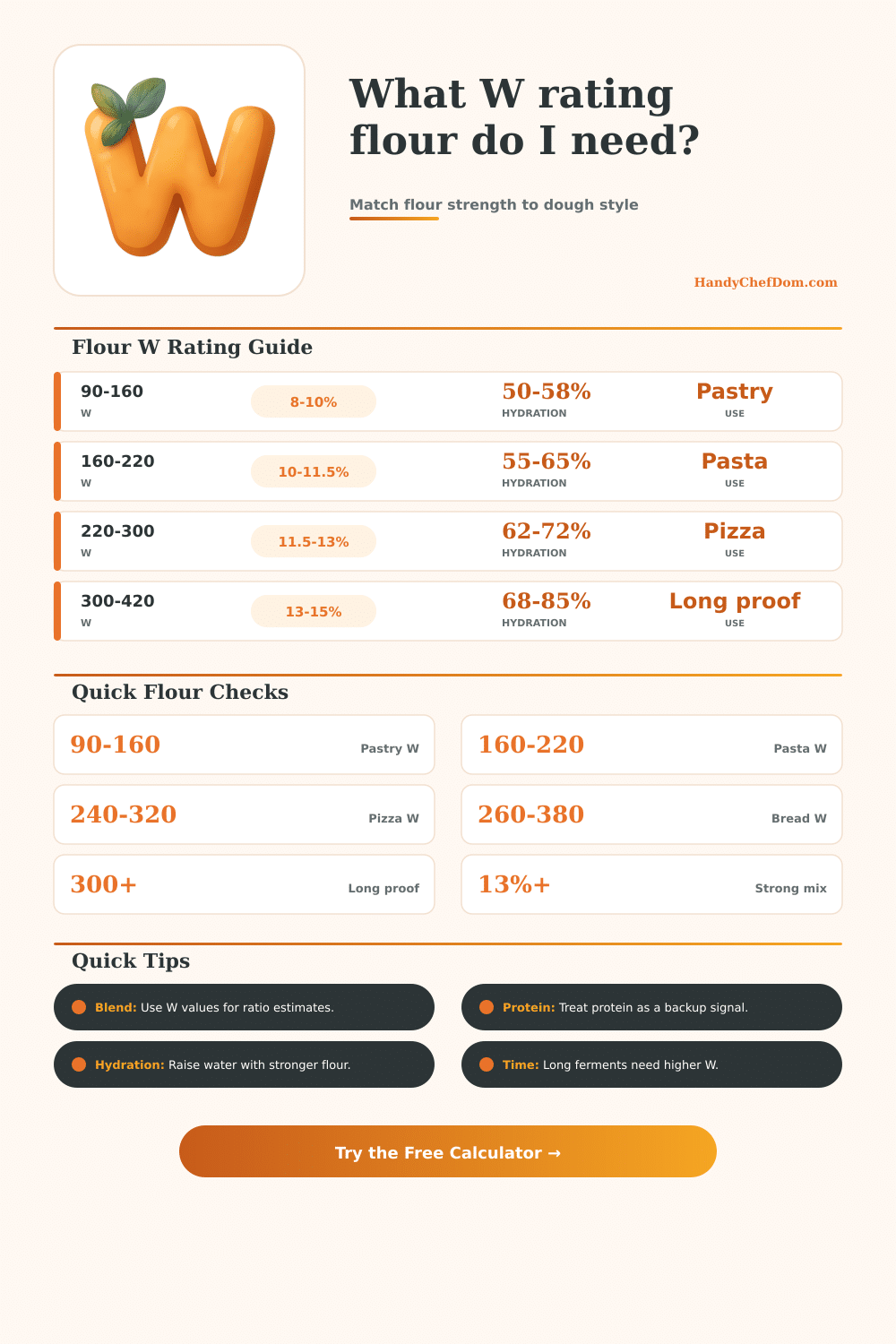
| Strength Band | Approx W | Typical Protein | Hydration Comfort | Best Uses |
|---|---|---|---|---|
| Weak flour | 90 to 160 | 8% to 10% | 48% to 58% | Pastry, biscuits, crackers |
| Medium flour | 160 to 220 | 10% to 11.5% | 55% to 64% | Fresh pasta, short pizza, rolls |
| Medium-strong flour | 220 to 300 | 11.5% to 13% | 62% to 72% | Neapolitan pizza, baguette, focaccia |
| Strong flour | 300 to 380 | 13% to 14.5% | 68% to 80% | Sourdough, pan pizza, long proof |
| Very strong flour | 380 to 450 | 14% to 15.5% | 72% to 88% | Enriched dough, long cold fermentation |
| Dough Style | Target W | Protein Cue | Fermentation Range | Hydration Range |
|---|---|---|---|---|
| Short pastry dough | 90 to 150 | 8% to 10% | Minimal rest | 45% to 55% |
| Fresh pasta dough | 160 to 220 | 10% to 12% | 30 to 90 min rest | 38% to 48% egg or water |
| Focaccia | 220 to 300 | 11.5% to 13% | 4 to 24 hr | 70% to 85% |
| Neapolitan pizza | 250 to 310 | 12% to 13% | 8 to 36 hr | 58% to 68% |
| Pan pizza | 280 to 360 | 12.5% to 14% | 12 to 72 hr | 68% to 82% |
| Artisan sourdough | 300 to 380 | 13% to 14.5% | 8 to 48 hr | 70% to 85% |
| Protein Label | Likely W Range | Absorption Cue | Handling Cue | Notes |
|---|---|---|---|---|
| 8% to 9% | 80 to 140 | Low | Tears easily | Choose for tender crumbs |
| 10% to 11% | 150 to 220 | Moderate | Extensible | Good for pasta and flatbreads |
| 11.5% to 12.5% | 220 to 290 | Medium-high | Balanced stretch | Common pizza zone |
| 13% to 14% | 300 to 380 | High | Elastic and strong | Long proof or high hydration |
| 14.5% to 15.5% | 370 to 450 | Very high | Needs rest time | Use carefully in blends |
| Blend Goal | Strong Flour | Weak Flour | Estimated Ratio | Use Case |
|---|---|---|---|---|
| W220 | W320 | W120 | 50% / 50% | Medium bread flour |
| W260 | W380 | W180 | 40% / 60% | Baguette or pizza |
| W300 | W380 | W180 | 60% / 40% | Long pizza dough |
| W330 | W420 | W240 | 50% / 50% | Pan pizza |
| W360 | W420 | W260 | 63% / 37% | High hydration bread |
| W390 | W450 | W300 | 60% / 40% | Enriched dough |
W values are Chopin alveograph strength numbers. This calculator estimates kitchen decisions from flour specs and dough conditions; milling method and damaged starch can still change water absorption.
The W rating of an flour is a measurement of the strength of the flour. The W rating is determine through the alveograph test. During the alveograph test, the test measures the amount of pressure that is required to inflate and burst a bubbles of dough.
If the W rating of the flour is a high number, that mean the gluten in that flour can hold more gas before it fails. High W ratings is useful if you are looking to use flours with high water content or long fermentation times. Low W ratings indicate that the gluten are weaker and cannot perform as well as stronger flours; it will remain tender but not able to handle heavy loads with the dough.
What the W Rating of Flour Means
Another measurement of the flour is its protein percentage. The protein percentage of the flour are different than the W rating of the flour. The protein percentage of the flour indicates the amount of gluten material that is in that flour.
The W rating of the flour indicates how strong that gluten is. Looking at both measurements together will allow you to have a more accurate and stable understanding of the strength of the flour than if you look at only the W rating. If the two match one another, you can trust the flour.
If they does not, you will have to pay closer attention to the dough while you are mixing and resting it. The hydration levels of the dough will need to be adjusted according to the W rating of the flour. Strong flours will absorb more water than weak flours.
Therefore, flour with a W280 rating will absorb more water then flour with a W160 rating. Using the incorrect hydration level for the flour relative to the W rating will lead to dough that is either too tight or too wet. Fermentation time will also place a load upon the gluten in the flour.
Therefore, you should also consider fermentation time alongside W rating. A long fermentation time will require a stronger gluten network in the flour than a short period of fermentation. This is because enzyme will break down gluten networks during long periods of fermentation.
Therefore, if you use a calculator that estimate the appropriate amount of time for fermentation according to the W rating of the flour, it will tell you if the dough will be strong enough or if it will slacken during the process. Blending flours will allow you to reach a target W rating. You could blend a strong flour with a weaker flour to reach your target W rating.
A calculator that estimates the appropriate amount of each flour will not only allow you to determine the ratio in which you should blend your flours to reach your target W rating, but it will also allow you to determine the resulting protein level of that blended flour. However, keep in mind that the estimate from the calculator is only a starting point. The actual amount of water that the flour will absorb may be more or less based off the milling methods of the flours.
Environmental variables will change the way in which your flour behaves during kneading and mixing. The humidity in the environment can change the behavior of your flour. The temperature at which you mix your dough will change the way your dough feels during mixing.
High temperatures will cause the dough to develop quickly and feel strong, even with the same type of flour. Additionally, if milling have damaged the starch within the flour, it will absorb more water. However, this does not lead to the development of stronger gluten networks.
The W rating is a valuable tool that can help you to plan your dough recipe. However, you should not rely upon the W rating as a guarantee of the outcome of your dough. Use the W rating to decide the target strength and protein percentage of your flour.
Then, adjust the hydration and fermentation time according to the W rating of your flour. After the first mix, if the dough feels incorrect, you can always make a small correction. If the dough is slack and tearing after a period of cold fermentation, you need a stronger flour or shorter fermentation time.
If the dough is too tight and dense, it is likely that you use too strong of a flour for your hydration and fermentation time. The W rating is one of the factors that will help you to plan the load that your flour will carry in the formation of your dough. Understanding the W rating will help you to understand why some dough recipes calls for stronger flours than others.