🌽 Corn Flour for Thickening Calculator
Plan a cold slurry for sauces, gravy, soup, stir-fry glaze, and pie filling with regional corn flour naming built in.
Use this for starch-style corn flour thickening. In the UK, Australia, and many Commonwealth recipes, cornflour usually means cornstarch. In the US, fine yellow corn flour behaves more like a flour and needs a heavier, grainier dose.
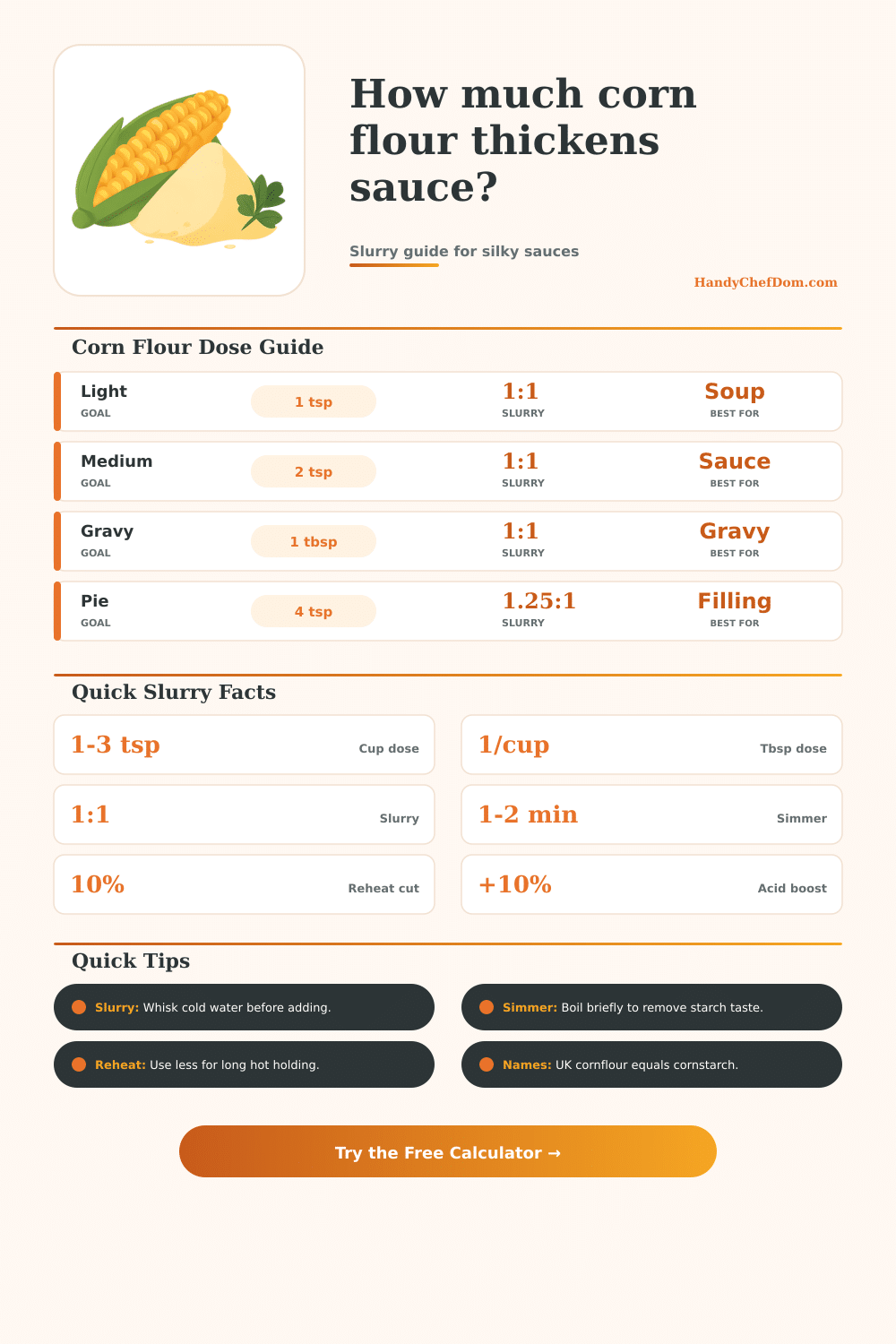
| Target Texture | Starch Dose | Best Use | Expected Finish |
|---|---|---|---|
| Light nappe | 1 tsp per cup | Broth sauces, soups | Coats spoon lightly |
| Medium body | 2 tsp per cup | Pan sauce, cream sauce | Visible ribbon |
| Gravy thick | 1 tbsp per cup | Roast gravy, pot pie sauce | Holds on plate |
| Glossy glaze | 2.5 tsp per cup | Stir-fry and teriyaki style sauce | Shiny cling |
| Fruit filling | 4 tsp per cup | Pie filling and fruit sauce | Sliceable when cool |
| Label In Recipe | Likely Ingredient | Calculator Style | Practical Note |
|---|---|---|---|
| UK cornflour | Pure corn starch | UK cornflour / cornstarch | Clear, glossy thickening |
| US cornstarch | Pure corn starch | UK cornflour / cornstarch | Use same dose as UK cornflour |
| US corn flour | Finely milled cornmeal | US fine yellow corn flour | Cloudier and less powerful |
| Masa harina | Nixtamal corn flour | Masa harina style corn flour | Earthy flavor, more body needed |
| Corn flour blend | Mixed flour and starch | Half cornflour, half wheat flour | Softer hold than pure starch |
| Condition | Adjustment | Why It Matters | Kitchen Cue |
|---|---|---|---|
| High acid | Add 10% to 15% | Acid weakens starch gel | Lemon and vinegar sauces thin faster |
| Rich dairy | Add 4% to 8% | Fat coats starch granules | Cream sauces need more whisking |
| Long simmer | Reduce 8% to 16% | Evaporation concentrates sauce | Stop once sheen turns glossy |
| Reheat later | Reduce about 10% | Cooling firms starch structure | Thin with stock after reheating |
| Fruit filling | Add 12% to 18% | Sugar, juice, and acid loosen set | Judge final texture after cooling |
| Measure | Volume | Approx Weight | Slurry Water |
|---|---|---|---|
| 1 teaspoon cornflour | 5 ml | 2.6 g | 1 teaspoon water |
| 2 teaspoons cornflour | 10 ml | 5.2 g | 2 teaspoons water |
| 1 tablespoon cornflour | 15 ml | 7.8 g | 1 tablespoon water |
| 1/4 cup cornflour | 4 tbsp | 31 g | 1/4 cup water |
| 1/2 cup cornflour | 8 tbsp | 62 g | 1/2 cup water |
Corn flour can act as a thickening agent due to the presence of starch granules within the corn flour. When you heat corn flour in a liquid, the starch within the corn flour begin to swell and tangle. This create a substance that transforms a thin broth or sauce into a thick one.
However, it is essential to use the apropriate amounts of corn flour to achieve the desired thickness. Using too little will result in a watery sauce, while using too much will result in a glue like sauce. There is several variable that influence the thickness of a sauce, including the volume of the liquid, the acidity of the liquid, the fat content of the liquid, and the temperature of the liquid.
How to Thicken Sauce with Corn Flour
The calculator included with this article can help you determine how much corn flour to use in you sauce. You must consider the texture of your sauce. If your sauce is already thick, you will need to use less corn flour than a sauce that is thin in texture.
You will also need to consider the desired texture of your finished sauce. A thin pan sauce will require a different amount of corn flour compared to a thick fruit filling. The calculator will provide a measurement for a cold slurry.
A slurry is mixed corn flour and water. Using a cold slurry will help prevent the formation of lumps in your hot sauce. The type of corn flour that you use can significantly affect the thickening property of your sauce.
In the United Kingdom, cornflour indicates cornstarch. However, in the United States, cornflour can indicate finely ground whole corn. Cornstarch is almost 100% starch, while whole corn contain protein and fiber.
Depending on what type of corn flour you use, the thickening properties of the sauce can change. For this reason, the calculator allows you to specify the type of corn flour that you are using to prepare an accurate measurement of how much of that specific corn flour to use in your sauce. The acidity and fat content of your sauce can play a significant role in the thickening action of corn flour.
Acidic ingredients, such as lemon juice or vinegar, will significantly weaken the gel structure that corn flour create. For this reason, you will have to use more corn flour in a sauce that has acidic ingredients. The fat content within a sauce, such as cream or butter, can also affect how fast the corn flour thicken your sauce.
Fat will coat the corn flour particles, which will significantly slow down the thickening action of the corn flour. Additionally, the length of time you simmer your sauce will also affect the thickness of the sauce. Simmering sauce for extended periods will change the amount of liquid that remains in your sauce pot.
Although many cooks may be accustomed to adding corn flour to a hot pot, doing so can result in the formation of lumps within the sauce. To avoid this problem, mix corn flour and water to create a slurry. Add this slurry to your hot sauce.
Simmering the sauce after adding the corn flour will cook out the raw taste of starch in the corn flour. The thickness of a sauce will change when the temperature of the sauce change. When a sauce cools, it will thicken.
When reheating a sauce, it will become less thick. To account for this, the calculator also includes a reheat setting. If the sauce become too thick after reheating it, add a splash of stock or water to the sauce.
If the sauce is too thin, add more corn flour slurry to the sauce to thicken it. Although the sauce will come close to the desired thickness using the calculations provided on the calculator, you may have to taste the sauce and further adjust it to achieve the perfect thickness for your needs.