🍯 Molasses to Make Dark Brown Sugar Calculator
Turn white sugar into light, dark, or extra dark brown sugar with measured molasses, final weight, batch buffer, and jar equivalents.
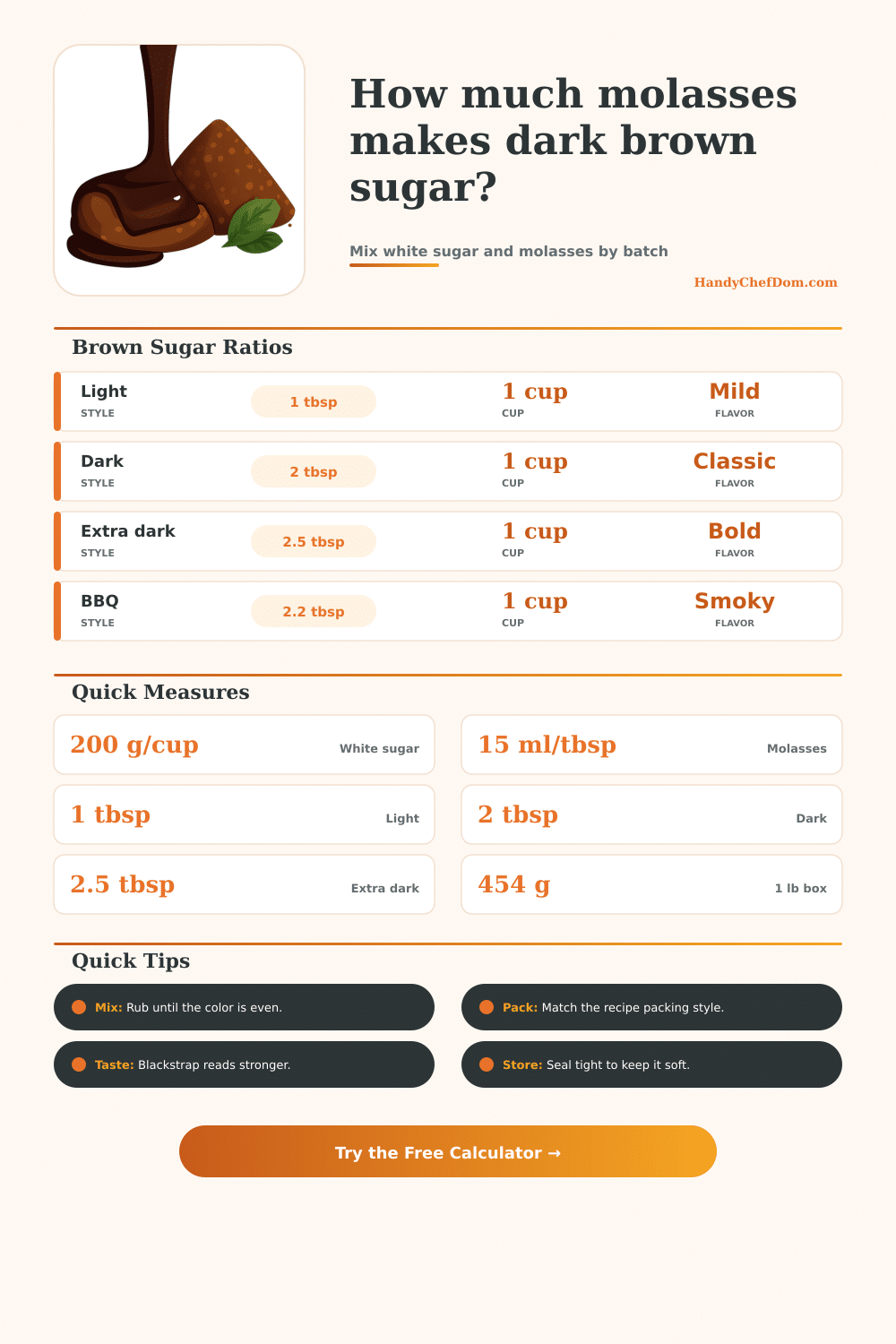
Choose the finished brown sugar amount you want. For classic homemade dark brown sugar, the calculator starts with about 2 tablespoons molasses per cup of white sugar, then adjusts for recipe use and molasses style.
| Darkness | Molasses per cup white sugar | Best result | Calculator baseline |
|---|---|---|---|
| Light brown sugar | 1 tablespoon | Soft caramel color | 1.00 tbsp per cup |
| Standard dark brown sugar | 2 tablespoons | Classic dark color | 2.00 tbsp per cup |
| Extra dark brown sugar | 2 1/2 tablespoons | Deep molasses color | 2.50 tbsp per cup |
| BBQ-style dark | 2 to 2 1/4 tablespoons | Smoky rub balance | Recipe-adjusted |
| Glaze-style dark | 2 1/4 to 2 1/2 tablespoons | Glossy sauce body | Recipe-adjusted |
| Packing level | Approx grams per cup | When to use | Calculator role |
|---|---|---|---|
| Spooned loose | 180 g | Sprinkling and oatmeal | Loose cup estimate |
| Lightly packed | 200 g | Crumbles and rubs | Gentle cup estimate |
| Standard packed | 213 g | Most baking recipes | Default cup estimate |
| Firmly packed | 220 g | Dense bars and sauces | Heavy cup estimate |
| Weight-first batch | Recipe grams | Scale-based baking | Solves by grams |
| Molasses type | Flavor | Strength adjustment | Best use |
|---|---|---|---|
| Unsulphured | Balanced and clean | 1.00x | All-purpose dark brown sugar |
| Mild baking | Soft and sweet | 1.08x | Cookies, oatmeal, bars |
| Robust | Deep and bitter-sweet | 0.95x | BBQ rubs and spice mixes |
| Blackstrap | Very strong and mineral | 0.75x | Small bold batches |
| Fancy | Round and glossy | 1.00x | Glazes and sauces |
| Sorghum style | Earthy and mellow | 1.05x | Breakfast bowls |
| Recipe use | Molasses adjustment | Texture goal | Practical note |
|---|---|---|---|
| Cookies and bars | 0.98x | Moist but scoopable | Keeps dough balanced |
| BBQ rub | 1.10x | Clumpy and sticky | Helps spices cling |
| Oatmeal topping | 0.90x | Loose sprinkle | Avoids wet clumps |
| Glaze or sauce | 1.15x | Glossy and bold | Deepens shine |
| Crumble topping | 1.00x | Classic packed sugar | Works by cup or grams |
| Marinade base | 1.08x | Dissolves quickly | Flavor-forward blend |
| Pantry refill | 1.00x | Everyday dark sugar | Store airtight |
Brown sugar can be made by combining white sugar and molasses. Making brown sugar allow people to control the color, moisture, and flavor of the brown sugar that is made. White sugar and molasses can be used to create different types of brown sugar, and each type of brown sugar can be made due to the fact that different recipes require different types and amount of moisture and color from the brown sugar.
For instance, cookie recipes may require a specific amount of moisture from the brown sugar to ensure that the cookies dont spread to much during baking, and meat rubs may contains a specific amount of molasses to provide the desired amount of stickiness to the rub. The ratio of white sugar and molasses determine what type of brown sugar can be made. Standard dark brown sugar can be made by using two tablespoons of molasses for every one cup of white sugar.
How to Make Brown Sugar at Home
If you use half of that amount of molasses, light brown sugar will be made. Extra dark brown sugar can be made by using more than two and a half tablespoons of molasses for every cup of white sugar. Using different ratios of white sugar to molasses will alter the flavor and color of the resulting brown sugar; thus, each type of brown sugar require a specific ratio to be used to make that type of brown sugar.
The type of molasses that is used will also affect the type of brown sugar that is made. If unsulphured molasses is used, it will have a relatively clean flavor, yet you can use it in a variety of recipes. If robust molasses is used, it will contain more bitterness, yet it can be used in spice rubs.
Finally, blackstrap molasses will contain a very strong flavor to the brown sugar, so you will use less blackstrap molasses than other types of molasses. The density of the brown sugar will affect the weight and volume of the brown sugar. Brown sugar that is spooned into a measuring cup will weigh less than brown sugar that is packed into the same measuring cup.
Brown sugar that is spooned will contain less white sugar and less molasses than brown sugar that is packed into the same cup. Recipes will typically use firmly packed brown sugar, so the cook must pack the sugar into the measuring cup to ensure that the recipe is accurate. Alternatively, brown sugar can be weighed in grams or pounds instead of using the measuring cup.
Using grams or pounds will remove the guesswork in measuring the brown sugar, and weighing the brown sugar will be more accurate than scooping it into the measured amount. Brown sugar must be stored in an airtight container to prevent the sugar from drying out. Because molasses will draw moisture from the air, the sugar could either absorb moisture from the air or it could lose moisture.
Either way, however, the sugar could become to hard or to clumpy for desired use. By storing it in an airtight container, the moisture content of the brown sugar will be maintained. The way that the white sugar and molasses are mix will affect the use of that brown sugar.
For crumble toppings, for instance, the brown sugar should be dried out. In recipes like marinades or glazes, however, more molasses will be used because the liquids in those recipes will balance the extra stickiness of the extra molasses. The amount of brown sugar that will be made can be determined based off how much brown sugar will be needed for the recipes that will be made.
For instance, an quart jar can hold alot of brown sugar for those who use it often, but a pint jar can hold less brown sugar for those who use it less frequently. Additionally, making brown sugar at home allows for control of the type and amount of white sugar and molasses used to make the sugar. Thus, the brown sugar will always behave in the same way.