🍋 Juice in One Lemon Calculator
Estimate fresh lemon juice from lemon size, count, juicing method, ripeness, zesting, recipe tablespoons, and kitchen waste.
Use recipe tablespoons when you need to know whether your lemons are enough. The calculator keeps the tablespoon standard at 14.8 ml, then converts the final yield to your preferred display units.
| Lemon size | Estimated juice | Metric yield | Best planning use |
|---|---|---|---|
| Key lemon | 1 tbsp | 15 ml | Small tart batches and tasting portions |
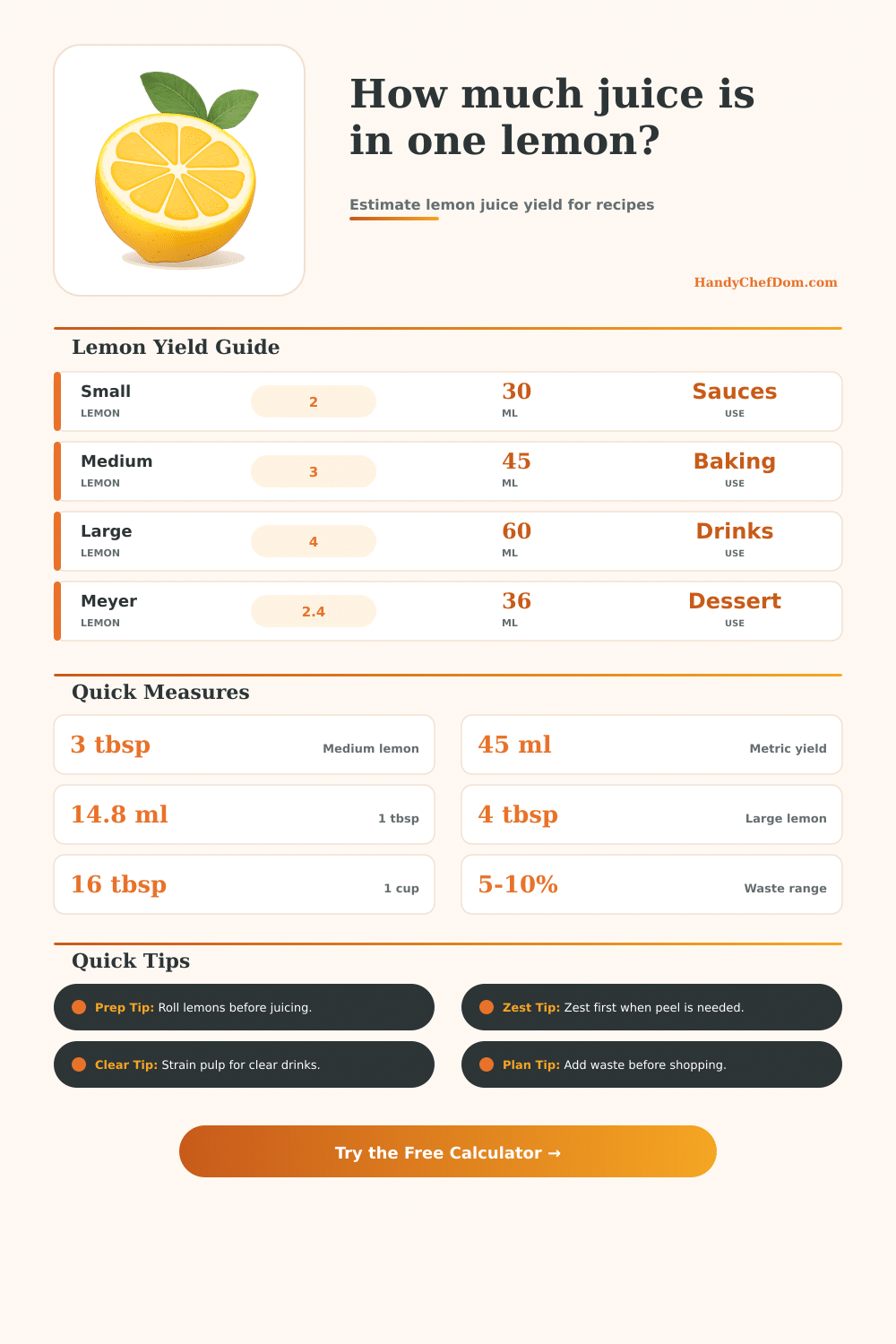
| Small lemon | 2 tbsp | 30 ml | Sauces, quick dressings, and garnish juice |
| Meyer lemon | 2.4 tbsp | 36 ml | Sweeter desserts, glazes, and mellow dressings |
| Medium lemon | 3 tbsp | 45 ml | Most baking recipes and everyday cooking |
| Large lemon | 4 tbsp | 60 ml | Lemonade, marinades, and larger bowls |
| Extra large lemon | 5 tbsp | 75 ml | Pitchers, party prep, and freezer cubes |
| Jumbo lemon | 6 tbsp | 90 ml | High-yield fruit with thick peel variation |
| Adjustment | Setting | Yield effect | Why it matters |
|---|---|---|---|
| Method | Hand squeeze | 0.88x | Leaves more juice in membranes |
| Method | Fork twist | 0.95x | Breaks more pulp sacs after squeezing |
| Method | Citrus press | 1.00x | Good everyday baseline for recipes |
| Method | Countertop reamer | 1.08x | Extracts more from each half |
| Ripeness | Underripe and hard | 0.82x | Firm fruit has less free juice |
| Ripeness | Very juicy and soft | 1.08x | Heavy fruit often yields more juice |
| Zest retained | Full zest removed | 0.95x | Zested peel flexes less while squeezing |
| Pulp style | Fine strained clear | 0.94x | Fine straining keeps more pulp behind |
| Recipe calls for | Metric amount | Approx medium lemons | Approx large lemons |
|---|---|---|---|
| 1 tbsp | 15 ml | 1/3 lemon | 1/4 lemon |
| 2 tbsp | 30 ml | 2/3 lemon | 1/2 lemon |
| 3 tbsp | 45 ml | 1 lemon | 3/4 lemon |
| 4 tbsp | 59 ml | 1 1/3 lemons | 1 lemon |
| 8 tbsp | 118 ml | 2 2/3 lemons | 2 lemons |
| 16 tbsp | 237 ml | 5 1/3 lemons | 4 lemons |
| Kitchen measure | Tablespoons | Fluid ounces | Milliliters |
|---|---|---|---|
| 1 teaspoon | 0.33 tbsp | 0.17 fl oz | 4.9 ml |
| 1 tablespoon | 1 tbsp | 0.5 fl oz | 14.8 ml |
| 1 fluid ounce | 2 tbsp | 1 fl oz | 29.6 ml |
| 1/4 cup | 4 tbsp | 2 fl oz | 59 ml |
| 1/2 cup | 8 tbsp | 4 fl oz | 118 ml |
| 1 cup | 16 tbsp | 8 fl oz | 237 ml |
The lemon juice calculator are useful to people who want to calculate how much lemon juice they will get from a certain number of lemon. People use lemon juice calculators because the size of lemons can vary, as well as the amount of juice that can be extracted from a lemon with different juicing method. People use the lemon juice calculator to decide whether they has enough lemons for the recipe that they are attempting to make.
Additionally, if they dont have enough lemons for a recipe, the lemon juice calculator will help them to determine how many more lemon they will have to purchase. The size of the lemon is one of the primary factors that you should consider when performing the calculation. A larger lemon will contain more juice than a smaller lemon.
How to Use a Lemon Juice Calculator
The method in which the lemon juice is extracted is another factor in the equation. For example, if you squeeze lemon juice out of a lemon with you hands, you will obtain less lemon juice with this method than if you used a handheld press or an electric juicer. The temperature of the lemon is another determining factor in the amount of juice that can be extracted from a lemon.
If the lemon that you use for your recipe is at room temperature, it will contain more juice than if you use a lemon that is cold from refrigerator. The preparation of the lemon is another factor in the amount of lemon juice that is extracted. If you zest the lemon prior to juicing it, the lemon will be different than a lemon that is juiced without zesting.
If you zest the lemon, you will lose some of the juice from that lemon because you will remove the peel before the juice is extracted. The method of straining the lemon juice is also a factor in the juice yield. If you strain the lemon juice through a fine sieve, you will lose some of that lemon juice because the juice will pass through the sieve.
However, if you do not strain the lemon juice, you will gain more lemon juice because the pulp from the lemon will remain in the juice. The result from the lemon juice calculator will allow you to compare the amount of lemon juice to the amount required for the recipe. For example, if your recipe requires a certain amount of lemon juice, this calculator will allow you to determine if your lemons will provide that amount of lemon juice.
Furthermore, the lemon juice calculator account for the waste of lemon juice that occurs during the juicing process. For instance, some of the juice can be lost when the lemon juice spill from the container in which it is stored. Additionally, you will lose some of the seeds of the lemon when you juice it, as will the amount of juice that remains in the lemon if it is not juiced propery.
There are a few habit that you can incorporate into your juicing routine to increase the amount of lemon juice that you extract. For instance, rolling the lemon prior to juicing it will cause the lemon to soften, increasing the amount of juice that is expressed from the lemon. Additionally, zesting the lemon while it is still attached to the peel will allow for easier extraction of the zest.
Finally, you should only strain the lemon juice as much as your recipe requires to ensure that you extract the maximum amount of lemon juice. This calculator cannot determine the differences between lemons due to the unique nature of each lemon. For instance, two lemons that are the same size might yield varying amounts of lemon juice due to the way in which the lemon grew.
Therefore, while the lemon juice calculator will allow you to plan your grocery trip and prepare your ingredients properaly, the actual preparation of the lemon juice will allow you to ensure that the lemon juice meet the requirements of your recipe. You should of used a calculator to help with the planning.