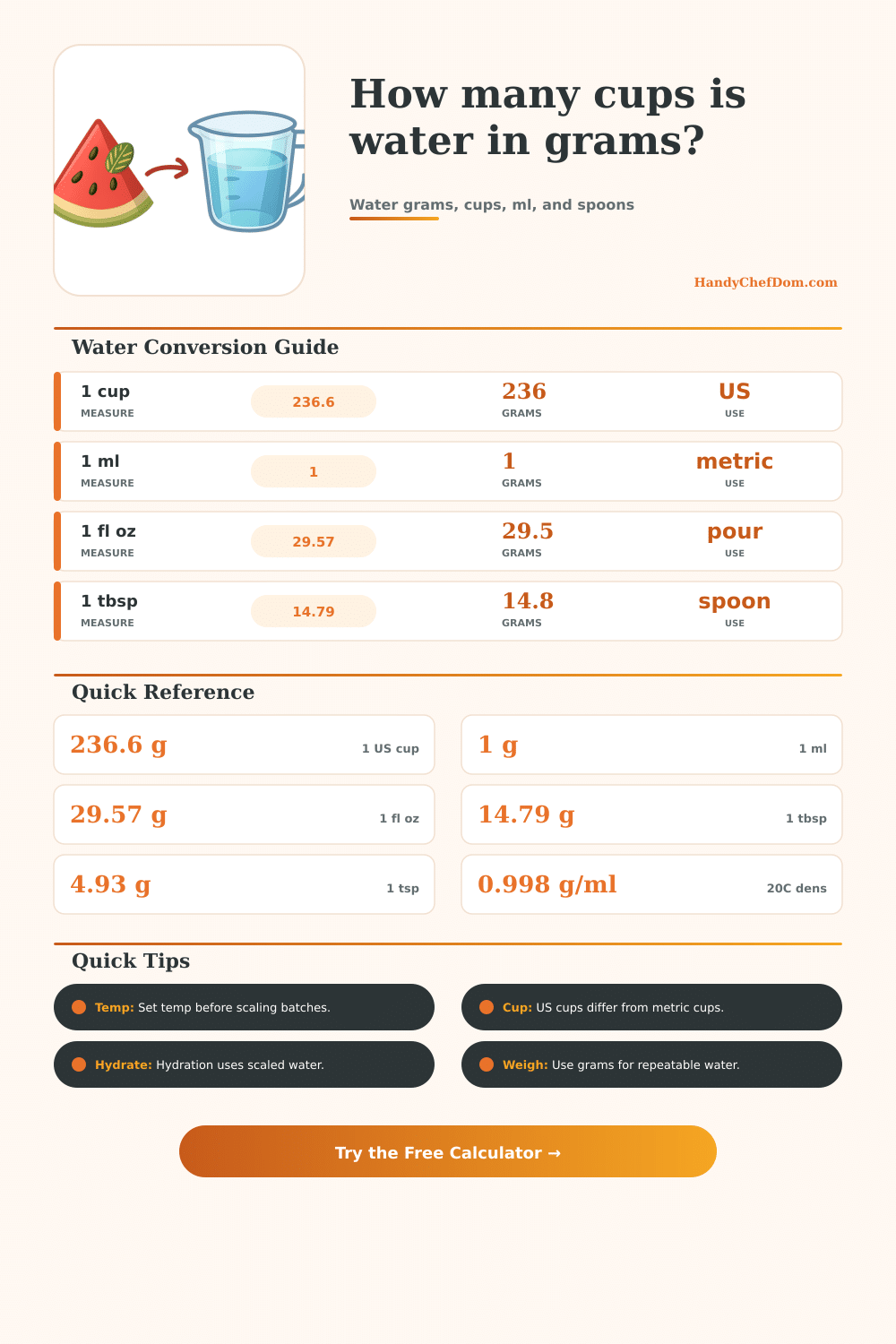
💧 Grams to Cups Water Converter
Convert water between grams, milliliters, cups, fluid ounces, tablespoons, and teaspoons with temperature density, recipe scaling, and hydration context.
Water is close to 1 gram per milliliter, but temperature and cup standard can shift real kitchen conversions. Set the source unit first, then scale for the recipe or hydration plan.
| Unit | Milliliters | Approx grams at 20 C | Kitchen use |
|---|---|---|---|
| 1 US cup | 236.588 ml | 236.1 g | US recipes |
| 1 metric cup | 250 ml | 249.5 g | Metric baking |
| 1 UK cup | 284.131 ml | 283.5 g | Older UK notes |
| 1 Japan cup | 200 ml | 199.6 g | Rice cookers |
| 1 US fl oz | 29.574 ml | 29.5 g | Drink batches |
| 1 tablespoon | 14.787 ml | 14.8 g | Small additions |
| 1 teaspoon | 4.929 ml | 4.9 g | Fine tuning |
| Water temp | Density g/ml | US cup grams | Conversion note |
|---|---|---|---|
| 0 C / 32 F | 0.9998 | 236.5 g | Near ice water |
| 4 C / 39 F | 1.0000 | 236.6 g | Maximum density |
| 20 C / 68 F | 0.9982 | 236.2 g | Room water |
| 40 C / 104 F | 0.9922 | 234.7 g | Warm mixing |
| 60 C / 140 F | 0.9832 | 232.6 g | Hot dissolve |
| 80 C / 176 F | 0.9718 | 229.9 g | Near kettle |
| 100 C / 212 F | 0.9584 | 226.8 g | Boiling point |
| Context | Common water | Cup check | Hydration cue |
|---|---|---|---|
| Bread dough | 350 ml | 1.48 US cups | Track flour ratio |
| Gelatin bloom | 30 ml | 2 tbsp | Small volume |
| Drink bottle | 500 ml | 2.11 US cups | Per bottle |
| Soup base | 1000 ml | 4.23 US cups | Batch liquid |
| Oatmeal | 240 ml | 1.01 US cups | Near 1 cup |
| Hydration plan | 720 ml | 3.04 US cups | Three servings |
| Scale | From 240 g | US cups | Best use |
|---|---|---|---|
| 0.5x | 120 g | 0.51 cups | Half batch |
| 1x | 240 g | 1.02 cups | Standard |
| 1.25x | 300 g | 1.27 cups | Slight boost |
| 1.5x | 360 g | 1.52 cups | Family batch |
| 2x | 480 g | 2.03 cups | Double batch |
| 3x | 720 g | 3.04 cups | Prep batch |
Water is often use in various kitchen tasks for different purpose. Water can be used to bloom gelatin, mix dough, or to meet your daily hydration goal. Water is difficult to measure because the weight of the water change with the water’s temperature.
Additionally, there is differences in the definition of a cup from different countries. A water converter can help you to avoid error in water measurements as it tracks gram, milliliters, and cups. Water temperature can change the density of water.
How to Measure Water with a Water Converter
Water that is colder will be denser then water that is much hotter. Using hot water instead of water that is required to be at room temperature can make the volume of water different from what the recipe require. By using a water converter, you can input the temperature of the water that you are measuring.
This ensure the calculations for water are accurate to the recipe. Some countries use different sized cup to others. For instance, a cup in the United States contain 236.6 milliliters of water while a metric cup contain 250 milliliters of water.
Recipes can use one or the other, but cook often do not check the recipe to ensure that it use one or the other. Using the incorrect amount of water due to the incorrect cup standard can lead to dough that is too tight or too loose. By changing the cup standard on the water converter, the water converter will show the weight of water correctly.
A recipe may need to be double or halve. Changing the volume of water for such a task may not match the measuring tool that you have in the kitchen. By using a water converter, you can enter the scale factor for the recipe and the water converter will adjust all measurement for the recipe.
Additionally, the water converter will show how much water there will be per serving of the recipe. Knowing the amount of water per serving can help you to portion drink for a group of people. Water can be measured to serve different purpose.
For instance, a bread formula may use water as a measurement for the water to flour ratio while a hydration plan may use the amount of water that an individual will consume. By using a water converter, you can label the purpose for which the water will be measured. The water converter will show you the total amount of water that is required for the recipe as well as the amount of water that is required per serving.
This will help you to avoid the error of correctly measuring the total amount of water for a recipe but incorrectly measuring the portion of water that will be used for each serving. The most common error in water measurements are due to the temperature of the water or the cup standard of the water that is being measured. Using too hot of a temperature for the water will result in a dense loaf of bread.
This occurs because hot water is less dense than water at room temperature. Using a metric cup of water instead of the United States cup can result in incorrect amount of baking compound for a cake recipe. These type of error can ruin a batch of food.
Therefore, it is important to ensure the water and cup standard for the recipe are accurate to the requirement of the recipe. One of the reference table within a water converter will display the density of water at various temperature. The table will display how the density of water decrease as the temperature of water increase.
Additionally, reference table will display the number of milliliters in various cup from different countries. While these table do not have to be memorized, they may help cook to understand the difference in water measurements. Using a kitchen scale to weigh water will provide the most precise measurement for water.
Using gram as a unit for water will provide accurate measurement of water even if the temperature of the water may change the density of the water. A water converter can still be of much use here as it will tell you the amount of gram of water that you need. With using a water converter many time, you will remember how many gram are in a cup or tablespoon of water.
Another reason to use a water converter is to read recipe from different culture. For instance, a Japanese recipe may use Japanese cup, a recipe from the United Kingdom may use the cup from the UK, and a United States recipe will likely use United States cup. By using the water converter to change the cup standard for the recipe, you can determine if the amount of water that is required for the recipe will fit within the kitchen equipment that you have.
By using the water converter, cook will not be frustrated when it turn out that the water measurement for a recipe are incorrect. Using a water converter will help cook understand the difference between the volume of a liquid and the weight of that liquid. For instance, if a recipe require 240 grams of water, the cook can recognize that 240 grams of water is approximately one United States cup.
Thus, the cook can decide whether they would like to measure the water by using a scale or using measuring cup. This type of understanding will be develop through using the water converter many time. By using a water converter, cook will avoid the need to guess at the amount of water that is needed to prepare a recipe.