🥚 Egg White Weight Calculator
Convert whole eggs, separated whites, or carton egg whites into grams, tablespoons, cups, protein estimate, and egg equivalents for baking, macarons, and meringue.
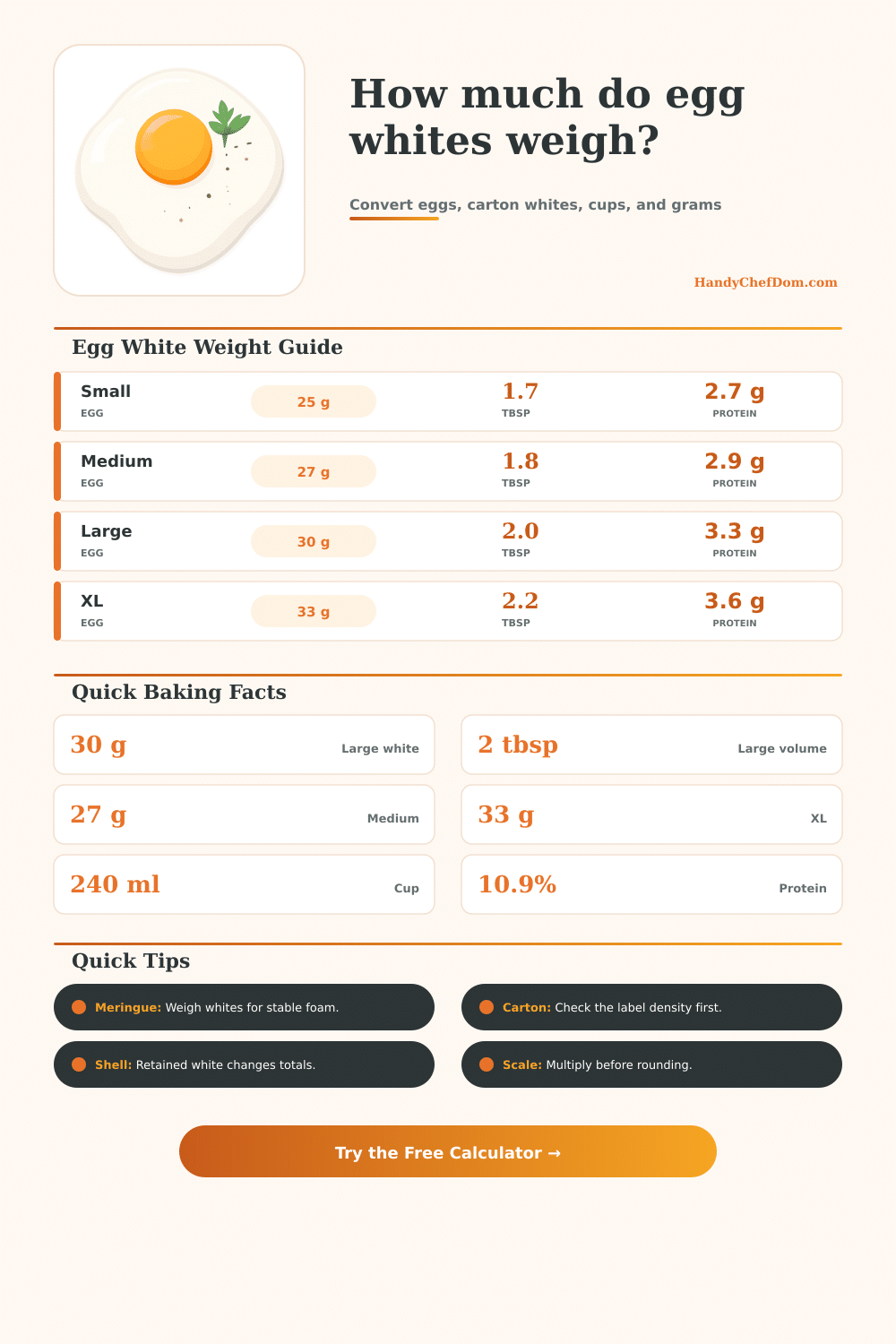
A large egg white is about 30 g, or about 2 tablespoons. Medium whites average 27 g and extra-large whites average 33 g. Use the carton field when the recipe starts from liquid whites instead of shell eggs.
| Egg Size | White Weight | Approx Volume | Large Egg Equivalent |
|---|---|---|---|
| Small egg | About 25 g white | 1.7 tablespoons | 0.83 large white |
| Medium egg | About 27 g white | 1.8 tablespoons | 0.90 large white |
| Large egg | About 30 g white | 2 tablespoons | 1.00 large white |
| Extra-large egg | About 33 g white | 2.2 tablespoons | 1.10 large whites |
| Jumbo egg | About 38 g white | 2.5 tablespoons | 1.27 large whites |
| Volume Measure | Egg White Weight | Large Whites | Best Use |
|---|---|---|---|
| 1 tablespoon | 15 g | 0.5 large white | Small icing corrections and tiny batches. |
| 2 tablespoons | 30 g | 1 large white | Default conversion for separated large eggs. |
| 1/4 cup | 60 g | 2 large whites | Small macaron or cookie glaze batches. |
| 1/2 cup | 120 g | 4 large whites | Swiss meringue or buttercream starts. |
| 3/4 cup | 180 g | 6 large whites | Pavlova and larger meringue shells. |
| 1 cup | 240 g | 8 large whites | Angel food cake and larger foam recipes. |
| Meringue Style | Sugar To White Ratio | Texture Target | Calculator Note |
|---|---|---|---|
| French meringue | 1.5 to 2.0 times sugar | Light, crisp, and piped | Humid settings push guidance toward the high end. |
| Swiss meringue | 1.5 to 2.0 times sugar | Glossy, dense, stable | Works well by weighing whites and sugar together. |
| Italian meringue | 1.5 to 2.2 times sugar | Very stable foam | Use exact grams because syrup formulas scale tightly. |
| Pavlova | 1.8 to 2.2 times sugar | Crisp shell, soft center | Humidity and stiff foam targets favor more sugar. |
| Macarons | 1.0 to 1.4 times sugar | Pipeable almond batter | The calculator keeps the egg white grams exact. |
| Recipe Target | Typical Whites | Weight Range | Practical Target |
|---|---|---|---|
| Royal icing or glaze | 1 to 2 large whites | 30 to 60 g | Use exact grams when thinning with liquid. |
| Small meringue cookies | 2 to 3 large whites | 60 to 90 g | Round to tablespoons only after weighing. |
| Macaron batch | 3 to 4 large whites | 90 to 120 g | Use grams for repeatable shells. |
| Pavlova | 4 to 6 large whites | 120 to 180 g | Choose stiff or humid foam settings as needed. |
| Angel food cake | 10 to 12 large whites | 300 to 360 g | Carton whites can help hit the final grams. |
| Souffle or foam batter | 3 to 6 large whites | 90 to 180 g | Soft foam target avoids over-stiff folding. |
When using a recipe that require using egg whites instead of whole egg, the amount of egg white that is used is important. Using an egg count instead of using an egg weight can lead to a failed meringue because the weight of the egg whites can vary with the size of the egg. One large egg white weigh approximately thirty gram, but the total weight of the egg whites can change with the fact that egg white can cling to the shell.
The calculator will perform the math for you after you enter your egg count, the size of the eggs, and the amount of carton egg whites that you will be using. Using the calculator will remove the guesswork in determining the exact weight of the egg whites that you will need. Many person use carton egg whites in recipes that require a specific gram count of the egg whites.
How to Measure Egg Whites for Baking
Carton egg whites are pasteurized, and they may contain some water that is slightly dilute with the egg white. Therefore, the ratio of tablespoon of carton egg whites to grams changes. The calculator will ask you if you are using separated shell eggs, whole eggs, or a mix of both type of eggs.
If you are making macarons, for instance, you need to ensure that the macarons is stable and that they contain the proper amount of egg whites. Carton egg whites will have a three percent shell-retention setting as the default setting because egg white naturaly remain on the shell and is lost with the separation of the egg white from the shell. The humidity in the kitchen also play a role in the weight of the egg whites.
A scale cannot measure the humidity. When the humidity is low, the egg white foam will set quick, and you can use a lower ratio of sugar to egg whites. In the opposite condition of high humidity, the egg white may weep, and you will have to add extra sugar to maintain the structure of the egg white foam.
Therefore, the calculator account for humidity in the recipe in the output of the range of sugar that should be used. The calculator also tracks the protein content in the egg whites. The protein content of the egg whites is important in baking recipes like Swiss meringue buttercream, as the protein content can help even the chef determine the reason that the buttercream does not contain air.
The use of volume measurements instead of weight measurements for egg whites can also create inconsistency in the recipes. Two tablespoon of egg white is considered the amount of egg white needed for one large egg. The volume of egg white can change according to the temperature of the egg white and the fact that carton egg whites may have settle after being stored.
This potential variable can be removed by converting the measurements to grams of egg white before beginning the recipe. Two reference tables provide common equivalents for egg whites so that you can determine if rounding the measurement of egg white is acceptable for your recipe or if you need to use the exact gram count. The weight of egg whites calculated by the calculator should be treated as a starting point.
If the calculated weight is one hundred twenty gram of egg whites, but your scale measure one hundred eighteen gram of egg white, you can add one tablespoon of carton egg white. This is an easier alternative to cracking another egg to use in your recipe. This ability to adjust for different kitchen and seasons for the same recipe indicates that the calculator allow for repeatable recipes.
Many people feel that the work is complete once you pour the egg whites into the bowl. However, the ratio of sugar to egg whites will determine the texture of the meringue that is created. The ratio of sugar to egg whites will determine if your meringue will be crisp, chewy, or dense.
The calculator will display the ratio of sugar to egg whites after you have chosen the type of meringue that you would like to use and the amount of egg whites that you want to use. The calculator accounts for this mathematical calculation so that you dont have to calculate this yourself. Therefore, the calculator makes the physical properties of the egg whites visible to the baker, and the numerical measurements of the egg whites and the sugar are no longer a chance encounter in the baking world.