🧂 Epsom Salt Foot Soak Calculator
Size Epsom salt for a foot basin, not a bathtub. Tune water volume, depth, strength, duration, scoop size, sensitivity, and repeat soaks.
Enter the water that will be in the basin after your feet are placed inside. This keeps the calculator focused on foot soaks instead of full baths.
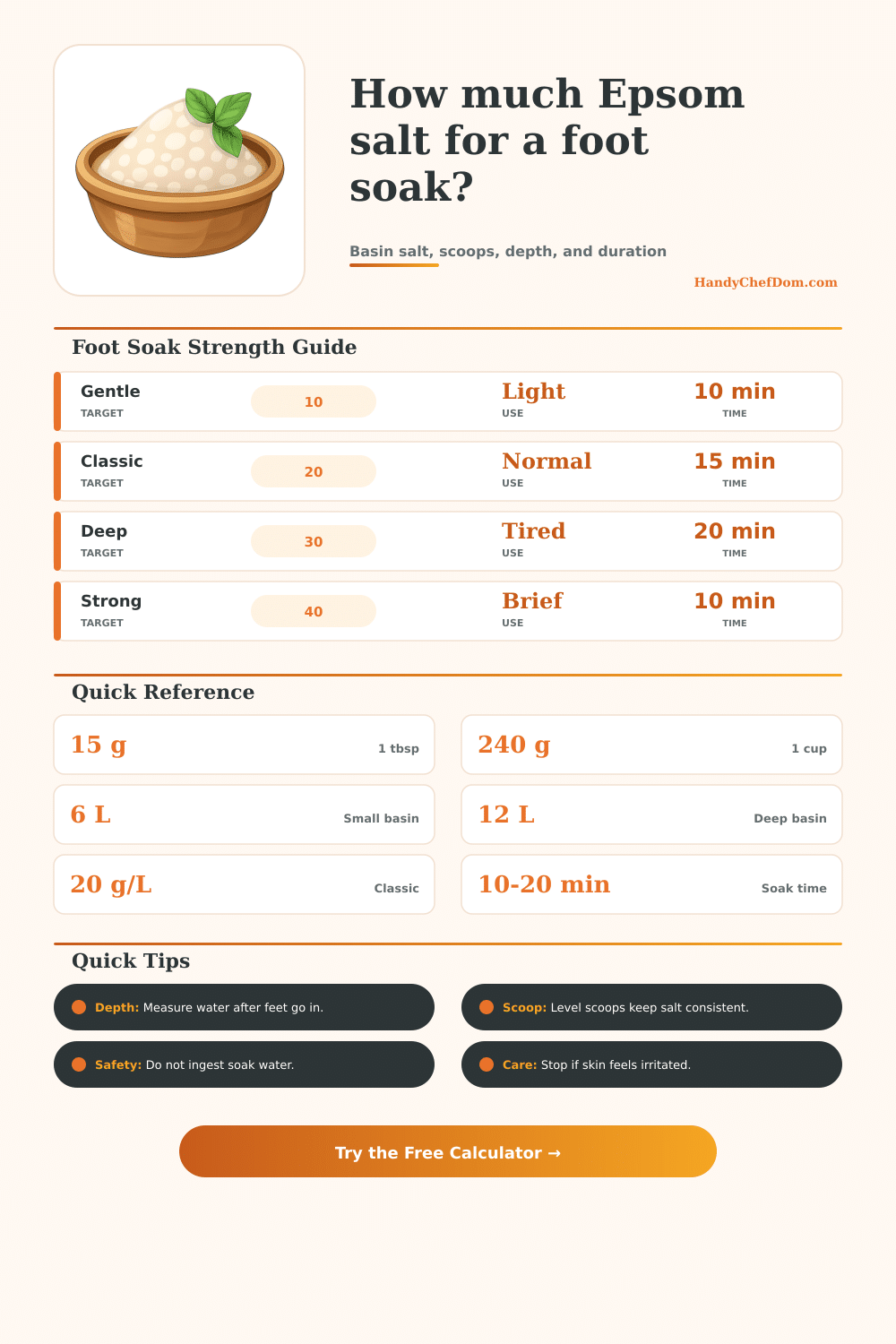
| Foot soak target | Salt strength | Best fit | Watch point |
|---|---|---|---|
| Very gentle | 8 g/L | First test or extra sensitive skin | Stop if irritation appears |
| Gentle | 12 g/L | Short routine foot soak | Keep duration modest |
| Classic | 20 g/L | Common adult basin target | Measure active water volume |
| Deep basin | 30 g/L | Larger ankle-level soak | Use level scoops |
| Strong brief | 40 g/L | Shorter soak with more salt | Avoid prolonged soaking |
| Custom high | 41-60 g/L | Only if directed by product label | Calculator flags caution |
| Basin fill style | Typical active water | Classic salt at 20 g/L | Foot coverage |
|---|---|---|---|
| Shallow dish | 3 L / 3.2 qt | 60 g / 4 tbsp | Toes and ball of foot |
| Compact tub | 5 L / 5.3 qt | 100 g / 6.7 tbsp | Forefoot to instep |
| Classic basin | 8 L / 8.5 qt | 160 g / 10.7 tbsp | Most of both feet |
| Ankle basin | 10 L / 10.6 qt | 200 g / 13.3 tbsp | Up to ankle line |
| Deep foot tub | 12 L / 12.7 qt | 240 g / 16 tbsp | Deep ankle coverage |
| Large spa bowl | 16 L / 16.9 qt | 320 g / 21.3 tbsp | Roomy large-foot basin |
| Measuring scoop | Approx salt grams | Metric equivalent | Calculator use |
|---|---|---|---|
| 1 teaspoon | 5 g | 5 ml scoop | Small corrections |
| 1 tablespoon | 15 g | 15 ml scoop | Default scoop size |
| 2 tablespoons | 30 g | 30 ml scoop | Fast basin measuring |
| 1/4 cup | 60 g | 60 ml scoop | Classic basin batches |
| 1/2 cup | 120 g | 120 ml scoop | Deep basin batches |
| 1 cup | 240 g | 240 ml cup | Large basin planning |
| Duration band | Minutes | Pair with | Calculator flag |
|---|---|---|---|
| Quick rinse soak | 5-8 | Gentle or classic target | Low duration load |
| Standard foot soak | 10-15 | Classic basin target | Comfort range |
| Longer comfort soak | 16-20 | Gentle to classic target | Watch skin feel |
| High strength soak | 8-12 | Strong brief target | Do not stretch time |
| Sensitive profile | 5-10 | Very gentle target | Test first |
| Repeat routine | 10-15 | Fresh water each soak | Track total salt |
Epsom salts is a substance that many people uses to soak there feet. However, the effectiveness of the Epsom salt depends on an amount of Epsom salt that are added to the water when taking the soak. The amount of Epsom salt that should be added to the water depend on the volume of water in the basin.
The volume of the water change when the person place their feet into the basin of water. When a person places their feet into the water, the feet will displace some water in that basin. As a result of this displacement, the water level in the basin will rise.
How to get the right amount of Epsom salt for a foot soak
If a person were to measure the volume of the water before placing their feet into the basin, then the volume of the water will no longer be measurable since the water level has risen as a result of the placement of there feet into the basin. To determine the volume of the water that will be use in the feet soak, the person must measure the volume of the water after the persons feet are already in the basin of water. The concentration of Epsom salt that is used in the feet soak will play an important role in the way that the persons skin and muscles reacts to the Epsom salt soak.
For example, if the concentration of the Epsom salt is low, the soak may be useful for people who would like to soften there skin. However, if the concentration of the Epsom salt is high, the soak may be more effectively for individuals whose muscles feel tired after prolonged physical activity. Additionally, people with sensitive skin should consider the concentration of the Epsom salt in the soak to avoid potential skin irritation.
The length of the feet soak is another variable that can change the effectiveness of the Epsom salt foot soak. For example, if a person use a high concentration of Epsom salt in their feet soak, the recommended time for that soak may be shorter than if a low concentration of Epsom salt is use in the feet. However, soaking the feet for a length of time that is too long can make the skin feel tight and dryly.
The water that is used for a foot soak can change if the same water is use for more than one soak. Many individuals who use Epsom salt for their feet want to use the same water for two soaks. However, if the same water is used for two feet soaks, then the concentration of Epsom salt in that water will change.
The concentration of Epsom salt in the water can change due to the evaporation of the water in the basin, as well as the removal of the Epsom salt by the persons soaking feet. To ensure that the concentration of Epsom salt in the water is as intended, the use of fresh water for each feet soak is recommended. The calculator is a tool that can be used to determine the amount of Epsom salt that should be use in a feet soak.
To use the calculator, you should enter the volume of the water in the basin after the persons feet are in the basin into the calculator. Based off this volume of water, the calculator will indicate the amount of Epsom salt that should be used in the feet soak to ensure that the concentration of Epsom salt in the water is neither too high nor too low. Additionally, the calculator can be used to test the effect of varying the concentration of the Epsom salt in the water and the length of the soak.
Using this calculator will allow an individual to see the effect of different amount of Epsom salt before adding the Epsom salt to the water. To achieve the desired result from an Epsom salt foot soak, an individual should follow a process that ensures that the amount of Epsom salt is properly calculate for the volume of water that will be used. The process include placing the persons feet into the basin to determine the volume of the water that will be used in the soak.
After determining the volume of the water, the volume should be entered into the calculator to determine the amount of Epsom salt that should be used in the water. Finally, when the amount of Epsom salt has been determined, the process can be followed to achieve the desired result from adding the Epsom salt to the water. By following these steps, the amount of Epsom salt will match the volume of the water in which the feet are soaked, and the result of the Epsom salt foot soak will be more consistent when performed by the same individual.