🥣 Fiber in Steel Cut Oats Calculator
Estimate total fiber, per-serving fiber, daily target percent, and cooked yield from dry oats, cooked cups, toppings, and your preferred serving plan.
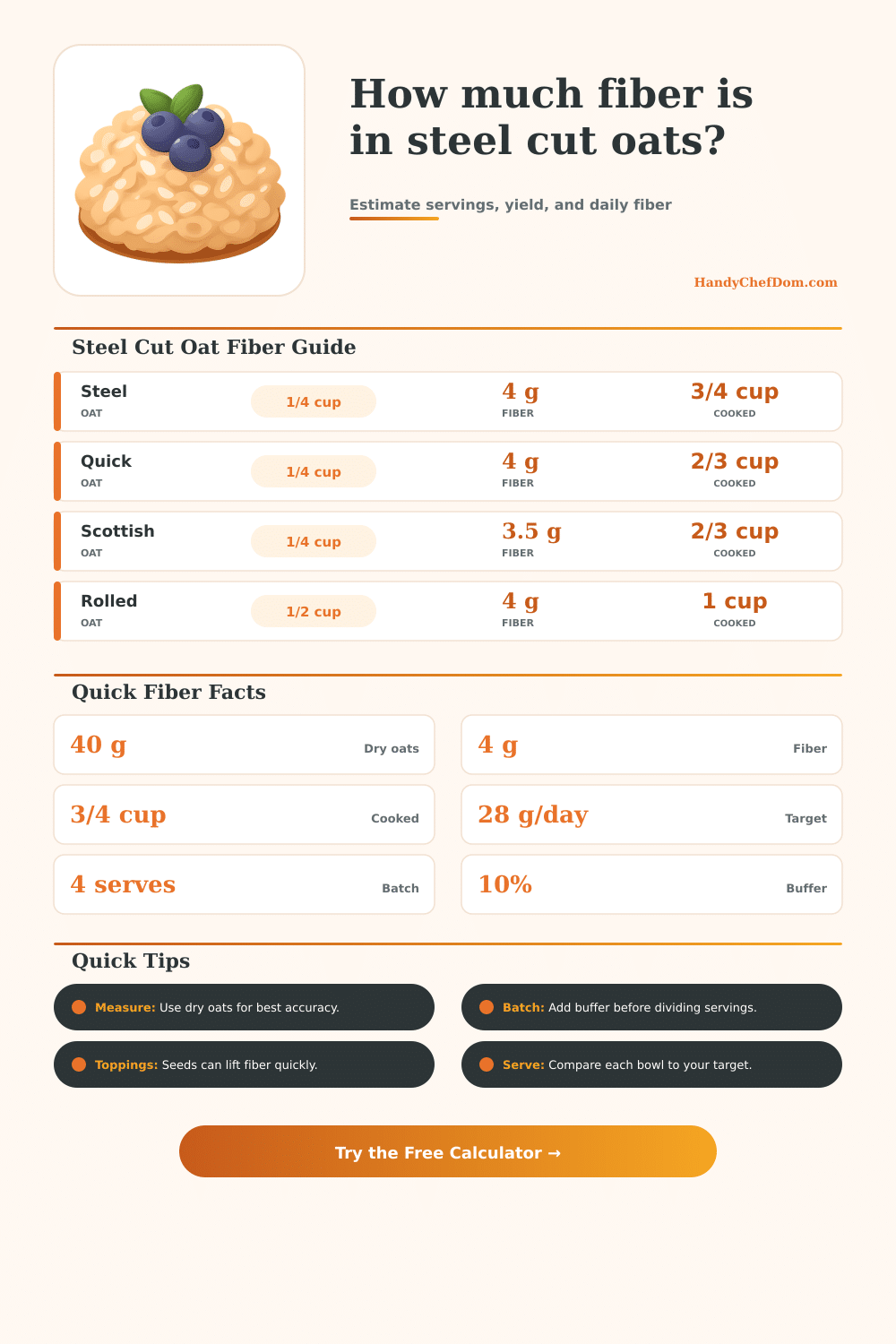
Base data uses about 4 g fiber per 1/4 cup dry steel cut oats, roughly 40 g dry. Toppings are added as estimated fiber per serving.
| Oat Form | Dry Measure | Dry Weight | Fiber |
|---|---|---|---|
| Steel cut oats | 1/4 cup | 40 g | 4 g |
| Quick steel cut oats | 1/4 cup | 40 g | 4 g |
| Scottish oats | 1/4 cup | 40 g | 3.5 g |
| Rolled oats | 1/2 cup | 40 g | 4 g |
| Thick rolled oats | 1/2 cup | 40 g | 4 g |
| Instant oats | 1 packet | 28 g | 3 g |
| Dry Oats | Dry Weight | Cooked Yield | Servings |
|---|---|---|---|
| 1/4 cup | 40 g | 3/4 cup | 1 bowl |
| 1/2 cup | 80 g | 1 1/2 cups | 2 bowls |
| 1 cup | 160 g | 3 cups | 4 bowls |
| 1 1/2 cups | 240 g | 4 1/2 cups | 6 bowls |
| 2 cups | 320 g | 6 cups | 8 bowls |
| 3 cups | 480 g | 9 cups | 12 bowls |
| Food | Serving | Fiber | Use In Calculator |
|---|---|---|---|
| Steel cut oats | 1/4 cup dry | 4 g | Base amount |
| Chia seeds | 1 tbsp | 5 g | Topping |
| Ground flax | 1 tbsp | 2 g | Topping |
| Berries | 1/2 cup | 4 g | Topping |
| Banana | 1/2 medium | 1.5 g | Topping |
| Apple cubes | 1/2 cup | 2.5 g | Topping |
| Serving Plan | Dry Oats | Total Fiber | Cooked Cups |
|---|---|---|---|
| Solo bowl | 1/4 cup | 4 g | 3/4 cup |
| Two bowls | 1/2 cup | 8 g | 1 1/2 cups |
| Family four | 1 cup | 16 g | 3 cups |
| Meal prep five | 1 1/4 cups | 20 g | 3 3/4 cups |
| Brunch eight | 2 cups | 32 g | 6 cups |
| Big batch twelve | 3 cups | 48 g | 9 cups |
Steel cut oats includes a level of texture due to the fact that the machine cut steel-cut oats into small pieces. Because steel cut oats are cut into small pieces, it take more time to cook the steel cut oats than rolled oats. Because steel cut oats take more time to cook, the oats retains a chewy texture when consumed.
The texture of the steel cut oats is created through the cutting of the steel cut oats, which also impacts the behavior of the fiber contain in those steel cut oats. Because many individual track their fiber intake, and because many individuals choose steel cut oats as a means of meeting their fiber need, it is important for individuals to understand the fiber content of steel cut oats. The fiber content that is list on a package of steel cut oats is based off the dry steel cut oats.
Steel Cut Oats: Fiber, Cooking and Serving Size
However, the weight of the steel cut oats will change once it are combined with water and/or milk. The weight of the cooked steel cut oats will change, but the amount of fiber contain in those oats will not change. Therefore, individuals should measure the dry steel cut oats prior to add water and/or milk to ensure that their fiber calculation are accurate.
However, if someone measures the cooked steel cut oats with water and/or milk, the amount of fiber per cup will appear to be lower because the cooked steel cut oats contain more water by weight. However, the amount of fiber is still the same than the dry steel cut oats. Various toppings that can be added to steel cut oats, such as chia seed or ground flax seeds, will contain additional fiber that is independent from the steel cut oats.
Therefore, by adding these ingredient to steel cut oats, the total gram of fiber that are ingested will increase. Furthermore, the calculator separate the fiber content of the steel cut oats from the fiber content of the toppings. Thus, individuals can use the calculator to determine whether the steel cut oats alone meet the fiber needs of the individual that consume the steel cut oats, or if the toppings must be used to help fulfill those need.
The liquid that is use to cook the steel cut oats does not contain fiber. However, the amount of cooked steel cut oats that are prepare will change based on the type of liquid use to cook the steel cut oats. For example, milk will make steel cut oats denser than water will.
Additionally, steel cut oats that are cooked in water will expand more than steel cut oats that are cooked in milk. While the amount of fiber contained in the cooked steel cut oats will not change, it may be necessary for cooks to consider the final volume that cooking the steel cut oats will be create. Adults require between twenty-five and thirty-eight gram of fiber each day.
One bowl of steel cut oats with toppings may contain a portion of the fiber that adults require each day. However, a single serving of steel cut oats contains between one quarter and one third of the daily fiber requirement of an adult. Thus, the remainder of an adult’s daily fiber requirement can be met through incorporate vegetables into their lunch or fruit into their afternoon meal.
By using the calculator to determine the amount of fiber that will be contained in steel cut oats, individuals can more easy plan the remainder of their meals to ensure that they meet their daily fiber requirement. Steel cut oats contain more fiber than other type of oats. For example, steel cut oats contain more fiber than Scottish oats because Scottish oats are ground to a finer texture than steel cut oats.
Additionally, rolled oats may contain a larger volume of dry oats to provide the same amount of fiber as steel cut oats. Therefore, the calculator also factor in these difference in fiber content between various type of oats. Thus, individuals should use the calculator when any type of oat are substituted for another type of oat.
Finally, it may be necessary for individuals that are preparing steel cut oats for several individuals to include a buffer in the recipe for the steel cut oats. A buffer is an extra amount of food that is cooked with the meal to ensure that there is enough food for all of the individuals that will consume the meal. For example, if four individuals are to eat the steel cut oats, a ten-percent buffer can be used in the recipe to account for the possibility that an individual will require a larger portion of steel cut oats than other.
The inclusion of a buffer ensure that when the cook divides the cooked steel cut oats between each individual, there is enough food for each person. Therefore, the buffer that is include in the calculator will scale the number of portion of steel cut oats that the cook is to be prepare.