🍪 Cookie Exchange Calculator
Plan swap portions, tasting cookies, recipe batches, boxes, and display table needs for a tidy cookie exchange.
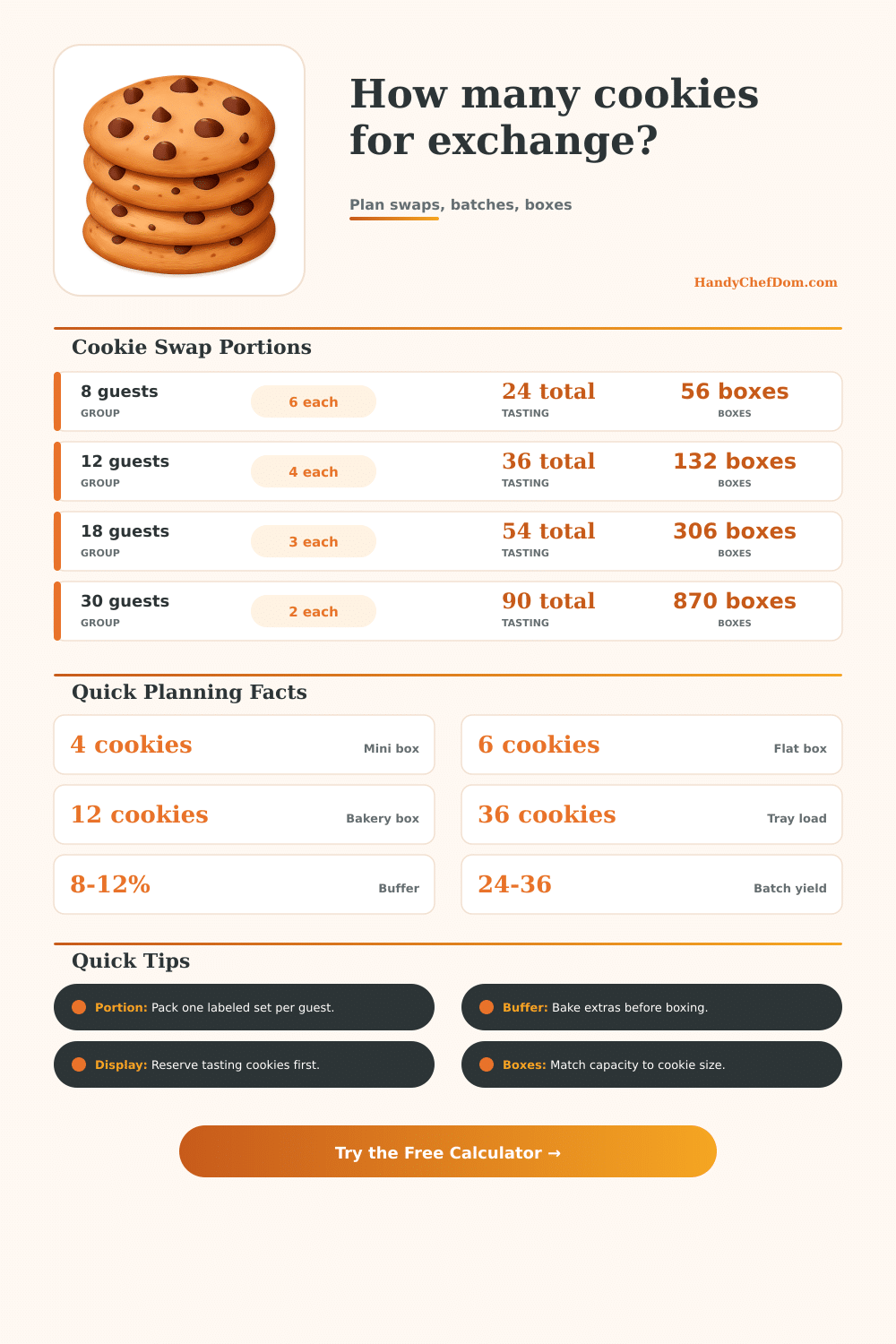
Enter how many bakers are swapping, how many cookies each recipient gets, and how many cookies you want held back for tasting or display. The calculator treats every participant as one cookie variety.
| Exchange Style | Cookies Per Recipient | Best Group Size | Planning Note |
|---|---|---|---|
| Mini sampler | 2 to 3 | 16 to 40 bakers | Keeps total baking manageable for large groups. |
| Classic box | 4 to 6 | 8 to 18 bakers | Works well when each guest leaves with many varieties. |
| Half dozen swap | 6 | 6 to 12 bakers | Easy to pack in flat boxes or small tins. |
| Full dozen swap | 12 | 4 to 8 bakers | Best for intimate family or close friend groups. |
| Cookie walk | Open choice | 20 to 80 bakers | Use tray capacity and table space as the main controls. |
| Favor sets | 2 to 4 | 25 to 120 guests | Plan by fixed packages instead of free selection. |
| Cookie Type | Typical Batch Yield | Package Fit | Planning Note |
|---|---|---|---|
| Drop cookies | 30 to 36 | Flat box | Reliable for chocolate chip, oatmeal, and spice cookies. |
| Cutout cookies | 24 to 30 | Bakery box | Leave more space when icing or decorations are tall. |
| Shortbread | 32 to 48 | Tin or sleeve | Dense cookies pack neatly and usually need less height. |
| Macarons | 20 to 30 | Cell pack | Count finished sandwiches, not shells, in the yield field. |
| Biscotti | 24 to 36 | Sleeve | Long cookies may lower package capacity by half. |
| Bars cut small | 36 to 64 | Bakery box | Use the finished piece count after trimming edges. |
| Packaging | Typical Capacity | Best For | Swap Portion Fit |
|---|---|---|---|
| Mini treat bag | 3 to 4 cookies | Small sampler portions | Use one bag per recipient set. |
| Flat cookie box | 6 cookies | Classic exchange portions | Good for half dozen shares. |
| Bakery window box | 10 to 12 cookies | Mixed shapes and iced cookies | Useful when cookies need breathing room. |
| Reusable tin | 12 to 18 cookies | Family swaps and freezer prep | Best when one recipient gets a larger set. |
| Clear sleeve | 2 to 3 cookies | Biscotti and decorated cookies | Plan multiple sleeves for larger shares. |
| Platter box | 24 to 36 cookies | Host table or potluck display | Use for tasting sets rather than individual swaps. |
| Display Need | Rule Of Thumb | Tray Capacity | Planning Note |
|---|---|---|---|
| Small table | 24 to 48 tasting cookies | 24 cookies | Use one row of labeled varieties. |
| Standard table | 48 to 108 tasting cookies | 36 cookies | Leave space for ingredient cards and serving tongs. |
| Large table | 108 to 180 tasting cookies | 48 cookies | Group trays by flavor or cookie style. |
| Cookie walk | 180 plus tasting cookies | 60 cookies | Use multiple lanes to prevent crowding. |
| Favor pickup | Boxed sets only | Not required | Use display samples only if guests choose varieties. |
| Freezer swap | Minimal tasting | 12 cookies | Keep the table compact and label freezer-ready sets. |
Cookie exchanges are most succesful if you calculate the mathematics of the cookie exchange before you begin to bake the cookies. Many people has experienced problems with their baked goods with each individual baker bringing an unknown amount of cookies to the exchange. These unknown amounts of cookies can lead to problems with unmatched portions of cookies or empty portions of cookies box after all of the boxes of cookies are delivered to there recipients.
Therefore, individuals must plan the number of cookies that will be baked in advance to avoid these awkward moment during the cookie exchange. The first step in planning the number of cookies is to determine the number of cookies that each individual should receive. This number is important because many of the other variables in the cookie exchange are determined by the number of cookies per individual.
Plan How Many Cookies to Bake for a Cookie Exchange
For instance, if there are few individuals who will be exchanging cookies, it is possible to provide each individual with a larger portion of cookies. However, if there are many individuals who will receive the cookies, it may be better to provide each individual with less cookies. This number can be entered into a calculator to ensure that each individual is accounted for and that no cookies are guess in the process of calculating for the cookie exchange.
The next variable that must be considered is the yield of each recipe. The yield of each recipe is the amount of cookies that can be produced from the recipe. However, there may not be enough cookies to distribute due to some of the cookies potentially breaking apart during the baking process or individuals eating some of the cookies while they are cooling.
Therefore, there is a buffer percentage that can be entered into the cookie exchange calculator to produce enough cookies to account for these potential issue. The packaging of the cookies will also introduce some constraints into the cookie exchange. For instance, if each box holds six cookies, but each box is too small to hold the size of the cookies that are produced by each recipe, then there will be a problem with the size of the cookies.
Therefore, it may be better to use a larger size container to hold all of the cookies. However, using these larger containers will require baking more cookies than those that could be distributed in the smaller boxes. Thus, the capacity of the boxes can be tested in the cookie exchange calculator to ensure that all of the boxes are of the apropriate size.
In addition to the size of the boxes, it is also necessary to calculate the amount of space that will be required for the cookies. For instance, if there are to be tasting tables with the cookies, it is impossible to use the same batch of cookies for both the tasting table and the boxes of cookies for the guests. Therefore, calculating the footprint of the cookies will allow the baker to determine if the tasting table will be large enough to accommodate the cookies.
Furthermore, ensuring that the footprint is calculated in advance will ensure that the tasting table will not be crowded or have the labels for the cookies covered by the napkins that will be provided to the guest. Finally, the format of the cookie exchange will also change the mathematical calculations that are required for that cookie exchange. A cookie walk with cookie trays requires people to taste more cookies than a pre-packed cookie swap because a cookie walk requires the participants to taste more cookies.
A favor-style cookie exchange for a large crowd will work better with smaller portions of cookies since the goal of a favor-style cookie exchange is to distribute the cookies to a large number of people. These different assumption will produce different outputs from the cookie calculator. People often make the mistake of assuming that all of the cookies that will be produced will be the same.
However, different types of cookies will take up different amounts of space on the baking trays. For instance, a tray of macarons will take up more space on the baking tray than a tray of shortbread squares, even if the number of macarons on the tray is the same as the number of shortbread squares on the tray. The diameter and style factor field in the calculator can be used to account for these different requirements for various types of cookies.
Using these fields will show how many extra units of table length will be required for baking batches of fancy cookies. Label cards will be required to identify which baker made which variety of cookies. Label cards can be printed such that each variety of cookie has either one label card, or two label cards such that the participants who read the label cards can read the ingredients of the cookies more easily.
The field for entering the number of label cards in the calculator will calculate the total number of label cards that will be required for all of the baked cookies. The tables that are provided on this page contain typical yields and capacities for the different types of cookies. Drop cookies can yield more cookies than cutout cookies, because the drop cookie dough spreads during the baking process.
Shortbread cookies will pack densely into the cookie tin, and, because the shortbread cookies will pack densely into the cookie tin, more shortbread cookies can be baked into the same sized cookie tin. These reference tables can help to ensure that the batch sizes of cookies that are planned will be realistic for the group. If the cookie exchange will be a freezer prep exchange, a different logic will have to be followed to calculate the number of cookies required for the exchange.
In a freezer prep exchange, the intention is to provide larger portions of cookies to the participants who will receive the baked treats, and who will store the cookies in the freezer. Thus, the portion size will be higher for each participant in a freezer prep exchange, and there will be fewer tasting cookies provided to each participant. However, the same calculator can be used to plan for a freezer prep exchange by adjusting the inputs that reflect the storage requirements for the baked cookies.
By running the numbers for a cookie exchange, each baker will know how many cookies to bake, and how many boxes of cookies will need to be prepared. Furthermore, the host can determine how much table space will be required to display the tasting cookies. By running the numbers for a cookie exchange, the host and bakers will be able to effectively plan for the cookie exchange, and ensure that it will be an organized event rather than a gamble.