📅 Food Expiration Date Calculator
Turn printed food labels, opening dates, and storage choices into clear best-by, use-by, opened-by, and freeze-by dates.
Enter the label date you see, when it was opened, and where it will be stored. The calculator favors the strictest date when opened-food timing is shorter than the printed label.
| Label preset | What it means | Calculator action | Use this result |
|---|---|---|---|
| Best if used by | Quality date | Calculates best-by and checks opened dates | Best-by card |
| Use by | Last recommended date | Treats printed date as a strict use target | Use-by card |
| Sell by | Store display date | Adds the food type storage window | Use-by card |
| Freeze by | Freeze before this date | Checks if freezer move was on time | Freezer row |
| Packed on | Packaging date | Adds storage days from the packing date | Use-by card |
| Prepared on | Cooking or prep date | Adds prepared-food fridge or freezer days | Opened card |
| Opened on | Package was opened | Starts the opened-food clock immediately | Opened card |
| Purchased on | Shopping date | Uses purchase date when no printed date exists | Breakdown |
| Food group | Fridge unopened | After opened | Risk flag |
|---|---|---|---|
| Cooked leftovers | 3 to 4 days | 3 to 4 days | High |
| Raw poultry | 1 to 2 days | 1 day | High |
| Ground meat | 1 to 2 days | 1 day | High |
| Steaks or chops | 3 to 5 days | 3 days | Medium |
| Deli meat | 2 weeks sealed | 3 to 5 days | High |
| Milk | About 7 days | About 7 days | Medium |
| Eggs | 3 to 5 weeks | Use promptly | Medium |
| Bagged salad | 3 to 5 days | 2 to 3 days | High |
| Storage move | How date changes | Best for | Risk note |
|---|---|---|---|
| Pantry to fridge | Starts fridge clock after opening | Canned food after opening | Never store opened cans in pantry |
| Fridge to freezer | Adds freezer quality window | Meat, leftovers, bread-like foods | Freeze before use-by date |
| Freezer to fridge | Use soon after thawing | Meal prep portions | Do not count freezer time as fridge time |
| Pantry sealed | Uses best-by quality date | Dry goods and sealed cans | Discard damaged packages |
| Fridge door | Subtracts buffer days | Condiments only | Avoid for milk and raw meat |
| Loose container | Shortens opened window | Temporary leftovers | Use airtight containers when possible |
| Risk flag | Triggered by | Calculator response | Kitchen action |
|---|---|---|---|
| Low | Sealed, dry, within quality date | Shows quality-focused date | Inspect package before use |
| Medium | Near deadline, opened, or cold door storage | Uses shorter buffer | Plan soon and check condition |
| High | Raw meat, leftovers, damaged package, or date passed | Flags strictest date | Discard if unsafe or spoiled |
| Freeze check | Move date before deadline | Adds freezer quality window | Label freezer date clearly |
Food expiration dates is used to convey information to consumer about food quality and food safety. However, food expiration dates dont always mean the same thing with every food item that are produced. Food packages will feature different expiration dates, and understand these dates will allow consumers to make informed decisions about food quality and food safety.
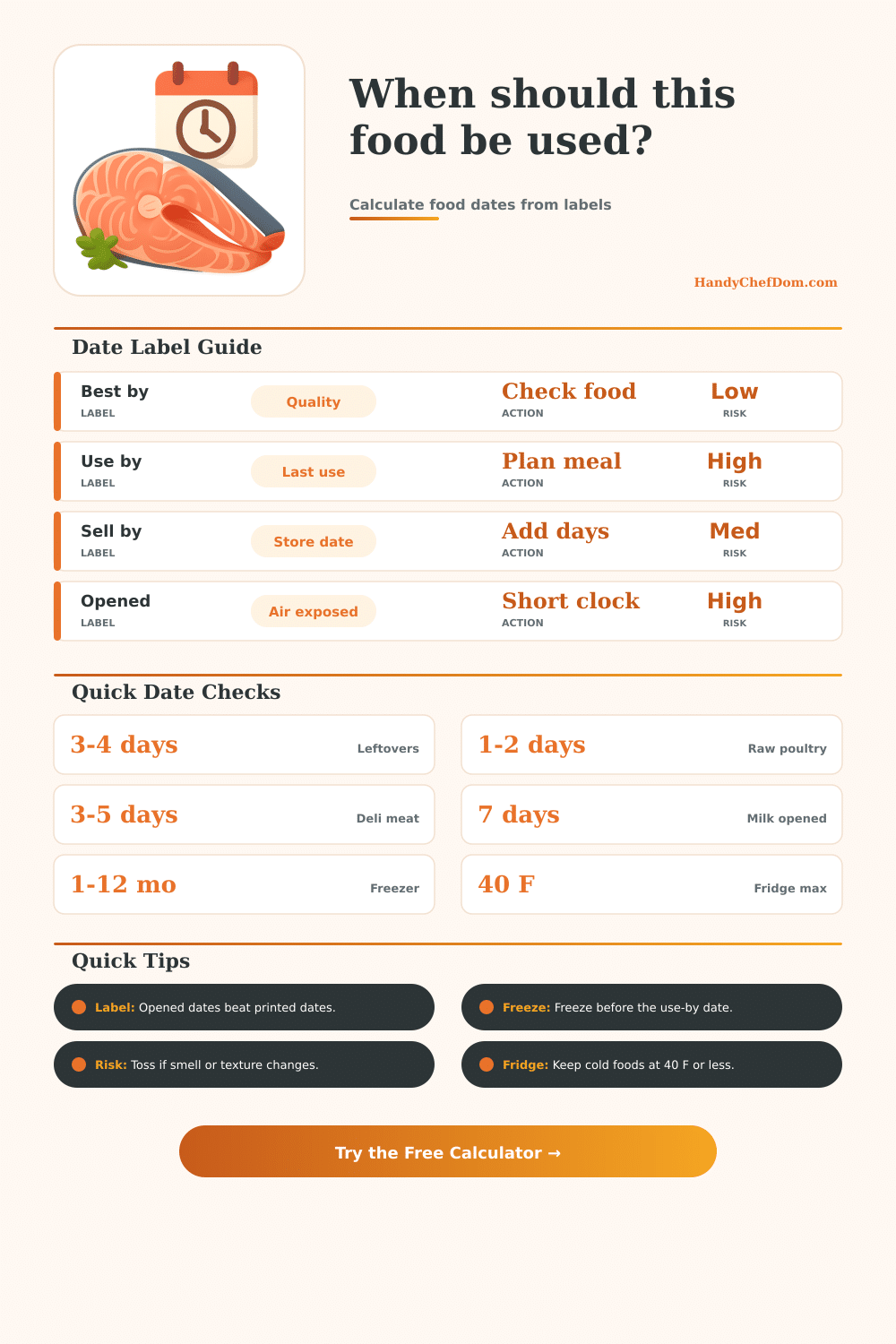
The best if used by date refer to the quality of the product. The use by date refer to the safety of the product. The store inventory management system use the sell by date to ensure proper management and availability of the product.
How to Use Food Expiration Dates
By understanding the expiration date on a package, a consumer can decide if he or she is managing the quality or the safety of a product. The storage of a product will have an impact upon both the safety and quality of that product. For example, storing a product in a sealed package in the back of the refrigerator will allow the product to last longer than if the product was stored in the door of the refrigerator.
Different products will require different storage method; raw meat will last longer in the refrigerator than hard cheese, for instance. Leftovers will require even more care in storage to ensure that they will still be safe to eat. Food calendars will allow consumers to input the type of food that will be stored, the expiration date, the date that the food will be opened, and the method in which it will be stored.
As soon as a consumer open the package of food, a new timeline for that food has begun. This timeline is likely to be shorter than the timeline of the expiration date that is printed on the food package. If air or utensils have made contact with the food, such as in the case of deli meat or leftovers, the food will have a new timeline that will last for fewer days than it would otherwise.
By entering the date that the food was opened into a food calculator, the food calculator will respect this new timeline. If this date isnt entered, a consumer may rely too much upon the expiration date printed upon the food package. Food transportation can lead to changes in the safety of the food.
If the food was transported in a warm car, or if it waited upon a dock while being loaded onto a truck, the food may have reached temperature that make it unsafe to consume. The food may have experienced a rise in temperature that make it not safe to eat after the food has been transported. These factor are not featured upon the food label, but they can be accounted for in the food calculator.
Freezing can extend the life of the quality of the food. However, freezing will only work if the food is frozen prior to the date upon which the food becomes unsafe to eat when stored in the refrigerator. If the food passed this date, freezing it will not make it safe to eat again, nor will it restore the quality of the food that was lost after this date.
Food calculators feature a field for the freezer quality of the food; this will allow the consumer to understand in how many month the food will be safe to eat if it is placed in the freezer. The condition in which the food is packaged may also have an impact upon the safety of the food. If the can is dent or the vacuum seal on a packaged product is torn, this may impact the safety of that food.
In this instance, the consumer should inspect the product; if the consumer finds the product to be in poor condition, that product should not be relied upon to feature dates that indicate the safety of the food. Food calculators also feature a field for the consumer to input the condition of the package; in the case of a damaged package, the food will not be safe to eat once it is opened. Many people make mistakes in considering expiration dates as the measure of safety of food products; they often make mistakes in ignoring the timeline once the food is opened.
For instance, many people will store opened milk in the refrigerator until the expiration date of the milk. However, opened milk often spoils before the expiration date of the milk. Similarly, people may make mistakes in suggesting that the best-by date on ground meat is similar to that of dry pasta; the risk of food-borne illness from ground meat is much more greater than with dry pasta.
Using expiration dates of food to plan meals can help reduce food waste. For instance, if a person enters the date that they plan to cook a meal into a food calculator, that calculator will indicate whether or not the meal date falls within the safety date of the food. If the planned meal date falls after the safety date of the food, the food calculator will indicate this; in this case, the food can be placed into the freezer for later meals or the meal can be canceled.
Food calculators turn all of these different rules into one simple comparison. From this single comparison, consumers can understand how the type of food, the date on the label, the date that it was opened, and the storage methods of the food can all impact and allow for a consumer to make an informed decision about food safety.