🍞 Baking Powder in Self-Rising Flour Calculator
Calculate baking powder and salt for homemade self-rising flour from cups or grams, with flour type, recipe style, freshness, altitude, and batch scaling included.
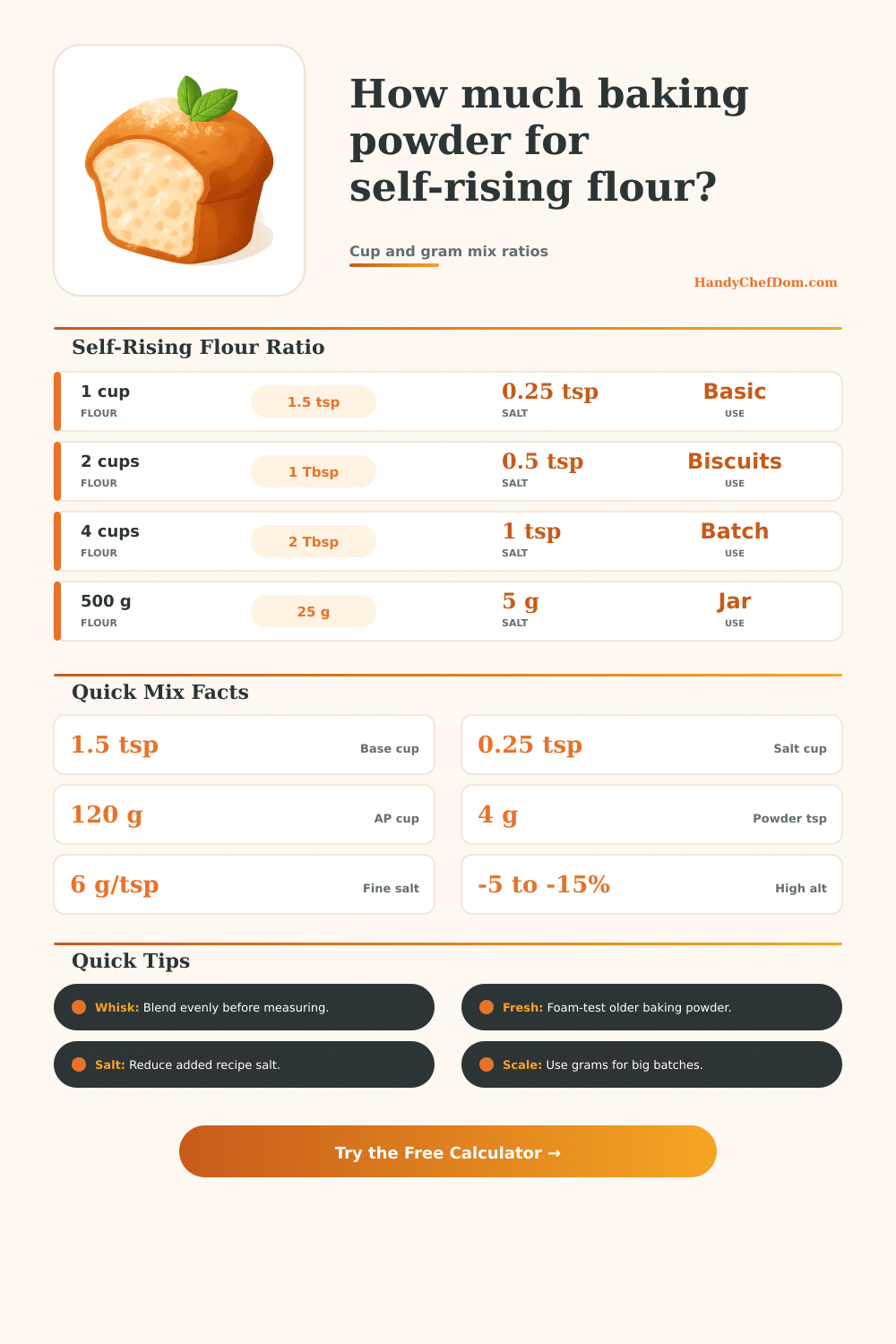
Reference ratio: 1 cup all-purpose flour plus 1.5 teaspoons baking powder plus 1/4 teaspoon fine salt. Adjustments are shown separately so the base ratio stays easy to audit.
| Plain Flour | Baking Powder | Fine Salt | Typical Use |
|---|---|---|---|
| 1 cup | 1 1/2 tsp | 1/4 tsp | Small recipe swap |
| 2 cups | 1 Tbsp | 1/2 tsp | Biscuits or pancakes |
| 3 cups | 4 1/2 tsp | 3/4 tsp | Muffins or quick bread |
| 4 cups | 2 Tbsp | 1 tsp | Storage jar batch |
| 6 cups | 3 Tbsp | 1 1/2 tsp | Large baking day |
| 8 cups | 1/4 cup | 2 tsp | Bulk pantry mix |
| Ingredient | Measure | Approx Grams | Calculator Use |
|---|---|---|---|
| All-purpose flour | 1 cup | 120 g | Default flour cup |
| Soft wheat flour | 1 cup | 115 g | Tender biscuits |
| Cake flour | 1 cup | 114 g | Lower protein bakes |
| Baking powder | 1 tsp | 4 g | Leavener weight |
| Fine table salt | 1 tsp | 6 g | Salt weight |
| Classic self-rising cup | 1 cup mix | 127.5 g | Flour plus additions |
| Recipe Type | Powder Adjust | Salt Adjust | Reason |
|---|---|---|---|
| General swap | 1.00x | 1.00x | Matches classic self-rising flour |
| Biscuits or scones | 1.02x | 0.95x | Extra lift, less salty with butter |
| Pancakes or waffles | 1.03x | 1.00x | Quick griddle rise |
| Muffins or quick bread | 1.00x | 1.00x | Balanced batter lift |
| Snack cake | 0.95x | 0.90x | Gentler crumb and cleaner flavor |
| Cornbread or batter | 1.04x | 0.95x | Supports heavier add-ins |
| Baking Powder | Calculator Factor | Best Batch Size | Mix Note |
|---|---|---|---|
| Fresh and active | 1.00x | Any batch | Use the classic ratio |
| Opened, foams well | 1.03x | Small or medium | Adds a modest cushion |
| Older, passes test | 1.07x | Use soon | Avoid long storage |
| Weak or near expiry | 1.12x | Immediate only | Replace if lift matters |
| High altitude mix | 0.85x-0.95x | Recipe batch | Less leavener can prevent collapse |
| Bulk jar mix | Fresh only | 1-4 weeks | Label and keep dry |
Baking powder will cause your baked goods to rise. Additionally, baking powder will also have an effect on teh texture of your cake as well as the height of your biscuits. Self-rising flour is an blend of flour, baking powder and salt.
Each of these ingredients has an effect upon your baked goods; baking powder will provide the lift that your baked goods require, and the salt will affect the flavor and the strength of the structure of your baked good. Each of these ingredients must be considered when you are creating your own self-rising flour. Factors to consider includes the type of flour that you use, the type of recipe that you are creating, and the altitude at which you are baking.
How to Make and Use Self-Rising Flour
Self-rising flour recipes typically call for one cup of flour, one and a half teaspoons of baking powder, and a quarter of a teaspoon of salt. This ratio is typically used as the starting point for most recipes that uses self-rising flour. However, the weight of the flour may change based off the type of flour that you use.
For example, one cup of cake flour may weigh less then one cup of all purpose flour. Additionally, the amount of baking powder that a recipe requires may differ from recipe to recipe. For instance, biscuits may contain more baking powder than cakes because biscuits requires more lift during the baking process.
Another factor to consider when using baking powder is the freshness of the baking powder. To test the freshness of the baking powder, place the baking powder into hot water. If the baking powder begins to foam the hot water, then the baking powder is fresh and you can use it in the amount that is indicated on the recipe.
If the baking powder does not foam the hot water, then the baking powder is old and may need to be increased in strength. The altitude at which you are baking can also impact the baking powder that is used in your baked goods. At high altitudes, the air pressure is lower which causes the batter to rise quick from the baking powder yet collapse as a result of the low air pressure.
To compensate for this quick rising of the batter at high altitudes, you should reduce the amount of baking powder that is used in your recipe. The amount of salt that you use in self-rising flour can be adjusted to the taste of your individual recipe. Many people prefer to use less salt in self-rising flour than the standard amount because self-rising flour already contains salt.
However, others may prefer to use the standard amount of salt if the recipe is creating savory flavored foods. When creating large batches of self-rising flour, you should consider the way that you measure the baking powder and salt. While you can use teaspoons to measure both baking powder and salt for small batch recipes, grams may be more accurate for baking powder and salt for large batches of self-rising flour.
Furthermore, accuracy in the amount of baking powder and salt is important to ensure that the baking powder and salt are distributed evenly throughout the batch of self-rising flour. Therefore, it is necessary to whisk or sift the flour, baking powder and salt together so that the baking powder and salt is evenly distributed. If baking powder and salt are not evenly distributed throughout the self-rising flour, some portions of your baked good may rise more than other portions of that same baked good.
By creating your own batches of self-rising flour, you gain control over the amount of baking powder and salt that is included in the flour. This control allows you to adjust the amount of flour according to your specific recipes and your specific environment.