🍲 Cornstarch to Thicken Stew Calculator
Calculate cornstarch slurry for stew by pot volume, current thickness, target body, ingredients, tomato acidity, simmer time, leftover plans, and batch buffer.
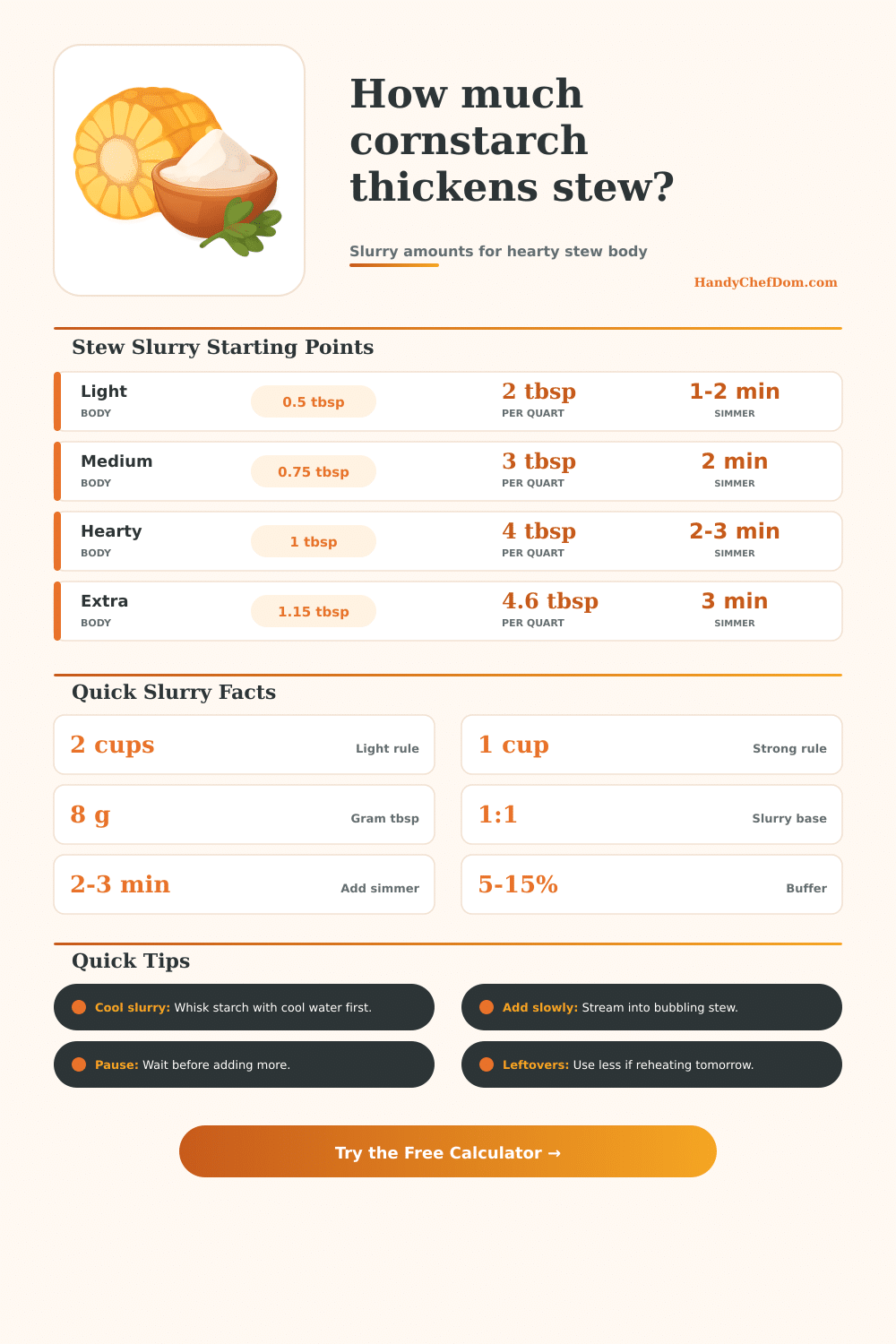
Reference rule: 1 tablespoon cornstarch thickens about 1 cup liquid strongly or 2 cups lightly. Stew solids, tomato acidity, simmer time, and reheat plans adjust that baseline.
| Target Body | Cornstarch Starting Point | Visual Cue | Best Stew Situation |
|---|---|---|---|
| Light broth body | About 1 tablespoon per 2 cups stew | Broth looks glossy but still flows freely | Chicken stew, vegetable stew, or delicate leftovers |
| Medium spoon-coating body | About 3/4 tablespoon per cup stew | Coats the back of a spoon, then drips | Most beef, chicken, and mixed vegetable stews |
| Hearty stew body | About 1 tablespoon per cup stew | Thick ladle body with a soft mound | Meat and potato stew, root vegetable stew, winter batches |
| Extra thick ladle body | About 1.15 tablespoons per cup stew | Very thick and slow-moving after resting | Pot pies, stew over biscuits, or extra-hearty bowls |
| Water Ratio | Texture | When to Use | Stirring Note |
|---|---|---|---|
| 1:1 water to cornstarch | Thick paste slurry | Small pots or precise additions | Whisk smooth before it sits and firms |
| 1.5:1 water to cornstarch | Loose but concentrated | Most stew pots | Easy to stream into a bubbling corner |
| 2:1 water to cornstarch | Thin pourable slurry | Large batches or thick stew with many solids | Stir longer so the extra water spreads evenly |
| 3:1 water to cornstarch | Very thin slurry | Buffet pots where gradual thickening is safer | Add in stages to avoid overshooting the body |
| Stew Volume | Light Body | Medium Body | Hearty Body |
|---|---|---|---|
| 1 quart / 4 cups | 2 tablespoons cornstarch | 3 tablespoons cornstarch | 4 tablespoons cornstarch |
| 2 quarts / 8 cups | 4 tablespoons cornstarch | 6 tablespoons cornstarch | 8 tablespoons cornstarch |
| 3 quarts / 12 cups | 6 tablespoons cornstarch | 9 tablespoons cornstarch | 12 tablespoons cornstarch |
| 4 quarts / 16 cups | 8 tablespoons cornstarch | 12 tablespoons cornstarch | 16 tablespoons cornstarch |
| 6 quarts / 24 cups | 12 tablespoons cornstarch | 18 tablespoons cornstarch | 24 tablespoons cornstarch |
| Thickener | Typical Strength | Finish in Stew | Calculator Note |
|---|---|---|---|
| Cornstarch slurry | Strong, fast thickening | Glossy and smooth when simmered gently | This calculator sizes cornstarch only |
| All-purpose flour | About half as strong by tablespoon | Opaque and hearty with longer simmering | Use roux or extra simmer time instead |
| Potato flakes | Moderate, very absorbent | Rustic and cloudy with potato flavor | Add by pinches after tasting texture |
| Arrowroot starch | Similar but more delicate | Glossy, can thin with long heat | Use gentler heat and avoid long holding |
| Reduction only | Slow concentration | Deep flavor but less predictable volume | Works before final slurry adjustments |
In order to achieve the proper thick for the stew, a person must use the correct amount of cornstarch when preparing the stew. If stew is prepared with insufficient amount of cornstarch, the stew will end up being too watery. However, if stew contains too much cornstarch, the stew may become too gluey when consuming.
To account for the fact that the reaction of cornstarch to stew can vary with different stew ingredient and other factors, a calculator can help a person to determine the proper amount of cornstarch to add to the stew. The calculator will ask for the volume of the stew to be measured. The volume of the stew will determine the amount of cornstarch required to thicken the stew.
How Much Cornstarch to Use in Stew
For instance, one quart of stew will require a different amount of cornstarch than a stew that contain six quarts of liquid. The thickness of the stew will also impact the amount of cornstarch required. For instance, if the stew is already glossy, it will require less cornstarch than a stew that is thin and brothy.
The second value to be entered into the calculator will be the target body of the stew. Different amounts of cornstarch will be required for stews of different consistencies. For instance, a stew may require more cornstarch to achieve a medium body than that required to achieve a broth like body.
Furthermore, different ingredients within the stew will impact the amount of cornstarch required. For instance, ingredients like potatoes and beans will naturaly release there own starch into the stew. Additionally, the acidity of ingredients like tomatoes may weaken the cornstarch gel that is prepared for the stew.
The third value that the cornstarch calculator will request of a user will be the simmer time for the stew. Cornstarch set when the stew is simmered to a certain temperature. Therefore, long simmer time will require more cornstarch than short simmer times.
Furthermore, if you will reheat the stew, the simmer time will need to be considered again. For instance, if the stew will be prepared as leftovers, the amount of cornstarch will be different than if the stew is to be simmered for a period of time after it is prepared. Cornstarch will thicken the stew while it is cooling, so the calculator will suggest a lower amount of cornstarch if the stew will be prepared as leftovers.
The final piece of information to be entered into the cornstarch calculator will be the size of a batch buffer. A batch buffer is used to ensure that the stew does not thin out as a result of the solid that are naturally contained within the stew. For instance, if the stew is ladled into a pot, the last ladle of stew may be thinner than the first ladle.
Therefore, adding a buffer of cornstarch to the stew ensures that the stew will be thick throughout the entire batch. After entering all of the required information into the cornstarch calculator, the calculator will provide the amount of cornstarch that should be used in both tablespoons and grams. Furthermore, the calculator will also provide the amount of water that will be required to prepare the cornstarch slurry.
The cornstarch should be added to the stew in stages. For instance, approximately two-thirds of the calculated amount of cornstarch should be added to the stew. The stew should then be allowed to bubble gentle.
Waiting allows for the stew to react to the cornstarch. If you add all of the cornstarch to the stew at once, the stew may become too thick. Furthermore, cornstarch will alter the taste of the stew.
The stew may require additional salt or vinegar after the addition of cornstarch. The thickness of the stew can be tested by using a spoon to test the thickness of the stew. If the cornstarch has thickened the stew properly, the coating on the spoon will remain on the spoon for one second before it begin to drip.
If the coating on the spoon begins to sheet off of the spoon in one slow layer, the stew has thickened beyond the target thickness. This same logic and the use of the cornstarch calculator can also be used to scale a stew recipe. For instance, if the amount of stew that will be prepared is less than the amount that was calculated for the original batch, less cornstarch will be required.
However, if the stew is to be cooked in a slow cooker, more cornstarch will be required. Furthermore, cooking stews in a slow-cooker may require the consideration of slow-cooker batches starting at a thin consistency to begin simmering. Using such a calculator allow for the avoidance of mental math when preparing stews.