🌿 Food Dehydrator Calculator
Calculate how much fresh food you need to reach your desired dried weight & yield
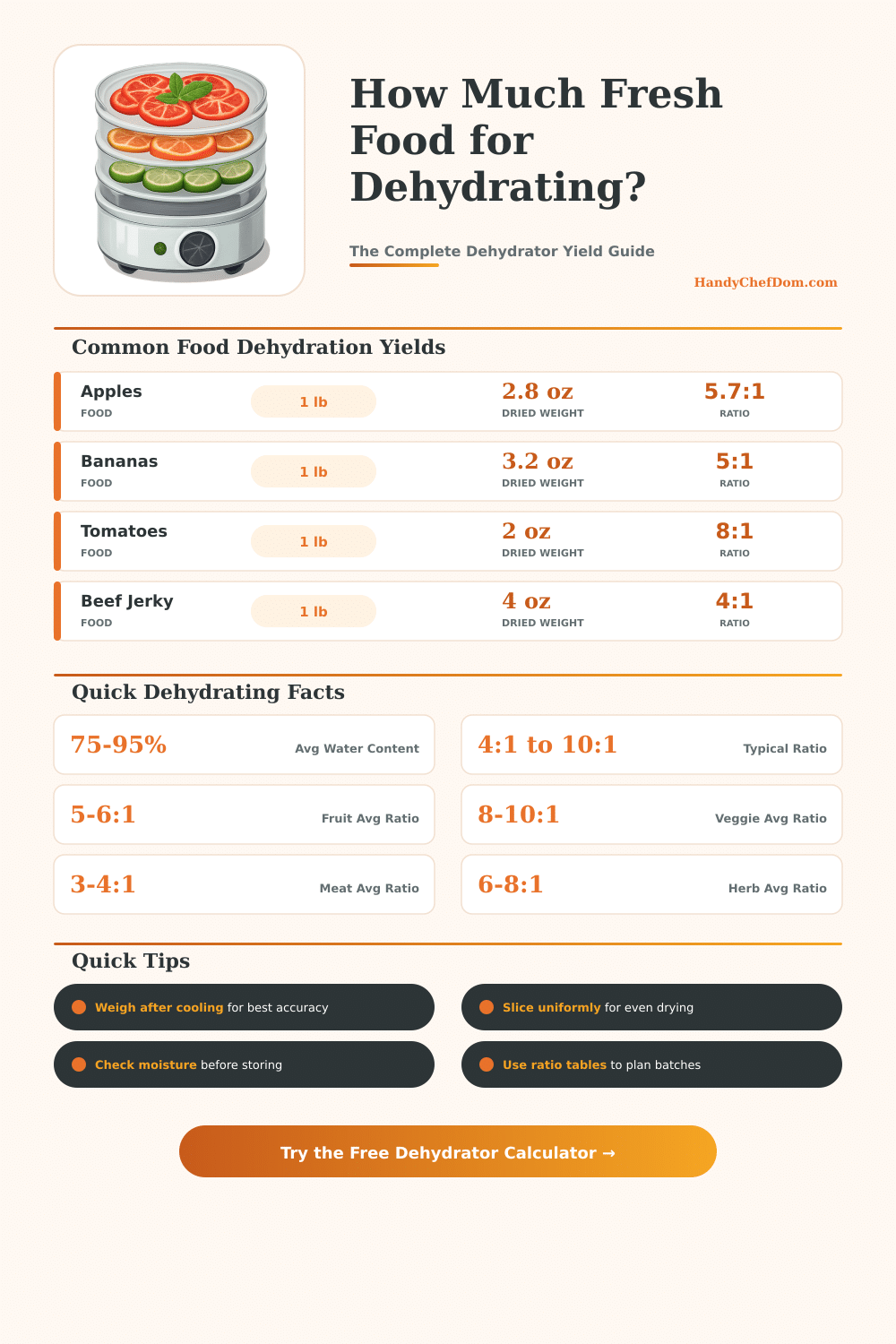
| Food | Water Content | Ratio (Fresh:Dried) | 1 lb Fresh Yields | 1 oz Dried = Fresh |
|---|---|---|---|---|
| 🍎 Apples | 86% | 5.7 : 1 | 2.8 oz | 5.7 oz |
| 🍌 Bananas | 75% | 5.0 : 1 | 3.2 oz | 5.0 oz |
| 🥭 Mango | 83% | 5.9 : 1 | 2.7 oz | 5.9 oz |
| 🍓 Strawberries | 91% | 8.0 : 1 | 2.0 oz | 8.0 oz |
| Pineapple | 86% | 6.0 : 1 | 2.7 oz | 6.0 oz |
| Peaches | 89% | 7.0 : 1 | 2.3 oz | 7.0 oz |
| Grapes (Raisins) | 81% | 4.5 : 1 | 3.6 oz | 4.5 oz |
| 🍅 Tomatoes | 95% | 8.0 : 1 | 2.0 oz | 8.0 oz |
| 🥕 Carrots | 88% | 7.5 : 1 | 2.1 oz | 7.5 oz |
| 🥦 Zucchini | 94% | 10.0 : 1 | 1.6 oz | 10.0 oz |
| 🍄 Mushrooms | 92% | 9.0 : 1 | 1.8 oz | 9.0 oz |
| Spinach / Greens | 91% | 8.0 : 1 | 2.0 oz | 8.0 oz |
| Bell Peppers | 92% | 9.5 : 1 | 1.7 oz | 9.5 oz |
| 🌿 Fresh Herbs | 85% | 7.0 : 1 | 2.3 oz | 7.0 oz |
| 🥩 Beef (Jerky) | 60% | 4.0 : 1 | 4.0 oz | 4.0 oz |
| Chicken | 65% | 4.5 : 1 | 3.6 oz | 4.5 oz |
| Salmon | 68% | 3.5 : 1 | 4.6 oz | 3.5 oz |
| Imperial | Metric | Common Use | Dehydrator Notes |
|---|---|---|---|
| 1 oz | 28.35 g | Small batch snacks | Single serving dried fruit |
| 4 oz (¼ lb) | 113 g | Herb drying | Approx. 1 herb tray yield |
| 8 oz (½ lb) | 227 g | Trail mix component | Good starter batch |
| 1 lb (16 oz) | 454 g | Standard batch unit | Reference batch size |
| 2 lb | 907 g | Medium batch | Fills 4–5 trays (fresh) |
| 5 lb | 2.27 kg | Large batch | Full dehydrator load |
| Food (1 oz dried) | Calories | Carbs (g) | Fiber (g) | Sugar (g) | Protein (g) |
|---|---|---|---|---|---|
| Apple Chips | 78 | 21 | 3.2 | 15 | 0.3 |
| Banana Chips | 147 | 17 | 1.5 | 9 | 0.6 |
| Mango Slices | 88 | 23 | 1.6 | 20 | 0.6 |
| Strawberries | 86 | 22 | 3.8 | 14 | 0.8 |
| Tomatoes | 73 | 16 | 3.5 | 11 | 3.7 |
| Carrots | 95 | 22 | 6.0 | 11 | 2.0 |
| Mushrooms | 65 | 11 | 3.2 | 3 | 7.0 |
| Beef Jerky | 116 | 3 | 0.0 | 2 | 9.4 |
A Dehydrator is a machine that removes moisture from foods to help them last longer. The method of drying foods allows you to preserve fruits, vegetables and basic proteins and it was already used by folks in old times. By removing the water from the food, the Dehydrator stops the growth of bacteria, yeasts and molds.
One must not add preservatives, so the natural process extends the short shelf life of the foods, which helps to save money.
What a Food Dehydrator Does and How to Choose One
Electrical Dehydrators remove the moisture by means of air flow, that can be horizontal or vertical, together with fans. The horizontal models have a bonus, because their air flow less mixes the smells, so various foods dry at the same time without problems. A good Dehydrator keeps stable heat and cleans without trouble.
Also the power in watts matters. Models with lower power use less energy, but heat a bit more slowly. Units with higher power reach the heat quickly and work well, even though they commonly cost more to buy and use.
The size also plays a role, so pick one that fits the available space.
The Cosori Stainless Steel Dehydrator is reliable for beginners. It is simple to use and gives stable results. Its built-in structure and inner fan allows even drying.
One downside is that it weighs a lot and costs a high price, and you can not change time or heat after the cycle starts. The Magic Mill 10-Tray Dehydrator works great long term. It has easily cleaned stainless steel trays, a heat range of 95°F to 176°F and an option to keep it warm.
To use it, no prior experience with Dehydrators is needed.
The Nesco FD-1018 Gardenmaster Dehydrator is rated as the best for home use. Models from Nesco can expand up too 30 trays. Some Nesco units fit to take more than 10 pounds of cut meat at once.
The most silent Dehydrator is the Samson Silent 6-Tray Dehydrator.
The capacity is measured by figuring out the surface of one tray, then multiplying by the total number of trays. Juicy fruits need more time for drying than meat or vegetables, so drying one big batch takes more time tahn doing several small loads over several days.
A Dehydrator works well for making beef jerky, slices of dried fruits, granola and homemade spices. Some of the most useful uses are drying herbs or vegetables like garlic and onions to create powders. Homemade garlic powder has much more flavor than the kind bought in a store.
Dried carrots and onions work well for fast soup making. Vegetables that risk going bad, you can chop and dehydrate for use later in sauces, soups, meatloaves or burgers. Drying helps to also pack more vegetables in your lunches.
Dried bits of angel food cake turn into crisp, nice treats similarto cookies.
Dehydrators cost from under 40 dollars and up. The design itself is not complex. It is made up of a fan and a basic heater under several levels for drying.
One sometimes finds them used at flea markets or yard sales.