🥜 Almond Flour to Substitute for Regular Flour Calculator
Estimate almond flour cups and grams from wheat flour, then adjust binder, liquid, leavening, pan size, and recipe suitability before testing the swap.
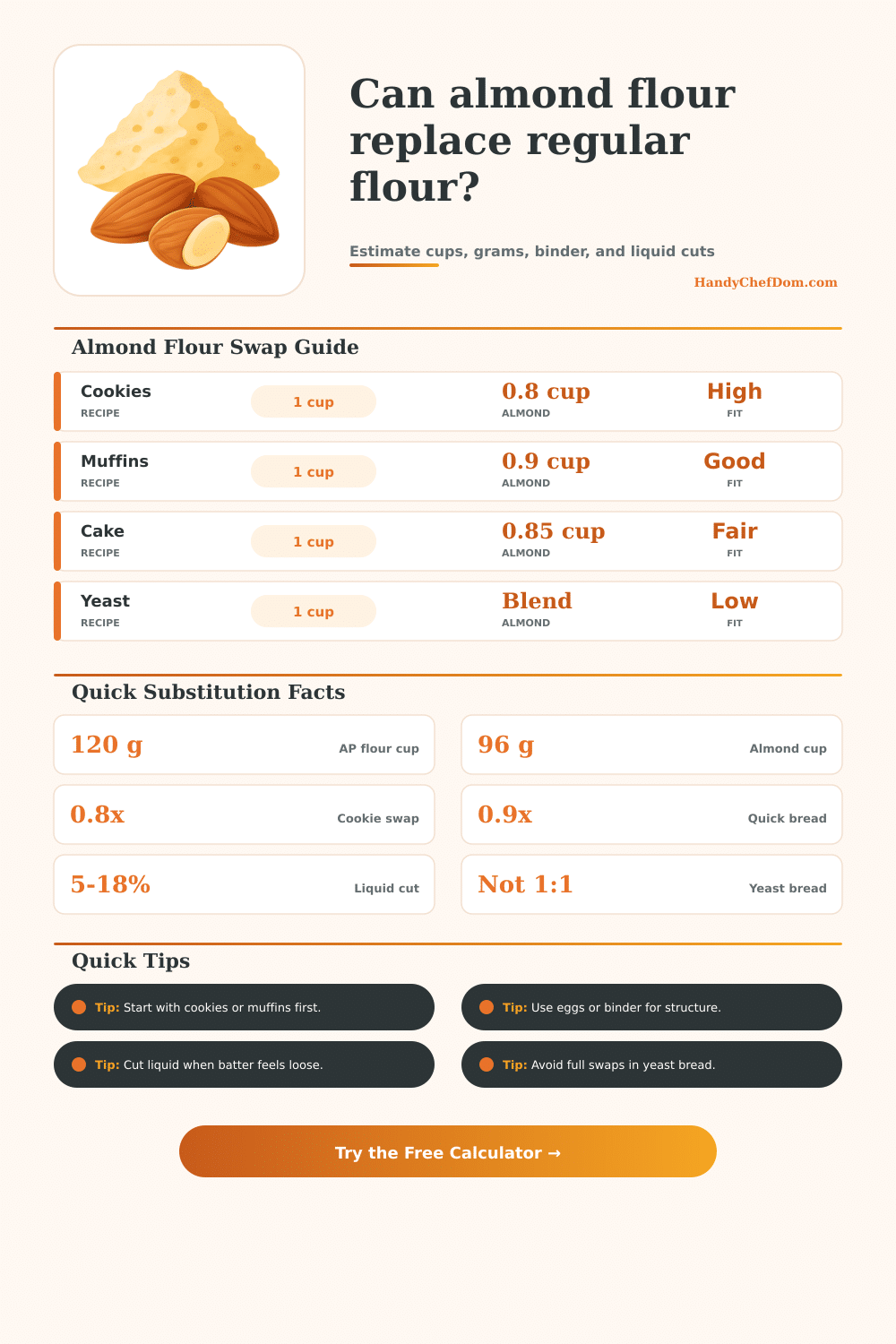
Almond flour is not a direct 1:1 wheat flour replacement because it has no gluten and more fat. It works best in cookies, quick breads, muffins, pancakes, crusts, and some cakes. Full swaps are not recommended for yeast bread.
| Original Wheat Flour | Safer Almond Flour Start | Approx Almond Grams | Adjustment Note |
|---|---|---|---|
| 1/4 cup wheat flour | 3 to 4 tablespoons almond flour | 18 to 24 g | Good for small binders and crumbles |
| 1/2 cup wheat flour | 6 to 7 tablespoons almond flour | 36 to 42 g | Watch dough softness before adding liquid |
| 1 cup wheat flour | 3/4 to 1 cup almond flour | 72 to 96 g | Range depends on recipe and texture |
| 2 cups wheat flour | 1 1/2 to 1 3/4 cups almond flour | 144 to 168 g | Use binder for sliceable quick breads |
| 3 cups wheat flour | 2 1/4 to 2 2/3 cups almond flour | 216 to 256 g | Partial swap is safer for tall bakes |
| Yeast bread formula | Use partial blend only | Varies | Almond flour is not 1:1 for gluten dough |
| Recipe Type | Almond Flour Fit | Best Swap Level | Likely Adjustment |
|---|---|---|---|
| Cookies and bars | High | 75% to 100% | Chill dough and reduce liquid lightly |
| Muffins and quick breads | Good | 50% to 90% | Add egg or binder for clean slices |
| Cakes and cupcakes | Moderate | 25% to 75% | Use superfine flour and avoid over-wet batter |
| Brownies | High | 75% to 100% | Works well because structure needs are lower |
| Pancakes and waffles | Good | 50% to 100% | Rest batter briefly before cooking |
| Scones and biscuits | Fair | 25% to 60% | Expect a more tender, fragile result |
| Tart crust or crumble | High | 75% to 100% | Excellent for crumbly short textures |
| Yeast bread or pizza dough | Low | 10% to 25% | Do not use as a full 1:1 substitute |
| Flour or Texture | Approx Cup Weight | Structure Effect | Calculator Factor |
|---|---|---|---|
| All-purpose wheat flour | 120 g per cup | Gluten-forming, absorbs water | Original basis |
| Superfine blanched almond flour | 96 g per cup | Most even texture and best lift | 1.00x |
| Fine blanched almond flour | 94 g per cup | Good all-purpose almond option | 0.98x |
| Natural almond flour with skins | 92 g per cup | Heavier look and heartier crumb | 0.96x |
| Coarse almond meal | 88 g per cup | Grittier and more fragile | 0.90x |
| Mixed almond plus starch blend | Varies | Better binding than almond alone | Use partial swap |
| Feature | Regular Wheat Flour | Almond Flour | Practical Impact |
|---|---|---|---|
| Gluten | Forms stretchy structure | No gluten | Almond flour needs eggs, binder, or partial blending |
| Fat | Low fat | Higher natural fat | Bakes can brown faster and feel richer |
| Starch | Higher starch | Very low starch | Less thickening and less elastic crumb |
| Moisture behavior | Absorbs and hydrates | Can make batter feel oily or loose | Reduce liquid or rest batter when needed |
| Best formats | Bread, cake, pastry, sauce | Cookies, crusts, muffins, pancakes | Choose the swap based on structure needs |
| Yeast dough | Can trap fermentation gas | Cannot build the same network | Not a full 1:1 substitute for yeast bread |
Almond flour behaves differently then wheat flour because almond flour dont contain gluten and because almond flour contains a high amount of natural fat. The results of substituting almond flour for wheat flour will change according to the type of food that you are bake. For instance, baked goods that contains a high percentage of almond flour may be tender like cookies, but may collapse if they contain a high percentage of yeast flour, which require the structure that gluten can form.
One tool that you can utilize to understand these different behaviors of almond flour is a substitution calculator. The substitution calculator will help you to understanding whether it is possible to substitute almond flour for wheat flour in a specific recipe. To determine whether it is possible to use almond flour in place of wheat flour in a specific recipe, you will have to input the amount of wheat flour that the original recipe use.
How to Use an Almond Flour Substitution Calculator
You must perform this initial substitution because almond flour weighs less per cup than wheat flour. Additionally, you will also have to select the type of recipe that you are baking. For instance, cookie dough can contain a high percentage of almond flour, but yeast dough cannot contain such a high percentage of almond flour because the yeast dough contains a high amount of gluten.
Thus, the substitution calculator may account for this need for gluten in the recipe and lower the percentage of almond flour that it suggest can be used in place of wheat flour. You will also have to select a texture for the baked goods that you are making with the almond flour. For instance, superfine blanched almond flour will create baked goods that has an even crumb with better lift, but if you use coarse almond meal it will have a grittier texture and provide a weak structure to the baked goods.
Thus, the texture selection will impact the amount of almond flour that it suggests to be used in place of the wheat flour, as well as the score that is provided for the suitability of using almond flour in that recipe. Other settings for the substitution calculator include the binders and the moisture content for the baked goods. Because almond flour contains fat that releases into the batter when baked, as well as because it absorbs less liquid than wheat flour, the recipe will have to reduce the amount of liquid.
Additionally, if the baked good does not contain the structure of gluten, like slices of bread, it can fall apart when baked with only almond flour; a binder would have to be used in this case. The substitution calculator may account for these difference in suggesting the amount of binders to use in recipes that contain medium or high amounts of gluten; it will also suggest the amount of liquid that should be reduced in recipes to avoid having soupy baked goods. Finally, the suitability score that the recipe provides is not a guarantee that the recipe will behave as expected with the use of almond flour for the flour ingredient, but it is a measurement of the suitability of using almond flour in that specific recipe.
Thus, a high suitability score will indicate the recipe can be tested using almond flour, while a low score will indicate that only a blend of flours should be used. Additionally, the reference tables on the page may provide additional information about the suitability of almond flour in different types of recipes. People can use the substitution calculator to determine how to substitute almond flour for wheat flour in recipes.
Many recipes that can be attempted using the calculator are recipes for cookies or muffins, as these types of baked goods contain higher percentage of fat and sugar than gluten. If individuals decide to try to use almond flour in place of wheat flour in their baking, it may be helpful for them to prepare and bake a test batch of cookies or muffins to observe whether an adjustment to the recipe is needed. After baking a test batch of cookies or muffins, individuals will have an understanding of how to perform future substitutions of wheat flour with almond flour, as the baking calculator will help with any math error that may occur in performing such a task.
Baking recipes that contain yeast bread may be more of a limitation for almond flour. Because almond flour cannot trap the gas that the yeast produce, any bread recipes will have a poor texture when using only almond flour. The suggestion of lowering the percentage of almond flour that can be used in place of wheat flour for recipes like yeast bread, as well as lowering the suitability score for recipes of this type, takes into account this difference between almond flour and wheat flour.
For recipes of this type, it is best to use only a small percentage of almond flour to recipes that contain wheat flour. The purpose of the calculator is not to provide a means of replacing all wheat flour with almond flour, but instead to indicate in what situation almond flour will be able to maintain the structure of the food that is to be baked. Each of the inputs in the question ask about the type of gluten, texture, binders, and moisture content in the recipe to provide an understanding of the type of balance that will be needed in the recipe.
Thus, once individuals understand how each of the settings in the calculator relate to the baking process, the output will provide a start to their baking endeavor with almond flour.