🍚 Polenta Per Person Calculator
Plan dry polenta cups, grams, liquid cups, cooked yield, and per-person portions for sides, mains, firm slabs, and grilled polenta.
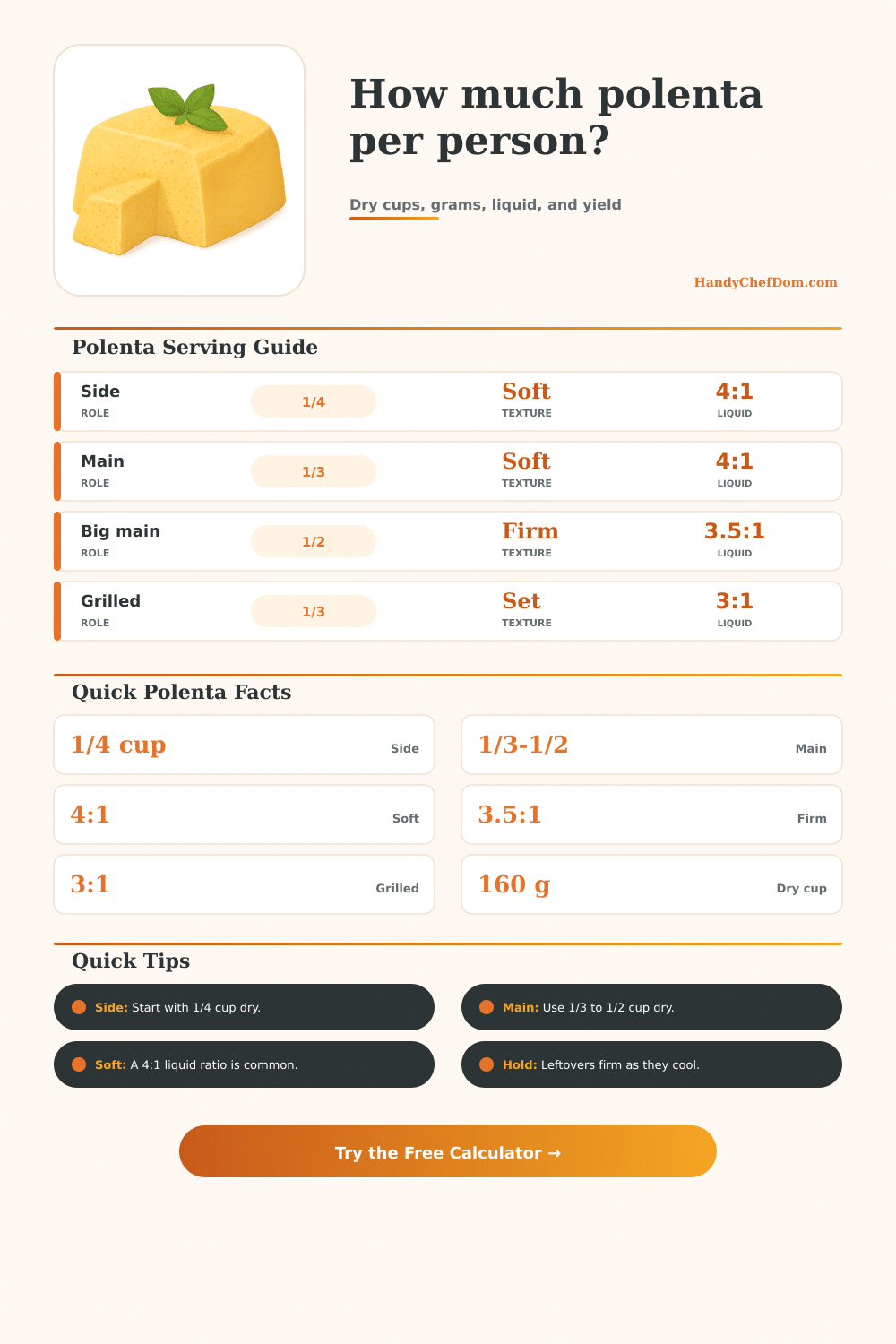
Reference rule: soft polenta often starts around 1/4 cup dry per person for a side, while main portions often use 1/3 to 1/2 cup dry. A 4:1 liquid-to-polenta ratio is a common soft starting point.
| Meal Role | Dry Polenta Per Person | Approx Grams | Best Use |
|---|---|---|---|
| Small appetizer | 3 tablespoons dry polenta | About 30 grams | Tasting plates, antipasti, or a small scoop under sauce |
| Side serving | 1/4 cup dry polenta | About 40 grams | Classic side portion with vegetables, stew, or roasted meat |
| Light main | 1/3 cup dry polenta | About 53 grams | Polenta bowls with sauce, beans, greens, or mushrooms |
| Main course | 0.42 cup dry polenta | About 67 grams | Generous dinner bowl when polenta is a central starch |
| Hearty main | 1/2 cup dry polenta | About 80 grams | Large appetites or a polenta-forward meal |
| Texture Goal | Liquid Ratio | Cooked Feel | Planning Note |
|---|---|---|---|
| Loose bowl | 5 cups liquid per 1 cup dry | Very soft and spoonable | Useful when the polenta will sit briefly before serving |
| Soft polenta | 4 cups liquid per 1 cup dry | Creamy, classic, and pourable | Common starting point for side servings |
| Firm polenta | 3.5 cups liquid per 1 cup dry | Thicker and moundable | Good for plated portions that need shape |
| Grilled polenta | 3 cups liquid per 1 cup dry | Set and sliceable after cooling | Best when chilling into slabs before grilling or frying |
| Texture | Suggested Role | Per-Person Range | Serving Style |
|---|---|---|---|
| Soft | Side or light main | 1/4 to 1/3 cup dry | Spoon under braises, mushrooms, vegetables, or sauce |
| Medium creamy | Main bowl | 1/3 to 0.42 cup dry | Serve in bowls with toppings mixed or spooned over |
| Firm | Plated starch | 0.33 to 0.50 cup dry | Spoon thick portions or spread into a shallow tray |
| Grilled or fried | Slabs, squares, wedges | 1/3 to 1/2 cup dry | Cook firm, chill, cut, then grill or pan-fry |
| Grain or Starch | Dry Side Portion | Liquid or Yield Style | Texture Compared With Polenta |
|---|---|---|---|
| Polenta | About 1/4 cup dry per side | Often 4:1 for soft polenta | Creamy corn base that firms as it cools |
| Rice | About 1/4 cup dry per side | Often yields about 3 cups cooked per cup dry | Separate grains rather than a porridge texture |
| Grits | About 1/4 cup dry per side | Often similar 4:1 liquid planning | Similar creamy corn texture, usually finer |
| Couscous | About 1/4 cup dry per side | Hydrates quickly with much less cooking liquid | Fluffy grains, not creamy or sliceable |
| Mashed potato | By potato weight rather than dry cups | Yield depends on potato and dairy added | Soft starch side but not grain-based |
Polenta are made from cornmeal. The amount of polenta that you need to cook depend on several specific factors. Factors to consider include the role of polenta in the meal and the texture of the polenta that you would like to serve.
If you are to serve the polenta as a side dish to the proteins and vegetable in the meal, then you will need a relatively small amount of polenta. However, if the polenta is to be the main component of a sauce or mushroom based dish, you will require more polenta. Additionally, the texture that you would like the polenta to have will play a role in the amount of liquid that you must add to the polenta.
How Much Polenta to Cook
For instance, if you want a loose polenta, there will be more liquid that must be added to the polenta than if you would like the polenta to be firm. A firm polenta is cooked with less liquid than a loose polenta so that it can be chilled and slice into large blocks. Another factor that will play a role in the amount of polenta that you must cook is the appetite of the individual that will eat the polenta.
For instance, many individuals have large appetite and will require more polenta than those with small appetites. Additionally, the topping that you use on the polenta will play a role in the amount of polenta that is required. If you plan to use heavy sauce on the polenta, you can use more of the toppings and less polenta.
If, however, you dont use any heavy sauce, you will need to prepare more polenta for those who will eat the dish to feel satisfied. Related to the topic of toppings is the fact that polenta often create leftovers. Polenta thickens when it is left to sit, so the polenta may be soft when you prepare the dish but will be much thicker when it is eaten the following day.
The calculator that is provided will allow you to calculate the amount of polenta that you must prepare for the number of guest that you are catering to. To use the calculator, you will need to enter the number of guests who will eat the polenta, the role of the polenta in the meal, and the texture that you would like for your polenta. Based on these entries, the calculator will display the weight of the dry polenta that will be required, the amount of liquid that is necessary to cook the polenta, and the expected yield of the polenta after it is cooked.
Additionally, you may also enter the weight of the polenta that you would like in gram to account for the purchase of the polenta. This calculator will save you the need to perform the calculation in your head. In addition to the calculator, there are also tables that include information that the calculator provides.
Polenta is not to be prepared in the same manner as rice. Polenta absorb the liquid slowly and becomes thicker after it has been removed from the heat source. Thus, the calculator will ask you for the desired texture of the polenta.
If you choose firm or grilled polenta in the calculator, the ratio of the liquid to the polenta will be low. This is so that the polenta will be able to set and thicken into firm polenta when prepared for grill into wedges. Another factor that may play a role in the amount of polenta that you cook is the weight of the cornmeal grind.
Coarse polenta and fine cornmeal will have different weight per cup of polenta. The calculator factor in the weight of the cornmeal so that the measurement to the polenta are accurate. Overall, the calculator is created to remove the second-guessing that you may do about the amount of polenta that should be cooked.
Once you have determined the role of the polenta and the texture that it should have, the calculator will provide you with the measurement of the polenta that should be cooked. This way, you can focus on the step that come after cooking the polenta, such as adding salt, butter or cheese to the cooked polenta.