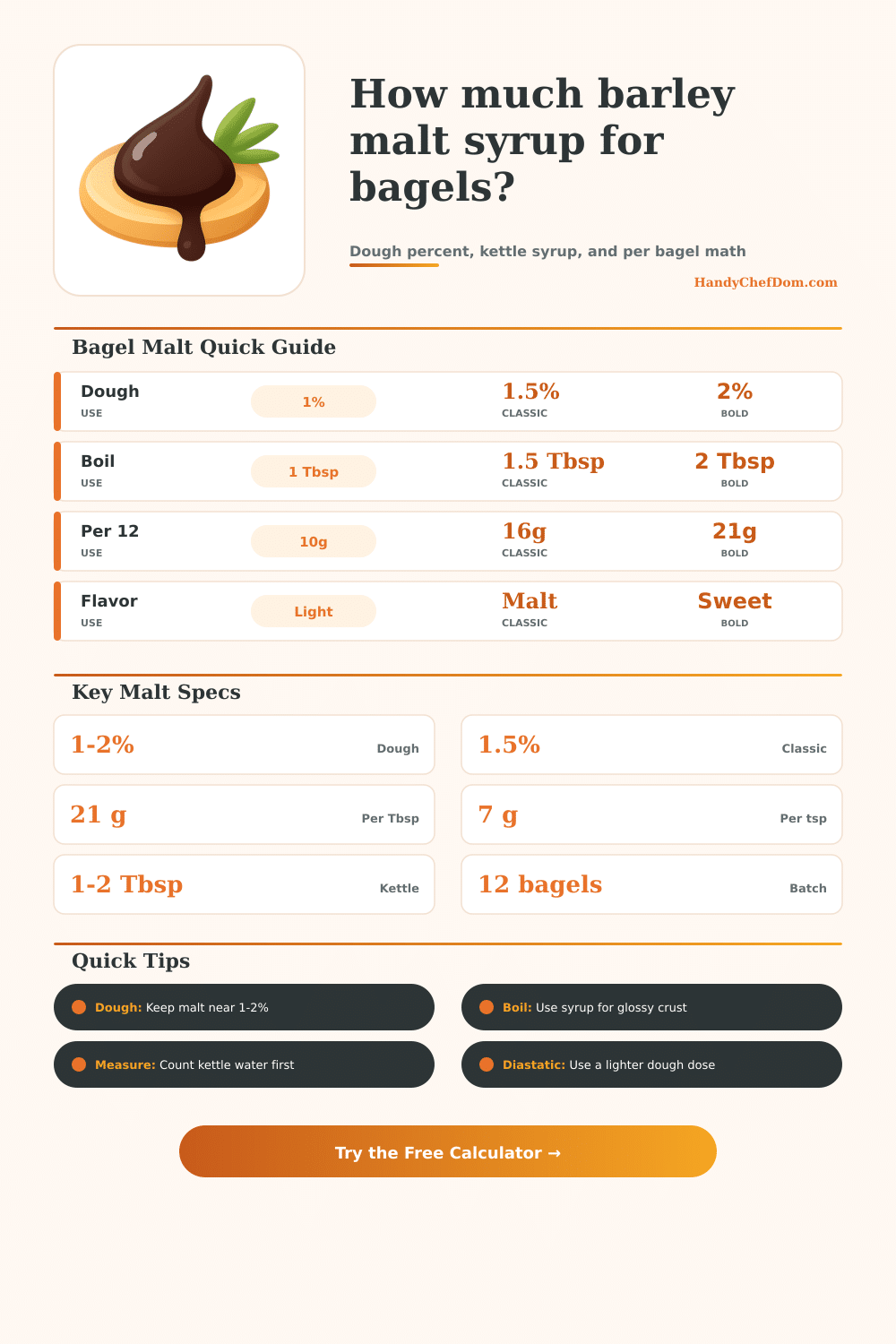
Barley Malt Syrup for Bagels Calculator
Estimate malt syrup for bagel dough and boiling water from flour weight, bagel count, sweetness target, and kettle volume.
🥖Bagel Batch Presets
⚖Enter Flour, Malt, and Kettle Details
Bagel Malt Results
📌Quick Malt Measures
📊Baker Percentage Reference
| Dough Target | Malt Syrup % | Flavor Effect | Best Use |
|---|---|---|---|
| Very subtle | 0.5% to 0.8% | Light color, mild sweetness | Lean dough or diastatic malt choice |
| Light classic | 1.0% | Noticeable malt without much sweetness | Everyday bagels |
| Balanced classic | 1.5% | Round malt flavor and better browning | Most home bagel batches |
| Bold sweet crust | 2.0% | Deeper color and more sweetness | Sweet-leaning bagels |
| Test batch only | 2.5%+ | Can feel sticky or too sweet | Small trials before scaling |
🍞Syrup Weights by Flour Amount
| Flour Weight | 1% Dough Malt | 1.5% Dough Malt | 2% Dough Malt |
|---|---|---|---|
| 500 g flour | 5 g / 0.25 Tbsp | 7.5 g / 0.36 Tbsp | 10 g / 0.48 Tbsp |
| 750 g flour | 7.5 g / 0.36 Tbsp | 11 g / 0.54 Tbsp | 15 g / 0.71 Tbsp |
| 1000 g flour | 10 g / 0.48 Tbsp | 15 g / 0.71 Tbsp | 20 g / 0.95 Tbsp |
| 1500 g flour | 15 g / 0.71 Tbsp | 23 g / 1.07 Tbsp | 30 g / 1.43 Tbsp |
| 2000 g flour | 20 g / 0.95 Tbsp | 30 g / 1.43 Tbsp | 40 g / 1.90 Tbsp |
💧Kettle Ratio Table
| Kettle Water | Light 1 Tbsp/qt | Classic 1.5 Tbsp/qt | Bold 2 Tbsp/qt |
|---|---|---|---|
| 2 qt / 1.9 L | 2 Tbsp / 42 g | 3 Tbsp / 63 g | 4 Tbsp / 84 g |
| 3 qt / 2.8 L | 3 Tbsp / 63 g | 4.5 Tbsp / 95 g | 6 Tbsp / 126 g |
| 4 qt / 3.8 L | 4 Tbsp / 84 g | 6 Tbsp / 126 g | 8 Tbsp / 168 g |
| 6 qt / 5.7 L | 6 Tbsp / 126 g | 9 Tbsp / 189 g | 12 Tbsp / 252 g |
| 8 qt / 7.6 L | 8 Tbsp / 168 g | 12 Tbsp / 252 g | 16 Tbsp / 336 g |
🍯Sweetener Comparison Grid
🧪Sweetener Comparison Table
| Sweetener | Dough Swap by Weight | Kettle Use | Bagel Result |
|---|---|---|---|
| Barley malt syrup | Use calculator amount | 1 to 2 Tbsp per quart | Classic malty crust and color |
| Honey | Use equal weight | 1 to 2 Tbsp per quart | Sweeter aroma, lighter malt note |
| Brown sugar | Use 80% of syrup weight | 1 to 2 Tbsp per quart | Sweet crust without syrup texture |
| Molasses | Use 50% to 70% of syrup weight | 0.5 to 1 Tbsp per quart | Darker color and stronger flavor |
| Diastatic malt powder | Use 0.3% to 1% of flour | Not the usual kettle choice | Enzyme activity, less syrup sweetness |
💡Bagel Malt Tips
Barley malt syrup is one of the primary ingredient in bagel production. Barley malt syrup is responsible for the color and flavor of the bagel. Barley malt syrup affect the color of the crust of the bagel, and barley malt syrup also affects the flavor of the bagel dough.
When making bagels, a baker must decide how many barley malt syrup to add to the dough and how much barley malt syrup to add to the boiling water in the kettle. The calculator that is available to assist in determining these amounts use parameters like the weight of the flour that will be used, the desired sweetness level of the bagel, and the size of the kettle to determine the amount of barley malt syrup that should be used. Using such a calculator is helpful for bagel makers because it can save them the guesswork of adding too much or too little barley malt syrup to the bagel dough or boiling water; using the calculator also prevents potential error caused by using general measurements like tablespoons of syrup.
How to Use Barley Malt Syrup for Bagels
Barley malt syrup perform two different function in the bagel making process. First, a baker adds barley malt syrup to the bagel dough, and the barley malt syrup in the dough affect the fermentation of the bagel and the browning of the bagel. The barley malt syrup in the bagel dough contribute to the sweetness of the bagel crumb, and also contributes to the dark color of the bagel crust after baking.
Second, the baker adds the barley malt syrup to the boiling water in the kettle in which the bagels will be boiled, and the barley malt syrup in the boiling water create a shine on the bagels surface and create a chewiness in the crust of the bagel. Because the function of the barley malt syrup are different in each of these steps in the bagel making process, the amount of barley malt syrup that is used must be measured differently in each step. If the amount of barley malt syrup in the bagel dough and the amount in the boiling water in the kettle is treated as the same ingredient in the bagel making process, bagels may end up with the wrong color or being too sweet.
The amount of barley malt syrup that is contained within the bagel dough is an important factor in many bagel recipes. The amount of barley malt syrup in the dough impact the sweetness of the bagel; increasing the amount of barley malt syrup will make the bagel taste significantly sweeter. Therefore, bakers must pay attention to the setting that control the target sweetness of the bagels according to the recipe calculator.
Additionally, adding more barley malt syrup to the bagel dough will also make the bagel dough more sticky; this impact the way in which the bagel dough should be shaped. The amount of barley malt syrup that is added to the boiling water in the kettle is determined by the volume of the water, while the weight of the bagel flour determines the amount of barley malt syrup in the bagel dough. These two measurement should be kept separate in the bagel making process so that the flavor and texture of the bagels can be adjusted.
It is also necessary to be able to distinguish between two different type of barley malt syrup: non-diastatic barley malt syrup and diastatic barley malt syrup. Non-diastatic barley malt syrup is used in bagel recipes to provide flavor and color to the bagel; diastatic barley malt syrup contain enzymes that allow for the softening of the bagel dough. If large amount of diastatic malt syrup is added to the bagel dough, the texture of the bagel may be affected.
For these reasons, most traditional bagel recipes use non-diastatic barley malt syrup. The bagel recipe calculator allow the baker to select the type of barley malt syrup that they will use in their recipe. Based on the type of syrup that is selected, the calculator ensure that the measurements for that type of syrup will be provided.
Many people make mistake when measuring the amount of barley malt syrup for bagels. For example, many people use visual estimation of the amount of syrup to be added to the boiling water in the kettle, or they use the same spoon to add the syrup to both the bagel dough and the boiling water; these methods often result in adding too much barley malt syrup to the bagels. Additionally, many people dont remember to adjust the amount of barley malt syrup according to the size of the batch of bagels that they are making; people tend to ignore the need to scale the recipe.
Therefore, the recipe calculator should of been used each time that the batch size is changed; the calculator will ensure that the amount of barley malt syrup that is used in the bagel recipe is always correct according to the amount of bagel flour that will be used. While the bagel recipe calculator will provide bakers with a reliable starting point in the bagel making process, there are some adjustment that can be made manually to the recipe. For instance, knowing how the flour and the oven will react to different amount of barley malt syrup will allow bakers to make small adjustments.
The most important factor to remember in making good bagels is maintaining correct amount of barley malt syrup in both the bagel dough and in the boiling water in the kettle. When both of these ingredients are correct in the bagel making process, the bagels will have a consistent flavor and color.