🍞 Rosemary Sourdough Bread Calculator
Estimate fresh or dried rosemary for sourdough bread from flour weight, loaf count, bread style, flavor intensity, hydration, salt level, and inclusion timing.
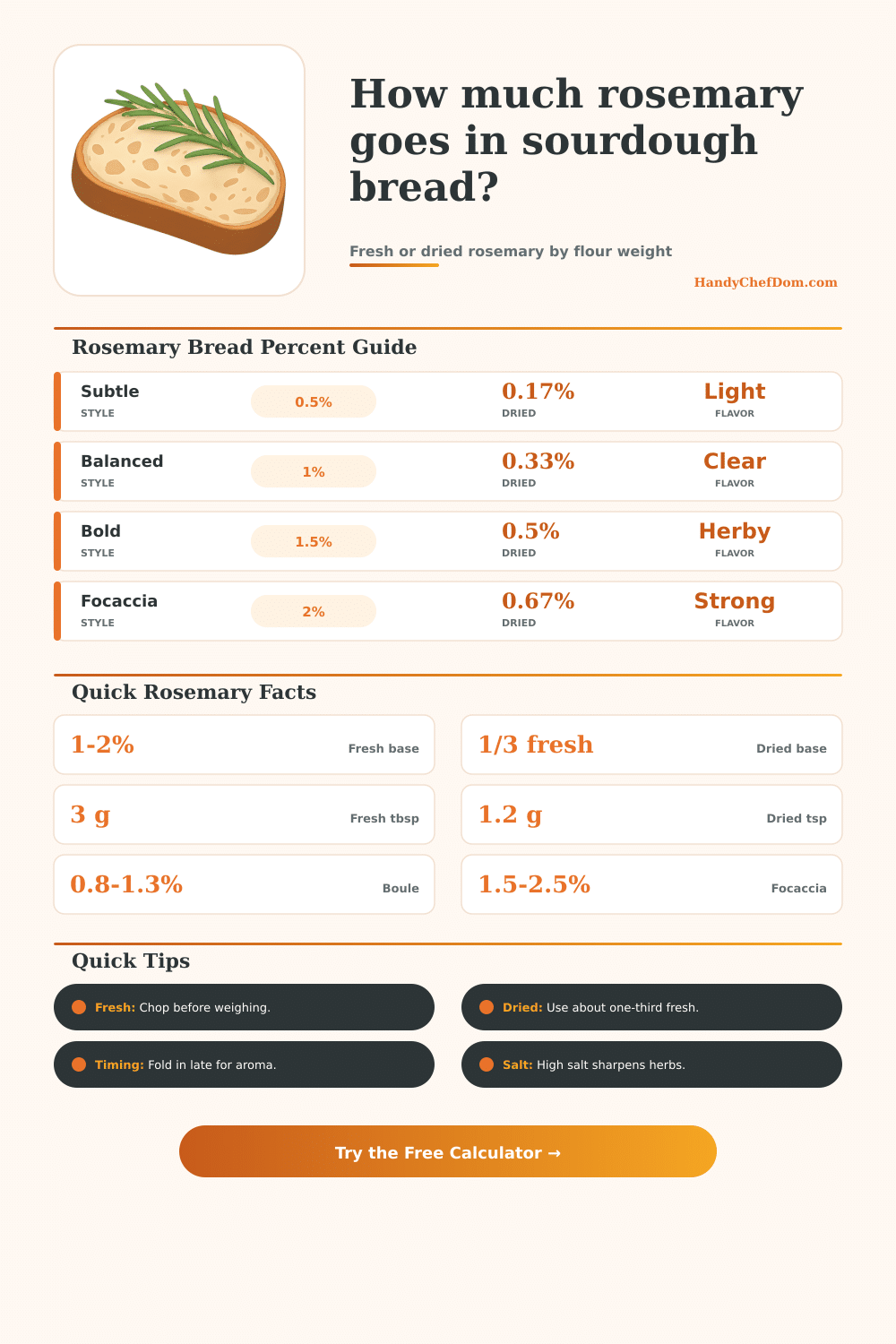
For noticeable rosemary sourdough, fresh rosemary often lands around 1% to 2% of flour weight. Dried rosemary is stronger by volume, so use about one-third of the fresh spoon volume.
| Rosemary Form | Working Density | Flavor Strength | Best Bread Use |
|---|---|---|---|
| Fresh chopped rosemary | About 3 g per tablespoon | Green, aromatic, rounded | Best default for sourdough boule or focaccia dough |
| Dried rosemary leaves | About 1 g per teaspoon | Woody and concentrated | Crush lightly before mixing so needles do not feel sharp |
| Crushed dried rosemary | About 1.2 g per teaspoon | Even, strong, easy to dose | Good dried equivalent when fresh rosemary is unavailable |
| Fine rosemary powder | About 1.5 g per teaspoon | Very fast release | Use sparingly because it can dominate the crumb |
| Rosemary surface topping | Measure separately from dough | Strong first aroma | Useful for focaccia, especially with olive oil and salt |
| Fresh Rosemary Percent | Dried Equivalent Percent | Flavor Result | When To Use |
|---|---|---|---|
| 0.3% to 0.5% | 0.10% to 0.17% | Gentle background herbal note | Plain sandwich loaves or first tests |
| 0.6% to 0.9% | 0.20% to 0.30% | Mild but noticeable aroma | Country sourdough with cheese, olive oil, or garlic |
| 1.0% to 1.4% | 0.33% to 0.47% | Balanced rosemary flavor | Classic rosemary sourdough boule or batard |
| 1.5% to 2.0% | 0.50% to 0.67% | Bold herb-forward bread | Focaccia, olive loaves, or strongly flavored dough |
| 2.1% to 2.8% | 0.70% to 0.93% | Very pronounced rosemary | Use carefully for sheet-pan bread or rosemary lovers |
| Bread Style | Fresh Rosemary Range | Hydration Clue | Timing Recommendation |
|---|---|---|---|
| Free-form sourdough boule | 0.8% to 1.4% | 68% to 78% hydration | Fold in after the first rest for cleaner aroma |
| Batard or sandwich-style loaf | 0.6% to 1.2% | 64% to 74% hydration | Mix in gently or add during early folds |
| Focaccia or sheet-pan sourdough | 1.4% to 2.5% | 75% to 95% hydration | Use some in dough and some on top if desired |
| Mini loaves or rolls | 0.7% to 1.3% | 62% to 72% hydration | Chop fine so small pieces taste evenly seasoned |
| Olive rosemary dough | 0.9% to 1.6% | 70% to 82% hydration | Add olives and rosemary together during folds |
| Herb | Typical Fresh Baker Percent | Dried Conversion | Bread Flavor Note |
|---|---|---|---|
| Rosemary | 1% to 2% | About one-third fresh volume | Piney, savory, strong with salt and olive oil |
| Thyme | 0.5% to 1% | About one-third fresh volume | Earthy and gentle in lean sourdough |
| Oregano | 0.5% to 1% | About one-third fresh volume | Assertive Mediterranean aroma, good with tomato |
| Basil | 1% to 2% | Dried is less bright | Better in enriched or oil-rich dough than lean bread |
| Sage | 0.3% to 0.8% | Use lightly when dried | Can become bitter if pushed too high |
A rosemary sourdough bread calculator are a tool that will help you determine the amount of rosemary to add to your sourdough bread recipe. Using a rosemary sourdough bread calculator is useful because it will turn all of the different variable into the specific amount of rosemary that your sourdough bread recipe require. If you dont use a sourdough bread calculator, you may have to guess the amount of rosemary to add to your sourdough bread recipe.
Adding the wrong amount of rosemary to your sourdough bread will lead to incorrect flavor result from your sourdough bread recipe. There are many different variables that you will have to enter into the calculator to determine the correct amount of rosemary to add to your sourdough bread. The first of these variables will be the weight of the flour that will be used in the sourdough bread.
How to Use a Rosemary Sourdough Calculator
The number of loaves of sourdough bread that will be baked are another variable. The flavor intensity that you would like in your sourdough bread is another variable. The hydration levels and the salt levels of the sourdough bread recipe is also variables.
Finally, the time at which the rosemary is to be added to the sourdough bread is the final variable. The reference tables will show how much rosemary to add to different types of bread. These tables will show how much fresh rosemary to use versus dried rosemary.
These tables will also show how different types of bread requires different amounts of rosemary. For example, country boule bread will require a different amount of rosemary than sheet pan focaccia bread. The sourdough bread calculator will make the mathematical calculations of the amount of rosemary to add to sourdough bread once you have chosen the type of bread you would like to make, the flavor intensity, and the timing of the addition of the rosemary to the sourdough bread.
You can use a sourdough sourdough bread calculator to calculate the amount of rosemary that is needed for a mild boule sourdough bread or a high hydration focaccia sourdough bread. It is easy for many individuals to make mistakes when adding rosemary to there sourdough bread recipe. Adding too much rosemary to sourdough bread can result in the crumb portion of the sourdough bread having a resinous taste.
Adding too much rosemary can also cause the crust portion of the sourdough bread to brown unevenly during the baking process. Fresh rosemary is much more strong than dried rosemary. This is because fresh rosemary contains essential oils that will be released during the baking process.
Many bread recipes do not state whether they use fresh or dried rosemary. This ambiguity in many bread recipes causes people to either add too much or too little rosemary to the sourdough bread. Another mistake that people make is in the timing of the addition of the rosemary to the sourdough bread.
If the rosemary is added at the beginning of the sourdough bread recipe and the dough is kneaded, the rosemary may bruise. This will give the sourdough bread a harsh aroma and taste. The baker should fold the chopped rosemary into the sourdough dough during the first or second set of stretches of the dough.
This will preserve the rosemary aroma. The sourdough bread calculator allows the baker to select when to add the rosemary to the dough. This selection will change the amount of rosemary that is calculated for the sourdough bread recipe.
The salt levels of sourdough bread can change how the rosemary taste in the sourdough bread. High salt levels will make a small amount of rosemary taste stronger. Low salt levels will require a higher percentage of rosemary to the sourdough dough so that the flavor of the rosemary can be tasted.
The sourdough bread calculator flags these differences so that the amount of rosemary calculated takes into account the salt level and hydration levels of the sourdough bread. Finally, the type of sourdough bread that will be baked will change the amount of rosemary that is required for the recipe. For instance, the type of bread that is baked will change the type of crumb that is baked.
Free form sourdough boules will have a tight crumb to them. This makes the rosemary taste more stronger in these types of sourdough bread. Focaccia bread will have a less pronounced amount of rosemary in the sourdough bread.
The size of the sourdough bread will also change the amount of rosemary that is required for these recipe. Small loaves of sourdough bread will require the rosemary to be chopped into finer pieces so that the rosemary does not dominate each bite of the loaf of sourdough bread. These trade-offs are made visible to the baker when the sourdough bread calculator is used to select the type of sourdough bread and the hydration levels of the sourdough recipe.
Using a sourdough bread calculator and determining the amount of rosemary that is required for a sourdough bread recipe allows the baker to stop treating rosemary as an optional flourish in sourdough bread and to start treating it as an essential ingredient in the sourdough formula. By treating the sourdough formula as a formula, it is possible to see how the amount of salt or the amount of rosemary will change the percentage of rosemary in the sourdough bread that will taste good to the baker. Using a sourdough bread calculator will train the baker’s judgment skill over time.
Eventually, the baker will develop enough judgment skills to know when to use a scale to weigh the amount of rosemary, when to fold the chopped rosemary into the sourdough bread dough, and when to taste the sourdough bread dough. You’ll find that it should of helped you avoid errors. It’s important to do this naturaly so you dont ruin teh bread.
You’re goal is a perfect loaf. This is actualy alot of work. Use the calcualtor for better results.
There is many ways to improve. One of the ways is to use a moddern scale. A armchair is not needed, just a scale.
One can absorbs more flavor if you do it right. The recipe’s outcome depends on it. A extra bit of rosemary might be too much.
Just dont make mistakes. It is better than having a bad loaf. One must of known that.
Its important. The sourdoughs flavor will be better.