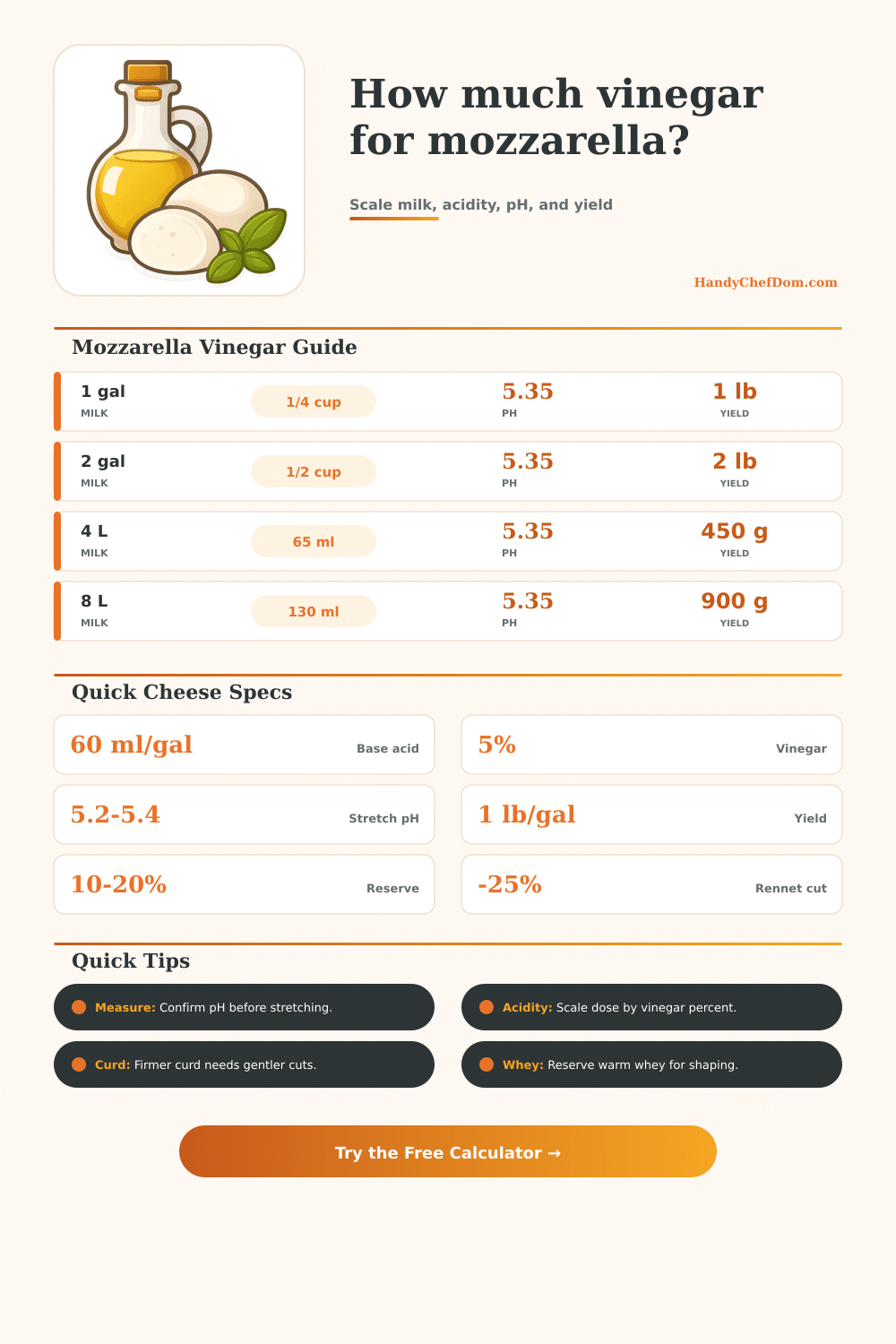
Vinegar to Make Mozzarella Cheese Calculator
Estimate vinegar dose from milk volume, vinegar acidity, target pH, curd firmness, method, mozzarella style, yield, and whey reserve.
This calculator gives a planning estimate for direct-acid mozzarella. Vinegar strength and milk solids vary, so use the result as a starting dose and confirm the actual curd pH with a meter or strips.
| Vinegar Acidity | Use For 1 Gallon Milk | Use For 4 Liters Milk | Planning Note |
|---|---|---|---|
| 4 percent mild vinegar | 75 ml / 5 tbsp | 79 ml | Needs more volume because the acid is weaker. |
| 5 percent standard vinegar | 60 ml / 1/4 cup | 63 ml | Default reference point for most kitchen vinegar. |
| 6 percent stronger vinegar | 50 ml / 3 tbsp plus 1 tsp | 53 ml | Measure carefully because the dose changes quickly. |
| 8 percent pickling vinegar | 38 ml / 2 1/2 tbsp | 39 ml | Often too sharp unless added in smaller increments. |
| 10 percent strong vinegar | 30 ml / 2 tbsp | 32 ml | Use only if the label clearly states the acidity. |
| Milk Profile | Expected Yield Per Gallon | Curd Behavior | Calculator Adjustment |
|---|---|---|---|
| Whole cow milk | 0.95 to 1.15 lb | Balanced curd and moisture | Baseline yield and acid dose. |
| High-protein milk | 1.10 to 1.30 lb | More curd solids | Raises yield and firmness score. |
| Jersey or rich milk | 1.20 to 1.40 lb | Richer curd, more fat retention | Raises yield and may need a small acid buffer. |
| 2 percent milk | 0.75 to 0.95 lb | Leaner and less plush | Lowers yield and firmness expectation. |
| Goat milk | 0.65 to 0.90 lb | Softer, smaller curd | Lowers firmness and yield estimate. |
| Weak-setting milk | 0.70 to 0.95 lb | Fragile curd break | Adds a small dose buffer but flags pH testing. |
| Estimated pH | Curd Feel | Stretch Planning | Practical Use |
|---|---|---|---|
| 5.65 to 5.85 | Soft, high moisture | May resist clean stretch | Useful for holding curd before final acid check. |
| 5.40 to 5.60 | Medium soft | Gentle stretch window | Good for fresh balls when texture is more tender. |
| 5.20 to 5.40 | Classic mozzarella zone | Best stretch planning range | Common target for direct-acid mozzarella. |
| 5.05 to 5.20 | Firm and tangier | Can tighten quickly | Better for drier block style if monitored. |
| Below 5.05 | Over-acid risk | Stretch may become brittle | Reduce acid next batch and verify measurement. |
| Style | Method Fit | Reserve Whey | Yield Note |
|---|---|---|---|
| Fresh ball mozzarella | Direct acid or rennet assisted | 10 to 18 percent | Moist, rounded yield with moderate drain loss. |
| Bocconcini or pearls | Direct acid, tender curd | 15 to 22 percent | Small shapes lose a little more during handling. |
| Drier pizza-style block | Rennet assisted or firm acid set | 8 to 14 percent | Lower moisture means lower finished weight. |
| Braid or rope shape | Classic stretch pH | 12 to 20 percent | Needs enough warm whey for repeated shaping. |
| Curd-only holding batch | Rennet assisted works well | 18 to 30 percent | Reserve more whey because final shaping is later. |
Until now, home cheesemaking was an exercise in guesswork, particularly if you were attempting to achieve just the right level of acidity with vinegar. If there’s not enough acid, your milk protein won’t form a stretchy curd; too much and you’ll have grainy, sour cheese. Enter the calculator up top, which will help you determine that fine balance without having to spend hours tinkering.
Each of those goes into tool because it alters the amount of acid that actualy makes its way to the milk. The type of milks matters. Richer milks with more protein create more curd, altering behavior of the same dose of vinegar. The strength of the vinegar also plays a role in math. Standard vinegar solutions are at five percent. If you want higher acidity, you can use a smaller amount of strong vinegar to achieve the same thing. The calculator adjusts the dose based off the number you choose.
How to Use the Cheese Calculator
The choice of method changes things again. If you’re doing a batch directly acidified, then you’ll take a full dose. With the rennet-assisted recipes, the enzyme will do some of work toward forming the curd; you don’t need as much vinegar to get to the stretch zone.
What about target pH? That’s the one we’re all keeping our eye on. If the curd isn’t stretching at all, the answer lies in the pH. The classic window is 5.2-5.4. The calculator calculates how close your batch should of be, but also lets you know that the true test comes when the curd is ready and you use strips or a meter to check.
How do the style you choose and your firmness setting affects this? A drier style, like a pizza block, needs extra drainage time and a little more acidity. A firmer curd will need similar things. In contrast, a soft fresh ball wants to keep some moisture and stretch gently when finished.
But even beyond precision, the yield estimate lets you plan. You can see how many batch could fit into a given day and if it makes sense to bother with this batch on a busy day. How much cheese do I expect to recieve per gallon of milk? The whey reserve estimate serves as a kind of safety net. It allows you to save some of the still-warm whey in case you want to shape and salt again, such as when repeatedly handling your little braid or small shapes.
That’s why there is also this table of reference on the page, vinegar isn’t always exactly as acidic as it should be, nor is milk ever identical in solids. There is a table that explains how different vinegar strengths affect the resulting volume. Another table covers the milk profile to show what kind of yield to expect. It’s not a rule so much as a starting point, if your vinegar/milk varies from batch to batch.
The most common errors arise when people skip checking the pH or rush the acid addition. You can overdo it by adding all the acid at once, or you might not have time to stretch out as clean because the curds has already tightened up. Better to use less acid, stir thoroughly and test first, then add more if necessary on the way to final stretch.
Same goes for those using rennet, which will do some of work for you, so that you just need enough vinegar to nudge the pH into range. Direct-acid mozzarella can be made with some pretty good results just plugging your inputs into the calculator. That’s the easy part.
Knowing what adjustments to make along the way… Based on how the curds are reading instead of following some target number, that take practice. But then it becomes less guessing and more: I know this combination will do that so I’ll do it again.