🍮 Cornstarch to Thicken Pudding Calculator
Estimate cornstarch tablespoons and grams for pudding by milk cups, egg yolks, sugar, cocoa, fruit puree, target set, serving size, chill time, and slurry liquid.
Use automatic starch mode for a formula-based recommendation, or enter a planned cornstarch amount to test whether it will set softly, spoonably, or firmly after chilling.
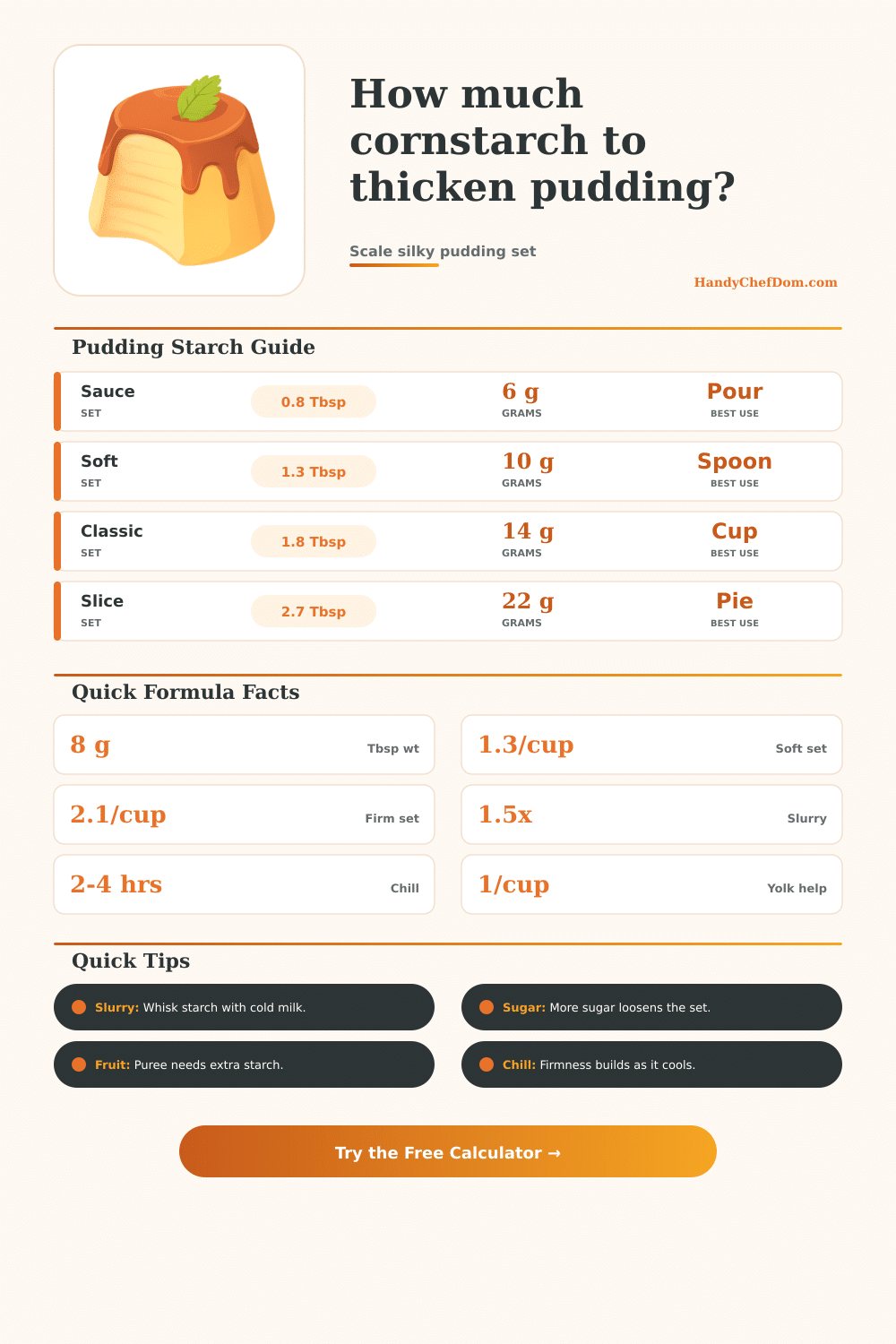
| Target Set | Base Cornstarch Rate | Approx Grams Per Cup | Best Dessert Use |
|---|---|---|---|
| Pourable dessert sauce | 0.70 to 0.90 tbsp per cup | 5.6 g to 7.2 g | Warm vanilla sauce, fruit drizzle, loose custard |
| Soft spoon pudding | 1.10 to 1.40 tbsp per cup | 8.8 g to 11.2 g | Delicate chilled cups with egg yolks or cream |
| Classic pudding cup | 1.55 to 1.95 tbsp per cup | 12.4 g to 15.6 g | Everyday pudding that mounds on a spoon |
| Firm layered pudding | 1.90 to 2.35 tbsp per cup | 15.2 g to 18.8 g | Banana pudding, parfait layers, trifle cups |
| Pipeable pastry cream | 2.15 to 2.65 tbsp per cup | 17.2 g to 21.2 g | Filling that holds ridges after cooling |
| Sliceable cream pie | 2.45 to 3.05 tbsp per cup | 19.6 g to 24.4 g | Pie filling that cuts with a firmer edge |
| Formula Factor | Typical Adjustment | Why It Matters | Calculator Treatment |
|---|---|---|---|
| Egg yolks | Reduce starch up to about 18% | Yolk proteins thicken custard as heat sets them | Counts yolks per milk cup and trims starch gently |
| Sugar above 1/6 cup per cup milk | Add about 4% to 14% | Sugar ties up water and softens the gel | Raises starch when sugar load is high |
| Cocoa powder | Reduce 0% to 6% for dry absorption | Cocoa solids make chocolate pudding feel denser | Offsets a small part of the starch need |
| Fruit puree or juice | Add about 8% to 35% | Extra water and acid weaken cornstarch structure | Uses fruit amount and fruit type multiplier |
| Short chill time | Add about 4% to 14% | Pudding keeps firming after it cools | Boosts starch if chill time is below target |
| Cream-rich base | Reduce feel by 2% to 5% | Fat gives a thicker mouthfeel even with less starch | Adjusts the final set score and cue |
| Milk Base | Soft Pudding | Classic Pudding | Sliceable Filling |
|---|---|---|---|
| 1 cup milk | 1.25 tbsp / 10 g | 1.75 tbsp / 14 g | 2.70 tbsp / 21.6 g |
| 2 cups milk | 2.50 tbsp / 20 g | 3.50 tbsp / 28 g | 5.40 tbsp / 43.2 g |
| 3 cups milk | 3.75 tbsp / 30 g | 5.25 tbsp / 42 g | 8.10 tbsp / 64.8 g |
| 4 cups milk | 5.00 tbsp / 40 g | 7.00 tbsp / 56 g | 10.80 tbsp / 86.4 g |
| 6 cups milk | 7.50 tbsp / 60 g | 10.50 tbsp / 84 g | 16.20 tbsp / 129.6 g |
| 8 cups milk | 10.00 tbsp / 80 g | 14.00 tbsp / 112 g | 21.60 tbsp / 172.8 g |
| Cornstarch Measure | Approx Grams | Slurry Liquid Range | Kitchen Note |
|---|---|---|---|
| 1 teaspoon | 2.7 g | 1 to 2 teaspoons | Useful for tiny sauce corrections |
| 1 tablespoon | 8 g | 1.5 to 2 tablespoons | Whisk smooth before adding to hot milk |
| 1/4 cup | 32 g | 6 to 8 tablespoons | Enough for many 2 to 3 cup puddings |
| 1/3 cup | 43 g | 8 to 10 tablespoons | Common for firmer cream pie fillings |
| 1/2 cup | 64 g | 12 to 16 tablespoons | Large batch or tray pudding amount |
| 100 grams | 12.5 tbsp | 19 to 25 tablespoons | Best measured by scale for repeat batches |
With a correct amount of cornstarch for pudding, it goes into set nicely. But not every ingredient are the same, so how much you need isnt an exact science; it’s based off what else you’re putting in the bowl.
Sugar. Cocoa. Fruit. Egg yolks. Chill time. Volume of milk. All these factors affect final product. That’s where calculator comes in. Just plug those variables into the thing up top. Then, you won’t have to guess if your next attempt will be too runny to set or hold together.
How to Choose the Right Amount of Starch
Keep in mind that it’s all about liquid base. Most recipes begins with some milk (or a combination of milks), and the key is that you has to match the starch to every additional cup of liquid you use. But this isn’t an exact one-to-one ratio; using fruit will also add water and acid that may weakens the starch network, and adding sugar will loosen the gel by competing for water. I built the math to account for these competing factors so you don’t blindly increase your starch and wonder why results is gluey.
Egg yolks adds their own structure through heat-set proteins. So when you back off on starch because it’s firmer, you have that other source of structure to lean on. This is another trade-off a lot of cooks don’t consider, so they puts in all the starch regardless. You get a dish with more heft then desired. The tool takes into account how many yolk there are per cup of milk and reduces the starch by that amount, so you know exactly what the set will feel like.
Chill time matter more than most recipes admit. After coming off of stove, starch gels keep getting firmer over several hours. This means a recipe needs just a little bit more starch if your chill time is shorter then normal to have enough body when stirred onto a spoon. But wait too long… Overnight; and what was barely thickening on the stove turns out nice and sliceable. That’s why the calculator accounts for this in its recommendation instead of making you guess if four hours would of been sufficient.
The question then becomes: With your quantity of starch, what will it be put into? Hot liquid turns cornstarch to lumpy glop; generally most cooks make a slurry by whisking some cornstarch with a little cold water or milk before adding it to whatever they are making. Because of this, we provide a range for amount of slurry needed for the total starch being used. This ensures the mixture is neither under- nor over-diluted. No matter where you fall within that range, you will end up with something that is not too thick, but also does not have lumps from having to little liquid.
From there, the numbers goes into the reference tables on the page where various desired final consistencies (or “textures”) translate to cups of starch. The ranges allow you to choose between a firm filling that’ll cut cleanly in a wedge; a soft, spoonable dessert meant to be eaten from a cup; and a thinner consistency good as a pour-over cake topping. It’s simple to tweak the amount depending on whether your guest wants something lighter, if they are traveling, or if you want to avoid pudding sloshing around during the trip. Having them all lined up side-by-side just helps.
But still: you have to watch and taste real batches. Very ripe fruit will push the texture one direction; cocoa the other. It can hide a bit of a soft set by adding dry bulk. The calculator is a reliabel starting point, but the only thing that counts is what hits your final spoonful. After a while, you will intuitively understand how each ingredient affect the starch levels, rather than having to run another experiment.