🍰 Baking Time Adjustment Calculator
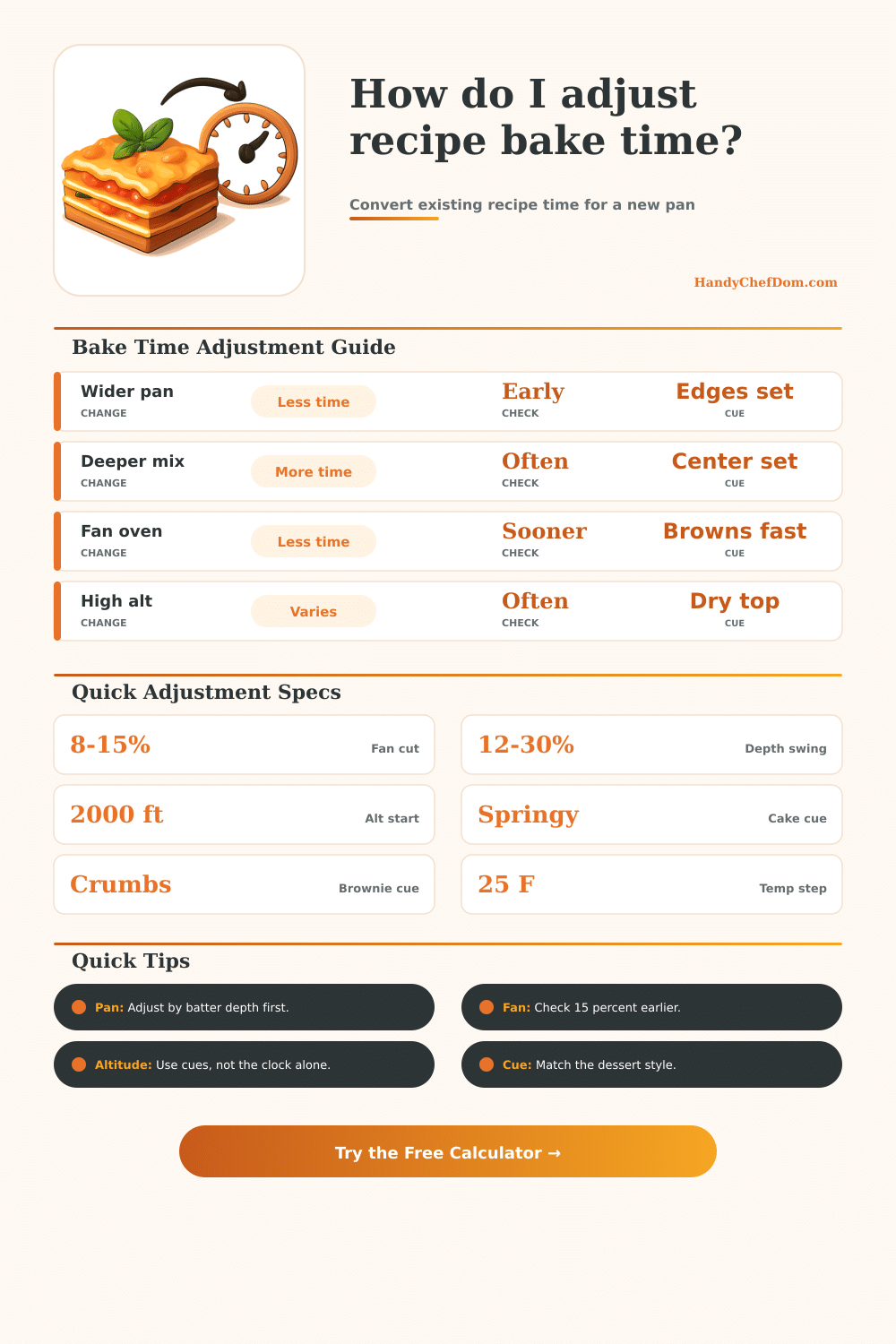
Start with a recipe bake time, then adjust it for a different pan, batter depth, oven temperature, convection, altitude, density, and doneness cue.
Use this when a recipe already gives a bake time but your pan, oven, or batter conditions changed. The calculator compares the original setup with the new setup instead of estimating from scratch.
| Pan Change | What Usually Happens | Time Direction | Best Cue |
|---|---|---|---|
| Same batter in wider pan | Batter becomes shallower with more exposed surface. | Shorter bake time | Edges set and center rebounds |
| Same batter in smaller pan | Batter becomes deeper and center sets later. | Longer bake time | Center no longer ripples |
| More batter in same pan | Depth increases and top may brown before center finishes. | Longer bake time | Thermometer or clean pick |
| Less batter in same pan | Thin layer sets quickly and dries if checked late. | Shorter bake time | Soft crumbs and set edges |
| Bundt or tube swap | Center tube removes mass but batter is often dense. | Moderate to longer | Cracked top and spring back |
| Cupcake conversion | Small portions heat fast from all sides. | Much shorter | Clean pick near center |
| Oven Or Pan Factor | Typical Adjustment | Use When | Watch For |
|---|---|---|---|
| 25 F hotter than recipe | About 7% to 10% less time | You need more lift or faster set | Edge browning |
| 25 F cooler than recipe | About 8% to 12% more time | You are protecting edges | Pale or slow center |
| Fan oven at same setting | About 12% less time | Convection temperature was not lowered | Fast surface browning |
| Fan oven already lowered | About 5% less time | You reduced the set point for fan baking | Dry edges |
| Dark metal pan | About 5% less time | Pan absorbs heat aggressively | Overdone sides |
| Glass or ceramic dish | About 6% to 10% more time | Dish heats slowly but holds heat | Late carryover heat |
| Batter Density | Calculator Bias | Why It Matters | Doneness Cue |
|---|---|---|---|
| Light sponge | Slightly shorter | Airy batter sets quickly and can dry fast. | Light rebound |
| Medium cake | Baseline | Standard layer cake timing behavior. | Springy center |
| Brownies | Longer at equal depth | Sugar and fat slow a fully dry center. | Moist crumbs |
| Quick bread | Longer | Loaf depth and moisture hold heat back. | Cracked dome set |
| Cheesecake | Longer and gentler | Custard-style center should not fully dry out. | Gentle jiggle |
| Pound cake | Longest cake bias | Dense crumb needs slow center heat. | Clean skewer |
| Doneness Cue | Best For | Timing Bias | Stop When |
|---|---|---|---|
| Springy center | Layer cakes and snack cakes | Baseline | Top bounces back lightly |
| Clean toothpick | Cupcakes and simple cakes | Slightly earlier | Pick has no wet batter |
| Moist crumbs | Brownies and fudgy bars | Earlier than clean pick | Crumbs cling without wet streaks |
| Thermometer target | Deep cakes and loaves | Slightly longer | Center reaches target range |
| Gentle jiggle | Cheesecake and custard bakes | Longer and cautious | Outer ring set, center wobbles |
| Set cracked dome | Quick breads and pound cakes | Longer | Crack looks dry, sides pull slightly |
This calculator adjusts timing from recipe conditions. Ovens, pans, and batter formulas vary, so start checking at the suggested time and finish by the listed cue.
Baking results changes due to changes in the pan, the oven, and the tempurature of the batter. A recipe will often feature a specific time for bake and a specific temperature to which the oven should be set. However, if any variable other than the recipe itself are changed, the baking time indicated in the recipe will not be accurate.
Each of these variables can be accounted for in adjust the baking time for a given recipe. The shape and size of the pans can impact the baking time. Pans that is wider or that have thinner layers of batter will allow heat to reach the center of the baking pan more quickly than pans that are deeper or narrower.
How to Adjust Baking Time for Different Pans, Ovens and Batters
Thus, baked goods that is intended to cook more quickly in these pans may result in the center of the good cooking while the edges of the good cook too quick. Pans of deeper depths require more baking time to ensure that the center of the baked good cook to the same level of doneness as the edges. The depth of the batter is one of the most important variable in baking.
Increasing the depth of the batter by more than a quarter inch may require additional baking time to cook the center of the baking pan. A baking calculator can help to determine the new baking time for a given recipe. The oven temperature and the way in which the oven circulate heat may also impact baking results.
Increasing the oven temperature will decrease the baking time for the baking good; however, the increased heat may cause the edges of the baked good to cook more quickly than the center. Convection ovens circulates hot air around the food, which cooks the edges and the surface of the food more quickly than an oven that does not circulate hot air. Convection ovens often require the user to reduce the temperature of the oven to account for this increased rate of bake.
The rate at which hot air circulates in the oven may have an additional impact on the baking good; however, that variable is outside of the consideration of most baking recipes. The altitude at which the recipe is baked may also have an impact on baking results. Air pressure decreases with increasing altitude.
At altitudes above 2,000 feet, the lower air pressure allow moisture to exit the baking good at a faster rate. Additionally, the lower air pressure can impact how much the batter will rise. Baking goods made at higher altitude may have a dry top with a center that is not yet fully cooked.
The recipe of the batter may impact baking time. Batters that contain light ingredient, such as sponge cakes, will cook more quickly than batters that are designed to be more dense, such as brownies and pound cakes. Dense baking goods may appear to be undercooked when using the same cue as would be used for a cake that contains a light, sponge batter.
Batters that contain ingredients like cheese will require a different cue for doneness than baking goods that use flour, sugar, egg, and spices. Additionally, the temperature of the batter will impact baking time. Using a batter that is cold from the refrigerator will require more baking time than warming the batter prior to baking.
A baking calculator may use a multiplier to account for differences in batter recipes and temperatures. Each baking good may require a different cue to indicate when the baking good has cooked to the desired doneness. For instance, the springiness of the center of the cake can best judge the doneness of layer cakes.
Brownies should be cooked to the point where a toothpick removed from the middle of the pan will feature moist crumbs; too much baking will result in a brownie that is too cake-like. Cheesecake should be baked until it begins to jiggle slight in the center but the outer ring of the cake is set. Quick breads and pound cakes may be baked until the dome of the good is dry to the touch and the sides of the bread cake pull away from the pan.
Using the correct cue to indicate doneness is essential to the baking process; using the wrong cues will result in undercooked or overcooked goods. A reference table on the baking calculator may help to identify the correct cue to use for various baking good. There are many variable in the kitchen that may impact baking results.
A baking calculator may account for a number of variables, but others are difficult to account for. For instance, each oven may have slight differences in heat; dark pans may heat to cooking temperatures more quickly than light pans. Pans made of glass may retain heat even after the oven is turned off.
The hydration of the baking ingredients may change with the time of year. These variables may have an impact on baking results; however, they are beyond the scope of the baking calculator. Therefore, different individual may find success in baking a good to the same time; however, the baking calculator may only provide an estimation of the time required.
By following the process described in the baking calculator, many of these baking problems can be prevented. One suggestion is to check the baking good after 15% of the estimated baking time remains. Use the cues indicated for that particular baking good to determine when to remove it from the oven.
If the center of the good is still moving or the toothpick feature wet ingredients, add more baking time and re-check the good with the same cue. Following this process will allow for the development of baking intuition on the part of the bakers.