🍮 Gelatin for Panna Cotta Calculator
Calculate powdered or sheet gelatin for panna cotta using cream cups, milk cups, bloom strength, desired set, serving molds, chill time, sugar, dairy fat, and fruit layer load.
Enter the dairy base and service style. The calculator adjusts gelatin for cream-to-milk balance, gelatin bloom strength, sugar, dairy fat, fruit layer weight, mold depth, unmolding stress, and chill time.
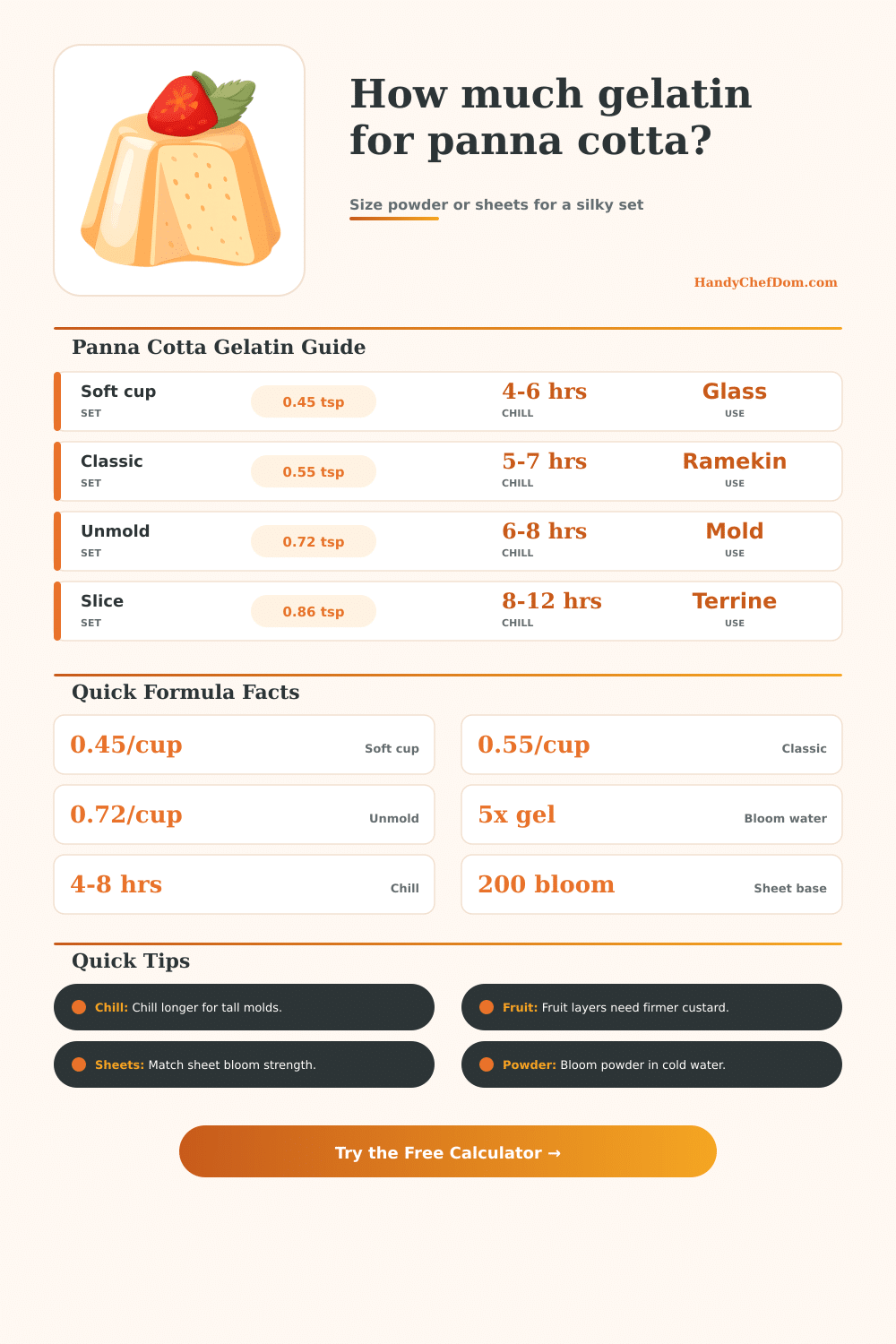
| Desired Set | Powder Rate at 200 Bloom | Best Mold Style | Texture Goal |
|---|---|---|---|
| Delicate spoon set | 0.40 to 0.50 tsp per cup dairy | Small glasses or dessert cups | Very soft, creamy, and barely holding. |
| Classic wobble set | 0.50 to 0.62 tsp per cup dairy | Ramekins and shallow molds | Silky wobble with a clean spoon edge. |
| Clean unmolded set | 0.66 to 0.78 tsp per cup dairy | Flexible molds or turned ramekins | Holds its shape without tasting bouncy. |
| Firm buffet set | 0.78 to 0.90 tsp per cup dairy | Transported cups or plated service | Stable under toppings and mild handling. |
| Sliceable terrine set | 0.86 to 1.00 tsp per cup dairy | Loaf molds and cut portions | Clean slice with a firmer custard feel. |
| Gelatin Type | Bloom Strength | Typical Weight | Calculator Conversion |
|---|---|---|---|
| Powdered gelatin | 200 bloom | 3.1 g per teaspoon | Baseline for home panna cotta formulas. |
| High-bloom powder | 225 bloom | 3.1 g per teaspoon | Uses less weight than standard powder. |
| Bronze sheet gelatin | 140 bloom | 3.3 g per sheet | Needs more weight because strength is lower. |
| Silver sheet gelatin | 160 bloom | 2.5 g per sheet | Reliable for soft custards and cup service. |
| Gold sheet gelatin | 200 bloom | 2.0 g per sheet | Direct strength match to the powder baseline. |
| Platinum sheet gelatin | 230 bloom | 1.7 g per sheet | Strong sheet option for small precise batches. |
| Dairy Batch | Soft Cup Set | Classic Set | Clean Unmold Set |
|---|---|---|---|
| 2 cups dairy | 0.90 tsp / 2.8 g | 1.10 tsp / 3.4 g | 1.44 tsp / 4.5 g |
| 3 cups dairy | 1.35 tsp / 4.2 g | 1.65 tsp / 5.1 g | 2.16 tsp / 6.7 g |
| 4 cups dairy | 1.80 tsp / 5.6 g | 2.20 tsp / 6.8 g | 2.88 tsp / 8.9 g |
| 6 cups dairy | 2.70 tsp / 8.4 g | 3.30 tsp / 10.2 g | 4.32 tsp / 13.4 g |
| 8 cups dairy | 3.60 tsp / 11.2 g | 4.40 tsp / 13.6 g | 5.76 tsp / 17.9 g |
| 10 cups dairy | 4.50 tsp / 14.0 g | 5.50 tsp / 17.1 g | 7.20 tsp / 22.3 g |
| Formula Factor | Typical Effect | Why It Matters | Calculator Treatment |
|---|---|---|---|
| More cream than milk | Add 0% to 8% | Rich fat softens perceived gel strength. | Uses cream share and selected dairy fat profile. |
| High sugar load | Add 0% to 10% | Sugar binds water and slows full set. | Calculates tablespoons sugar per cup dairy. |
| Short chill time | Add 4% to 18% | Gelatin keeps strengthening in the refrigerator. | Boosts rate below the target chill window. |
| Fruit topping load | Add 2% to 18% | Heavy or acidic toppings press on the custard. | Uses fruit ounces per mold and fruit type. |
| Unmolding stress | Add 0% to 16% | Turned custards need stronger edges. | Applies cup, plate, travel, or deep mold factors. |
| Acid or alcohol | Add 0% to 12% | Acid and alcohol weaken delicate gelatin structure. | Raises the set rate from tablespoons in custard. |
Panna cotta is a tricky dish; you have to know your setting agent as well as how it interact with other ingredients. Gelatin gives structure and holds all those ingredient together when they’re cold. If there’s not enough gelatin, the dish won’t come out of mold, or will slump over. With too much, it goes from silky to rubbery. It can be a finicky stuff. Many home cooks tinker with their recipe the first time around.
Milk and cream has their places, too: Milk sets the gelatin more solidly, while cream add fat, which will soften the finished texture. If you’re using more cream and less milk, for instance, use a little more gelatin so it firm up like milk-heavy version. Do the same with sugar, which slows rate at which the gel forms by helping bind some of water. Want your sugar-rich dessert to set up once unmolded? You’ll need to compensate in other ways.
Why Panna Cotta Needs Perfect Gelatin Amounts
It also depends on what type of gelatin you use. Gelatin come in both sheets and powder. Each has its own bloom strength, so using same weight of sheets as powder won’t yield identical results. The more bloom your gelatin is, the less gelatin it take to get the same set. When working with sheets, the way they absorb water during blooming affects how final mixture behaves, so the amount of liquid you use to soften them matter. All these little things are easy to forget when you realize one batch didn’t set, or set to hard.
There’s an additional variable: Fruit layers. Whether it’s a layer of fresh fruit atop the custard or a compote, weight and potential acidity of that fruit weakens the underlying gel. When you enter type and load of fruit in the calculator above, it does math for you so you don’t have to guess at how much added structure the base require.
Adding a little more gelatin is enough to keep it stable when the acid (in the form of citrus juice) or alcohol are simply folded into custard. The most important part: Chill time is no joke. Once your gelatin sets into dish-ready state, it keeps strengthening in fridge for hours. What tastes good at four hours will act different than eight. That said, you could of use slightly less gelatin overall if you allow more chill time before unmolding or serving a dessert. This extra time are crucial if you want to transport or serve panna cotta.
To see this in action, just look down at the reference table on the page. It explains it all: the types of mold match up with the expected amount of touching and handling. The type of set match up with the type of glassware being used. There is no need to turn anything out when using a delicate spoon set. Instead, use something firmer if serving buffet-style or filling a deeper, more luxurius mold that will be sitting around at room temperature for a while. Most texture issue can be solved before they even become an issue by matching your set style to your planned actual service style.
It took me some time before I realy understood those relationships. Now that I do, I don’t use them as a black box. Instead, I use them as a tool to play with my ideas. I tweak this and watch what happens, or tweak that and watch what happens. This helps me get a feel for what I truly need, based off my own preferences. That’s where the feedback loop come in. It turns one winning recipe into something repeatable and adjustable. You will know how to apply it to other fruit combos, other molds, or different schedules without having to reinvent the wheel each time.