🍷 Wine Making Sugar Calculator
Plan sugar additions for wine must by target ABV, current Brix or specific gravity, batch volume, sugar type, chaptalization cap, and step-feeding schedule.
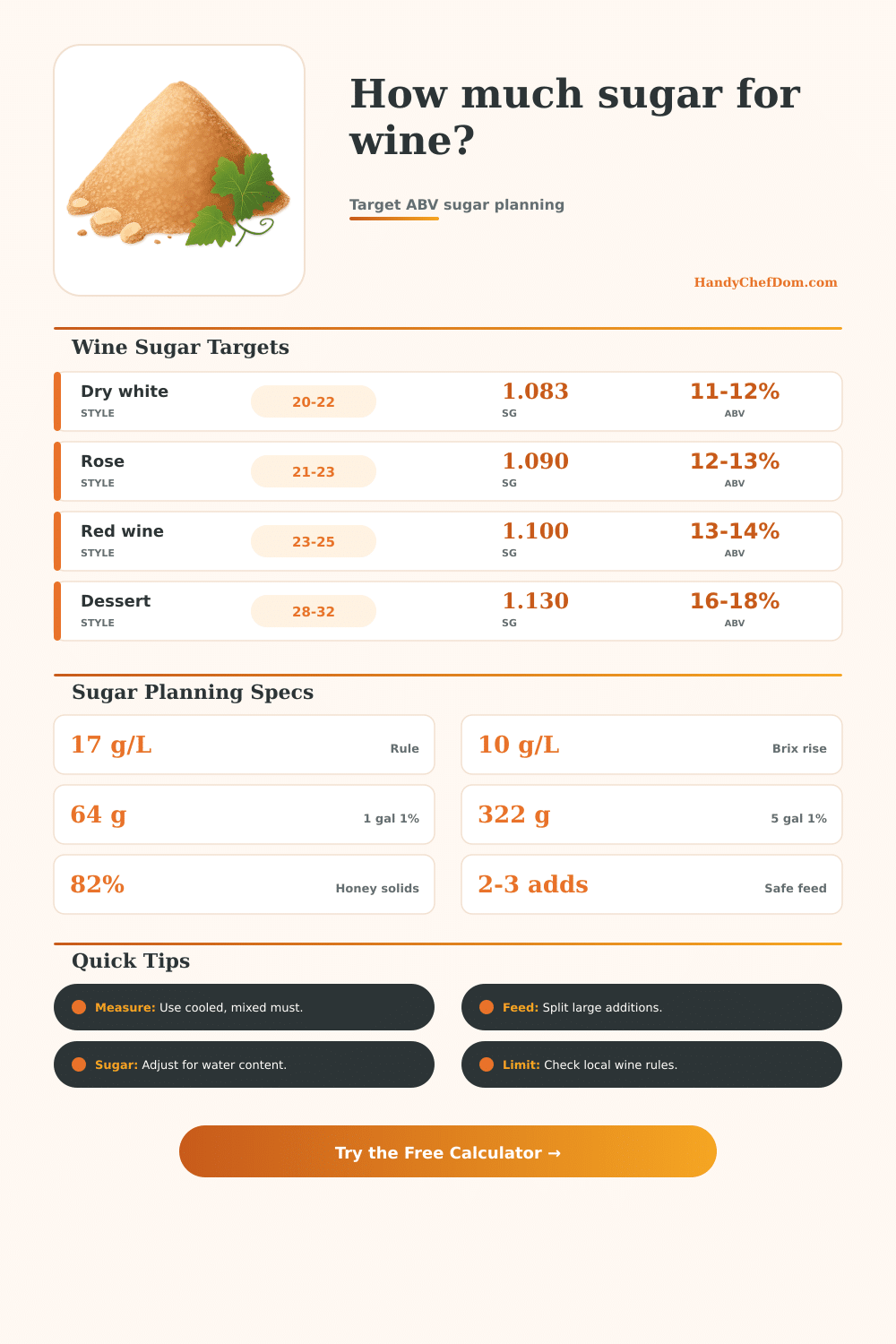
Use current must sugar and a target alcohol goal to estimate fermentable sugar, adjusted for sugar type and split into step feeds. The default planning rule is 17 g of fermentable sugar per liter for each 1% ABV increase.
| Wine target | Typical Brix | Approx SG | Potential ABV | Use cue |
|---|---|---|---|---|
| Light country wine | 18-20 | 1.074-1.083 | 10.5-11.8% | Fresh fruit |
| Dry white wine | 20-22 | 1.083-1.092 | 11.8-13.0% | Crisp table wine |
| Rose wine | 21-23 | 1.087-1.096 | 12.4-13.6% | Balanced blush |
| Light red wine | 22-24 | 1.092-1.101 | 13.0-14.2% | Pinot style |
| Bold red wine | 24-26 | 1.101-1.111 | 14.2-15.3% | Riper must |
| Dessert base | 28-32 | 1.121-1.142 | 16.5-18.9% | Feed slowly |
| Fermentable sugar goal | Per liter | 1 gallon batch | 5 gallon batch | 19 liter batch |
|---|---|---|---|---|
| Raise 0.5% ABV | 8.5 g | 32 g | 161 g | 162 g |
| Raise 1.0% ABV | 17 g | 64 g | 322 g | 323 g |
| Raise 1.5% ABV | 25.5 g | 97 g | 483 g | 485 g |
| Raise 2.0% ABV | 34 g | 129 g | 644 g | 646 g |
| Raise 3.0% ABV | 51 g | 193 g | 966 g | 969 g |
| Raise 4.0% ABV | 68 g | 257 g | 1287 g | 1292 g |
| Sugar source | Approx solids | Fermentation factor | Measure cue | Best use |
|---|---|---|---|---|
| White cane sugar | 99.9% | 1.00 | 200 g per cup | Clean chaptalization |
| Corn sugar | 91% | 0.92 | 160 g per cup | Soft ferment |
| Brown sugar | 97% | 0.98 | 220 g per cup | Country wine |
| Invert syrup | 75% | 0.99 | 330 g per cup | Fast dissolving |
| Honey | 82% | 0.95 | 340 g per cup | Mead and pyment |
| Grape concentrate | 68% | 0.97 | 270 g per cup | Grape must boost |
| Fruit concentrate | 72% | 0.94 | 280 g per cup | Fruit character |
| Maple syrup | 66% | 0.90 | 315 g per cup | Specialty wine |
| Step plan | Typical split | When to use | Reading cue | Fermentation note |
|---|---|---|---|---|
| Single addition | 100% | Small corrections | Under 1% raise | Mix fully |
| Two feeds | 50 / 50 | Moderate boost | 1-2% raise | Add after activity starts |
| Three feeds | 34 / 33 / 33 | Standard feed | 2-3% raise | Keep gravity moving |
| Four feeds | 25 each | Dessert target | Over 3% raise | Avoid sugar shock |
| Gentle rising | 20 / 25 / 25 / 30 | High ABV wine | Near tolerance | Watch yeast health |
| Front loaded | 50 / 25 / 15 / 10 | Strong early must | Active yeast | Do not over-sweeten |
Calculator values are planning estimates for home winemaking records. Confirm your final must with a calibrated hydrometer or refractometer and follow any local chaptalization rules that apply to your wine.
Making wine at home require the use of sugar, as the yeast that ferments the must into wine require sugar to create alcohol. The amount of sugar that is added to the must will determine the amount of alcohol that exists in the wine. If the amount of sugar that is added is the correct amount for the desired alcohol percentage, the wine will taste balancedly.
Adding the wrong amount of sugar, however, can result in thin wine or can prevent the fermentation process from reach completion. The amount of alcohol that the winemaking process will create is dependent upon the amount of fermentable sugar that the yeast consume. Winemakers can use the rule of seventeen grams of sugar per liter of must will create one percent of alcohol.
How Much Sugar to Add to Make Wine
This rule is used in relation to pure sucrose, as it is almost entirely fermentable by the yeast that is used in winemaking processes. The type of sugar that is used, however, will change this math equation, so a decision must be made as to the type of sugar that is to be use in the winemaking process. For instance, cane sugar, dextrose, honey, or grape concentrate.
Honey, for instance, contains water, which may alter the amount of honey that needs to be added to the winemaking process to achieve the same effect as if cane sugar was use in its place. The same is true of corn sugar, which is partly hydrate. The amount of sugar in the must also has an impact upon the amount of alcohol that can be produced.
If the must has a high Brix reading to start the winemaking process, it will contain some of that potential alcohol. Adding sugar to the must will increase that potential alcohol percentage, but only to a point; adding too much sugar to the must will cause the yeast to stop creating alcohol due to the yeast reaching its limit for the amount of sugar. The calculator that is used to calculate the amount of sugar to add to the must will ask for the Brix or gravity of the must to determine how much sugar to add to the must to reach the desired alcohol percentage.
The total volume of the winemaking batch also has an impact upon how much sugar should be added. Adding sugar to a small batch of wine will require a different amount of sugar than will be required for a large batch of wine. These different volume measurements are accounted for in the calculator.
The calculator may be set up to work with either metric or imperial units for the volume of wine that will be produced. Another consideration may be the process of step feeding. Step feeding is the process by which the sugar is split into two or three different additions instead of all of the sugar being added at once.
Splitting the amount of sugar that is to be added into the must allow for the yeast to adapt to that addition of sugar, and also allows the fermentation process to occur gradually. Should the calculator be programmed to allow for step feeding, it will provide a schedule for the addition of sugar during the winemaking process. This schedule is suggested, but may need to be changed during the winemaking process if the activity of the yeast is slow.
In some instances, wine may be chaptalized to increase the amount of alcohol in the wine. Many regions of the world, however, place limits upon the amount of sugar that may be added to the wine through the chaptalization process. Should the user select the chaptalization cap in the calculator, the calculator will ensure that the amount of sugar to be added to the must will not increase beyond the limit for that region of the world.
The calculator will still indicate the amount of potential alcohol that the winemaking process will create, so that the winemaker can determine whether the alcohol level is sufficient for the type of wine that they would like to create. The tables that are included in the calculator are provided as a means of providing context for the winemaking process. These tables may include the typical Brix readings for different types of wines, as well as the weights of the sugars that is required to reach those levels of Brix.
These tables may be used to compare the calculations that the calculator makes with the typical range of those values. Should the target alcohol percentage for the wine be outside of the typical measurements for that type of wine, the tables will still display the values necessary for calculating the amount of sugar to add, but will also warn the winemaker if the measurements may be pushing the yeast beyond its limits. The temperature at which the winemaking process occurs will impact the measurements of sugar that are made with tools like hydrometers and refractometers.
These tools will provide inaccurate measurements of the sugar if the must is too warm. To obtain the best measurements of the amount of sugar in the must, it is recommended that the must is allowed to cool to the proper winemaking temperature, and that you stir it prior to taking a measurement. Additionally, a second measurement can be made one hour after the initial measurement is taken to ensure that the initial measurement was accurate.
In addition to the type of sugar that is used, the type of sugar will have an impact upon the total volume of the wine that is created. For instance, if honey or grape concentrate is used in the winemaking process, the total volume of the wine will increase. For table wines, the amount of volume that will change due to the addition of honey or grape concentrate is small.
For dessert wines, however, the difference in volume is significant. The information that is provided from the calculator is an estimate for the amount of sugar that should be added to the must. Numerous factors will impact the amount of sugar that is fermented into alcohol by the yeast, such as the health of the yeast, the amount of nutrients in the wine, and the fermentation temperature.
If previous batches of wine have contained less alcohol than those that are calculated by the calculator, the efficiency of the winemaking process can be lowered within the calculator to ensure that the estimate of the amount of sugar that should be added is mathematicaly adjust for the fermentation conditions that exist in the winemaker’s winemaking process. In general, adding sugar to the must will increase the alcohol percentage of the wine. Increasing the amount of alcohol can improve the stability of the wine.
The downside of increasing the amount of sugar, however, is that yeast can become stressed from too much sugar, which may lead to the development of off flavors in the wine. Each of these factors can be considered with the information that the calculator provides, which considers the current measurements of the must, the target alcohol percentage, and the type of sugar that is to be use in the winemaking process.