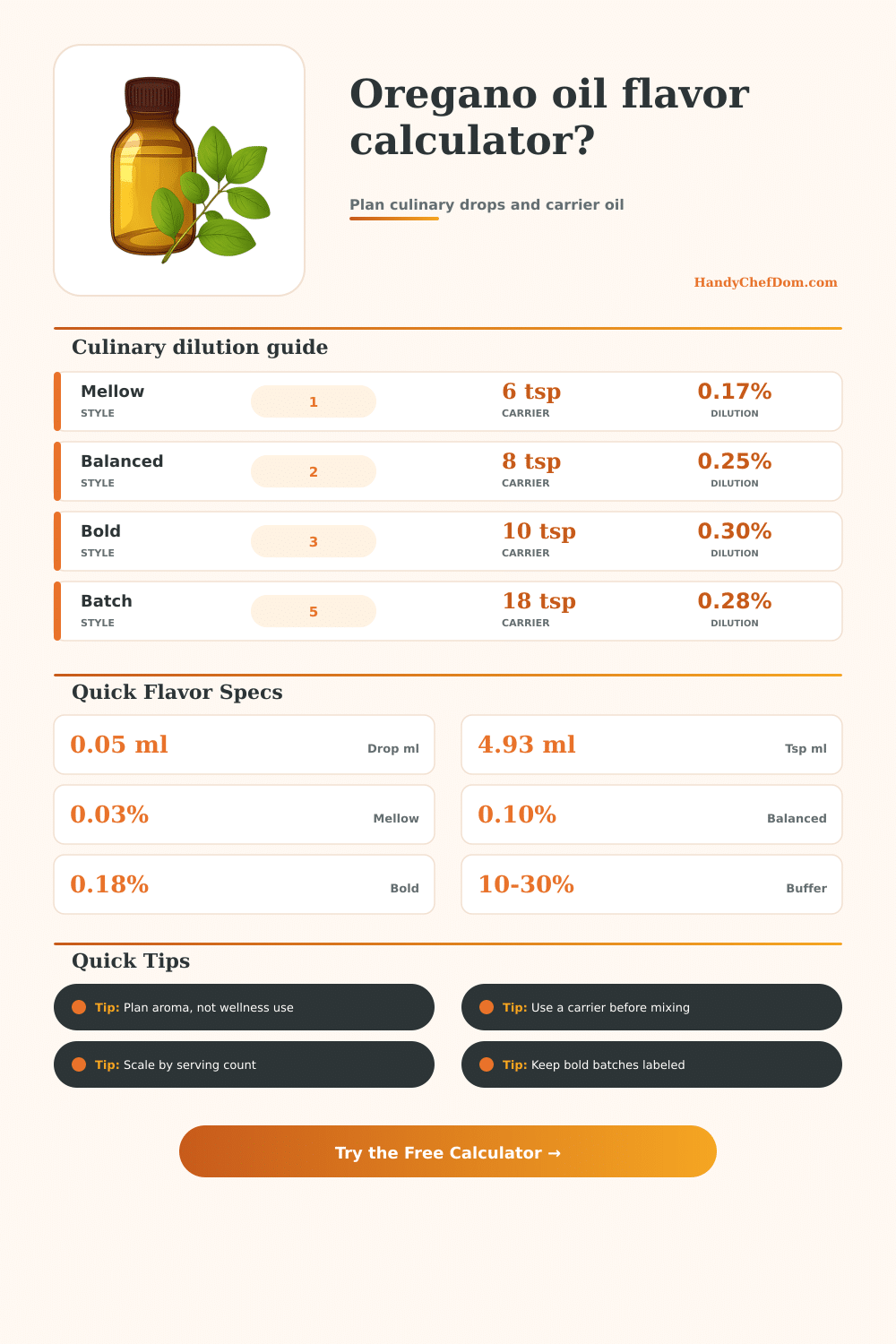
Oregano Oil for Candida Calculator
Recipe-use planner for oregano oil drops, carrier oil, culinary dilution percent, servings, herb equivalent, batch size, and flavor sensitivity buffer.
| Intensity label | Flavor role | Calculator target | Best recipe fit |
|---|---|---|---|
| Mellow background | Soft herbal aroma | 0.03 percent | Dressings, dips, mild sauces |
| Gentle herb note | Clear but restrained | 0.06 percent | Marinades, yogurt bowls, bean salads |
| Balanced savory | Noticeable oregano profile | 0.10 percent | Tomato sauce, stew bases, vinaigrettes |
| Bold oregano-forward | Prominent aroma | 0.18 percent | Pizza oil, grill glaze, robust dips |
| Assertive spoon taste | Strong tasting-spoon blend | 0.28 percent | Small test batches only |
| Drops | Oil ml estimate | Carrier at 6 tsp | Carrier at 12 tsp |
|---|---|---|---|
| 1 drop | 0.05 ml | 0.17 percent | 0.08 percent |
| 2 drops | 0.10 ml | 0.34 percent | 0.17 percent |
| 3 drops | 0.15 ml | 0.51 percent | 0.25 percent |
| 5 drops | 0.25 ml | 0.84 percent | 0.42 percent |
| Recipe format | Liquid base counted | Flavor caution | Good calculator input |
|---|---|---|---|
| Vinaigrette | Oil plus vinegar | Aroma blooms quickly | Carrier tsp plus vinegar ml |
| Dip or spread | Yogurt or soft base | Fat carries aroma | Recipe liquid as total base ml |
| Sauce pot | Tomato or broth | Large volume softens taste | Finished batch ml |
| Drizzle oil | Carrier oil only | Small batches taste stronger | Carrier tsp and servings |
| Herb shorthand | Per drop setting | Use when | Result meaning |
|---|---|---|---|
| Very light | 1/8 tsp dried | You want a soft note | Conservative flavor comparison |
| Moderate | 1/4 tsp dried | You want balanced aroma | Default recipe shorthand |
| Strong | 1/2 tsp dried | You expect bold oregano taste | High-impact flavor comparison |
| Extra bold | 1 tsp dried | You are labeling a test blend | Very strong flavor shorthand |
Dressing
Small batches where vinegar and oil carry oregano aroma immediately.
Dip
Creamy bases soften sharp edges and spread flavor through each serving.
Sauce
Large liquid volume lowers the calculated aroma concentration per spoonful.
Drizzle
Oil-only blends read stronger, so the buffer setting matters more.
You may be asking what oregano oil is. It’s got quite a pungent odor to it but adds an interesting twist to everyday foods! The key are to get the flavor right without overdoing it on the spiciness. With this tool, you calculate how many drops or teaspoons go in your dish, then it translates these measurements to numbers you understand! Then you simply enter amount of carrier oil you’re using and other ingredients will adjust accordingly.
Why? Because not all things is equally good at being bold or mellow. Sometimes, like when another ingredient are already strong in that dish, you want something mellow. And sometimes, like with some pizza oil or vegetable drizzles, oregano should of be the star of the recipe. Balanced is somewhere between those two extremes. It doesn’t overwhelm what’s there, but stands out. Bold is bold. Change the setting to taste if you think you’re overdoing it, underdoing it, or getting it right.
How to Use This Calculator
Volume measures come in two flavors: Batch Size and Servings. While Batch Size tells you how much finished liquid the oil ultimately sit inside, Servings tell you how total flavor gets divided among plates. (One drop of vinaigrette will taste more powerful in a little jar than it will in a big pot of sauce.) To avoid accidentally scaling incorrect number, calculator maintains these as distinct quantities.
For those of us thinking in teaspoons, the herb equivalent option shows how much dried herbs equals the amount of oil. This doesn’t mean that they will taste the same or cook the same… The tool provides a sort of rough comparison. It is a shortcut for cooks who typicaly measure out dried oregano when using it in a recipe.
There are also buffers and holdback percentages. The buffers adds a bit more carrier oil than was in your initial mix to make that first addition easier on food. The holdback prevents you from dumping all of your mix into the dish without first tasting some of it. This prevents you from adding all the oil before knowing what final result will taste like. Why do they has these? Because oil have a different concentration depending off if you’re putting it into a little cup or a big pot.
On the page there’s also a reference table of some commonly targetted intensities along with a format for recipes you might try. While these aren’t rules, you can get an idea from them whether your usual style tends towards stronger or more subtle. But keep in mind it’s just a pattern that has worked for others who’ve aimed for those sorts of flavors. Numbers are just a place to start, but final decision is made by tasting.
If you can trust that the calculator do the math for you, you can concentrate on how it tastes. You can make adjustments to match until it’s right again, repeating whatever you did before.