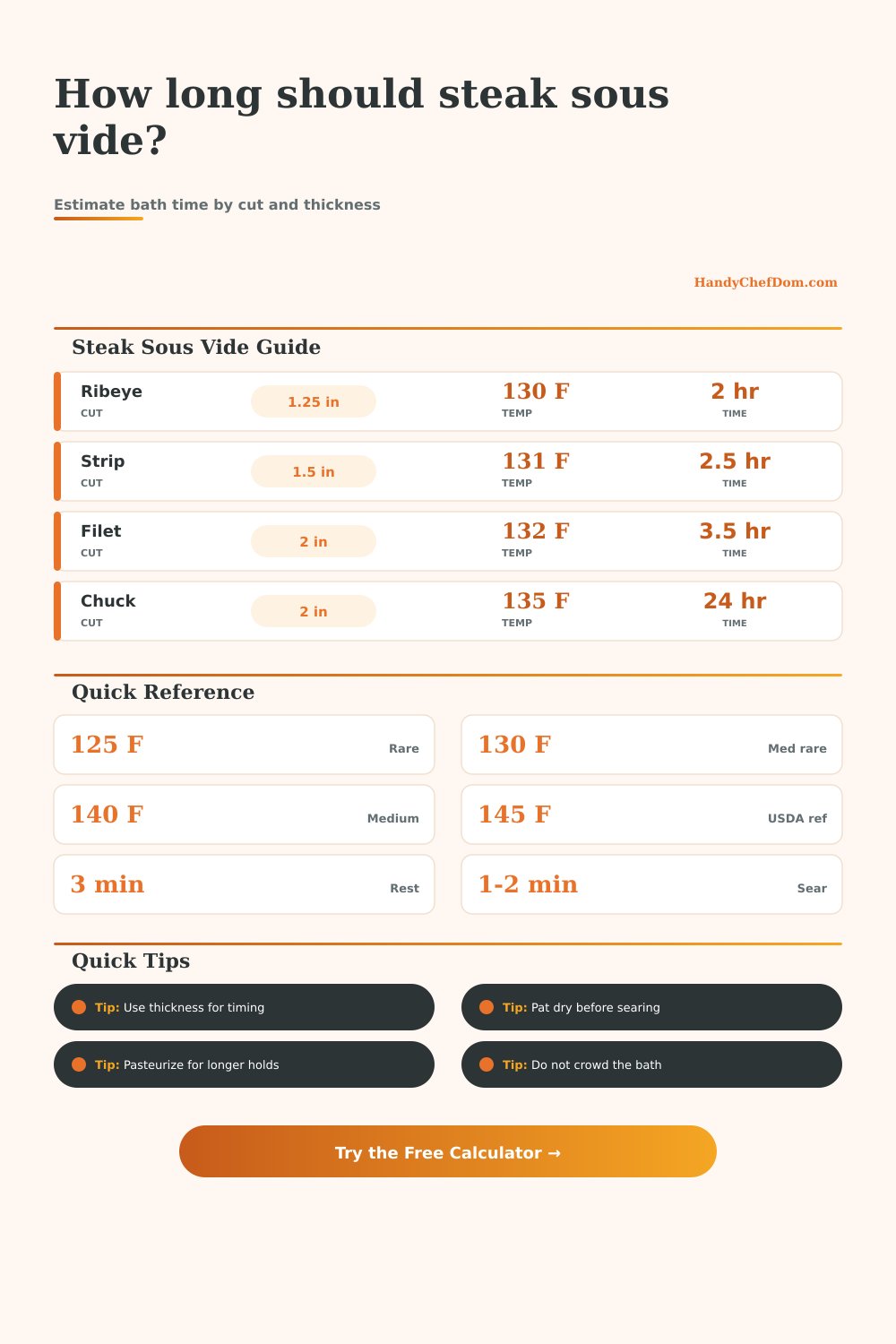
Steak Sous Vide Time Calculator
Estimate sous vide bath time from steak cut, thickness, bath temperature, doneness target, pasteurization preference, starting state, sear time, and hold window.
| Doneness | Bath Target | Texture Result | Safety Context |
|---|---|---|---|
| Rare preference | 125 F / 52 C | Red, very tender center | Below USDA whole-cut reference |
| Medium rare preference | 130 to 132 F / 54 to 56 C | Pink-red and tender | Use time table for pasteurization |
| Medium preference | 138 to 140 F / 59 to 60 C | Pink and slightly firmer | Faster pasteurization than 130 F |
| USDA whole-cut reference | 145 F / 63 C | Light pink to medium | 145 F plus 3-minute rest |
| Well done preference | 155 to 160 F / 68 to 71 C | Firm and cooked through | Above whole-cut reference |
| Thickness | Fresh Heat-Through | Frozen Estimate | Planning Note |
|---|---|---|---|
| 0.75 in / 20 mm | About 50 minutes | About 1 hr 10 min | Thin cuts finish quickly |
| 1.0 in / 25 mm | About 1 hr 15 min | About 1 hr 35 min | Common minimum steak bath |
| 1.5 in / 38 mm | About 2 hr 20 min | About 3 hr | Pasteurization may set time |
| 2.0 in / 50 mm | About 3 hr 30 min | About 4 hr 30 min | Do not stack or overlap bags |
| 2.75 in / 70 mm | About 6 hr 30 min | About 8 hr 20 min | Better as individual portions |
| Bath Temp | 25 mm Steak | 40 mm Steak | 60 mm Steak |
|---|---|---|---|
| 131 F / 55 C | 2 hr 45 min | 3 hr 30 min | 5 hr 15 min |
| 140 F / 60 C | 1 hr 30 min | 2 hr | 3 hr 15 min |
| 145 F / 63 C | 1 hr 15 min | 1 hr 45 min | 2 hr 45 min |
| 151 F / 66 C | 55 min | 1 hr 30 min | 2 hr 30 min |
| Cut Group | Best Bath Range | Texture Window | Hold Guidance |
|---|---|---|---|
| Ribeye, strip, sirloin | 129 to 140 F | 1 to 4 hours | Quality usually fades after 4 hours |
| Filet mignon | 128 to 136 F | 1.5 to 3.5 hours | Shorter holds preserve tenderness |
| Flank, skirt, flat iron | 130 to 138 F | 1.5 to 8 hours | Longer holds soften fibers |
| Porterhouse, tomahawk | 130 to 140 F | 2.5 to 6 hours | Thick bones need extra time |
| Chuck or blade steak | 131 to 140 F | 18 to 36 hours | Extended tenderizing cut |
For example, if you want to cook a steak but aren’t sure how long to put it in the oven, sous vide cooking take that part of the equation: set the water to whatever level of doneness you prefer, set the heat, and wait. Your steak won’t turn gray before it’s even halfway cooked… No more worrying about meat turning a dull color while you wait for the center to cook. The only variables remaining are the cut’s thickness and its final desired doneness level.
That’s where the calculator comes in. All you have to do is enter those two factors, and it figure out everything else for you. No need for you to estimate pasteurization coefficients or heating rates. Just enter your inputs and get an output. If you know what those inputs represent in terms of your food, it reduces a variable process into a fixed one.
How to Use the Sous Vide Calculator
Thickness is the most important input. Heat doesn’t travel well within thick slabs of muscle meat. While you can bring a half-inch thick strip steak up to temp in less than an hour, it will take almost four hours to warm through from freezer with a two-inch-thick tomahawk. To calculate that timespan, the tool uses thermal conductivity models for beef.
But the key is knowing how to read the answer: If you remove the steak before it’s ready, the outer part might be cooked-through, but the center will still be raw. That’s important not only for your taste buds but also for food safety. Confusion also exists among many home cooks between pasteurization (a biological process that kills germs under a combination of time and temperature) and heat through cooking. This setting can be toggled on the calculator to give either an estimate based off texture or a strict hold for safety.
Because we’re talking about low-temperature holds like 130-degrees fahrenheit, it’s going to take much longer to kill any bacteria in your meat then it will to warm it up. That’s why the chart displays that thicker cuts must sits longer at those temps in order to be safe. It doesn’t matter if you’re trying to calculate these values while rushing around at the end of a hectic weeknight, but understanding the role that duration plays in pasteurization allows you to make smarter plans. If you have kids or elderly diners, the added margin of error required to be sure they don’t get sick wouldn’t affect the flavor, even if you select the pasteurization option.
How long your meat cooks depends on its initial state as well. If you’re using frozen meat, you’ll need to add about forty-five to sixty minutes because water has to melt ice before it can start heating up the meat. That’s useful, though, because now you don’t have to defrost your steak and wait overnight, you can just put it in the sous vide straight out of the freezer. The extra time is built into the calculator, which means you won’t have to guess at some unclar “just in case” buffer.
It’s a crust-forming tool, the crust forms through searing, but you have to respect and remove the moisture barrier to allow it to brown. It doesn’t calculate sear time based on how long it takes to cook the steak. Instead, the steak is already cooked inside, and the tool calculates when it thinks the crust has formed. We don’t want to heat it more inside; we want the browning to occur on surface.
This means having a fully dry steak before introducing it to your grill or skillet. Moisture won’t brown. You have to pat off all the moisture because leftover water will cause the crust to steam and fall apart. If it’s still a little wet from thawing, just pop it in the freezer for ten minutes, then it’ll be good and solid with firm surface fats so you can get a hot sear without overcooking the middle.
Passive vs. Active: Sous vide is all about waiting patiently, trading off the act of monitoring for faith in a timer. More than anything else, sous vide demands that you trust something other than your senses. The calculator helps with this: It roots your cooking decisions not in intuition but in food science and physics.
Once you understand how temperature, texture, thickness, and time work together, you won’t worry about messing up expensive cuts of meat. You simply set it up, walk away, and come back to a perfectly pink center each time.