🍛 Cumin in Curry Calculator
Estimate ground cumin, toasted seed equivalent, grams, per-serving spice, and balance notes for curries scaled by servings, protein pounds, sauce cups, spice blend, toast level, heat target, base style, and simmer time.
📌Curry Presets
⚙Curry Inputs
A flexible curry baseline is about 1 to 1.5 teaspoons ground cumin for a four-serving pot, then adjusted for protein load, sauce volume, cumin form, spice blend share, toast level, heat target, coconut or tomato base, and simmer time.
📐Quick Cumin Ratio Cards
📊Curry Reference Tables
| Curry Style | Ground Cumin Start | Flavor Target | Adjustment Cue |
|---|---|---|---|
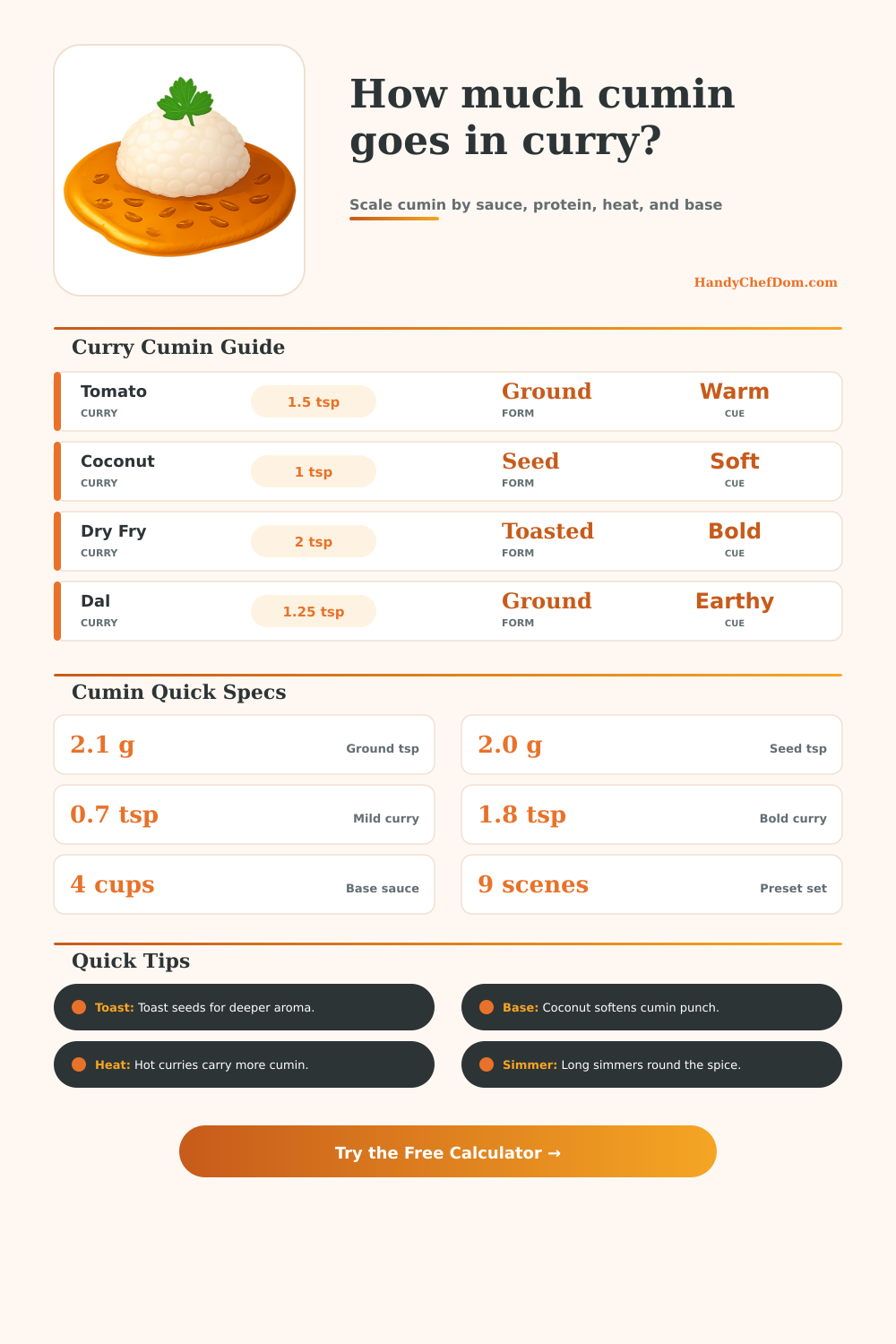
| North Indian masala curry | 1.25 to 1.75 teaspoons per 4 servings | Warm and rounded | Tomato and onion bases carry a classic cumin note |
| South Indian sambar or stew | 0.75 to 1.25 teaspoons per 4 servings | Supportive warmth | Use less when mustard seed, curry leaf, and tamarind lead |
| Coconut curry with cumin accent | 0.5 to 1.1 teaspoons per 4 servings | Soft background | Coconut milk rounds cumin and can make heavy doses muddy |
| Lentil dal or bean curry | 1 to 1.5 teaspoons per 4 servings | Earthy backbone | Legumes absorb spice and usually need a steady cumin base |
| Dry curry or bhuna style | 1.5 to 2.25 teaspoons per 4 servings | Bold aroma | Reduced sauce and oil bloom make cumin taste louder |
| Korma or creamy mild curry | 0.7 to 1.2 teaspoons per 4 servings | Gentle warmth | Keep cumin below the dairy and nut sweetness |
| Cumin Form | Strength | Weight Guide | Best Use |
|---|---|---|---|
| Ground cumin | Standard baseline | About 2.1 g per teaspoon | Fast sauce seasoning and even distribution |
| Fresh-ground cumin seeds | About 10 percent stronger | About 2.0 g per teaspoon | Fresh aroma with slightly smaller spoon measures |
| Whole cumin seeds for tempering | Warm but uneven | About 2.0 g per teaspoon | Bloom in oil, then add ground cumin if needed |
| Toasted ground cumin | Deep and rounded | About 2.1 g per teaspoon | Finishing cumin for dal, chana, and roasted bases |
| Black cumin or shahi jeera accent | Distinct and sharp | About 1.8 g per teaspoon | Use as a partial swap, not the full cumin amount |
| Older mild jar cumin | Softer aroma | About 2.1 g per teaspoon | Calculator raises the spoon measure for faded jars |
| Base Type | Cumin Effect | Typical Change | Why It Matters |
|---|---|---|---|
| Balanced onion-tomato masala | Classic curry profile | No major change | Onion sweetness and tomato acid both support cumin |
| Tomato-forward curry | Brighter and sharper | Add a small cumin lift | Acid can make cumin taste thinner unless balanced |
| Coconut milk base | Softer and rounder | Use a little less | Coconut fat mutes sharp spice edges |
| Yogurt or cream base | Mild and creamy | Trim slightly | Dairy makes cumin feel heavier if overused |
| Onion-heavy browned base | Sweet and roasted | Add a modest lift | Caramelized onion can carry toasted cumin well |
| Thin broth or rasam style | Clear and direct | Use restraint | Less fat means cumin tastes more exposed |
| Batch Size | Protein Load | Sauce Cups | Cumin Range |
|---|---|---|---|
| Weeknight dinner for 4 | 1.25 to 1.75 lb | 3 to 5 cups | 1 to 1.7 teaspoons |
| Family curry for 6 | 2 to 2.5 lb | 5 to 7 cups | 1.6 to 2.4 teaspoons |
| Meal prep for 8 | 2.5 to 3.5 lb | 7 to 9 cups | 2 to 3.3 teaspoons |
| Party curry for 12 | 4 to 5.5 lb | 10 to 14 cups | 3.2 to 5 teaspoons |
| Large tray for 20 | 7 to 9 lb | 16 to 22 cups | 5.5 to 8 teaspoons |
| Small test batch for 2 | 0.5 to 0.9 lb | 1.5 to 2.5 cups | 0.4 to 0.9 teaspoon |
🔍Curry Cumin Comparison Grid
💡Curry Cumin Tips
Almost all curries contains cumin (and most home cooks add it to their curries out of habit rather then based off need). However, what’s right for a quick chicken curry will be overpowering in a coconut korma or thin in a dry bhuna. Why? Because cumin is not an isolated ingredient; its flavor shifts depending on other ingredients in the dish.
A tool take into account cumin’s impact within the curry. It also considers your portion size, sauce volume, type of base, the protein being used, and the heat level. This eliminates the guessing game before first bite.
How to Use the Right Amount of Cumin
Adding the right amount of cumin isn’t all that matters: how those molecules travels during cooking also matters greatly. A pound and a half of ground meat or paneer (for four serving) will pull the spice out of sauce more than an equal weight of vegetables; likewise, reduced gravy will intensify cumin’s impact, whereas thin broth will spread it. The right measure to achieve desired result depends on whether your end goal is a thick, concentrated stew versus a thinner soup. This calculator accounts for all that and outputs the right dose based off your target finished texture.
And that’s where the base comes in: Does the sauce rely on tomatoes? Cumin will be made sharper. It’ll taste thinner as a result. The calculator adds more. Round the edge with coconut milk to mute sharpness instead. Lower the dose so spice doesn’t hide in fat. Cream and yogurt is somewhere in between, softening aromas but not obscuring them entirely. When you pick your base, these tweaks happen all at once, no need to memorize exception.
That changes with toast level and heat target. A light tadka will bring out smells without becoming bitter; a dark one roasts the seeds into depth. The calculator increases the higher end of that range for hotter curries because the heat masks strong taste of cumin. Similarly, longer simmering concentrate flavors while rounding their rough edges. So a single teaspoon of seed at the start feels different than a spoonful added after ninety minutes versus one added after twenty-five.
Actualy, it should of felt more distinct. There is no one magic number; instead, the tool provides a range that has an opening suggestion along with a tiny amount saved for taste. Why? Because cumin will read differently as it cooks down and may need additional garam masala or even some acid to finish. By starting low and adjusting near end, you avoid the all-too-common error of jumping the gun and adding too much too soon.
Once you go overboard with spices early, there’s nothing for it. When someone says that a curry is lacking in spice, most folks will go back and add another entire teaspoon instead of questioning whether something else has covered up heat. By demonstrating effects each variable has on whole, the calculator helps the corrections remain small and accurate.
Once you understand underlying logic of the input variables, the figure on-screen ceases to seem random. Instead it feel real; as though it’s the true quantity required. You would find it comfortabley easy once you get used to it.