Oregano Oil for SIBO Calculator
A culinary dilution planner for oregano oil flavor strength, carrier oil teaspoons, recipe liquid, servings, herb equivalent, batch size, and sensitivity buffer.
| Flavor lane | Target dilution | Kitchen description | Best recipe context |
|---|---|---|---|
| Trace aroma | 0.02 percent | Mostly background scent | Broths, egg bakes, light plates |
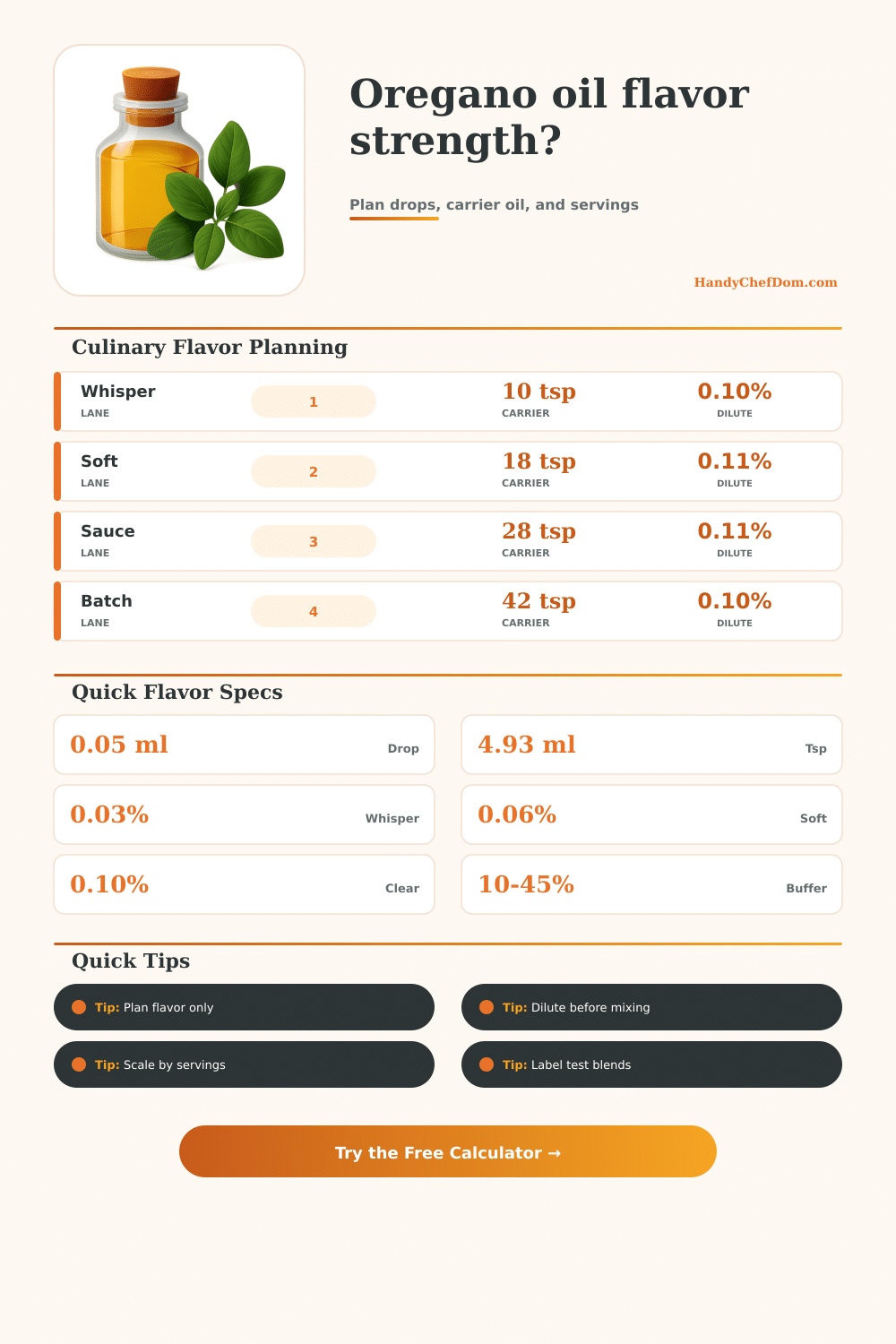
| Whisper herbal note | 0.03 percent | Soft oregano edge | Finishing oils and lemon blends |
| Soft savory balance | 0.06 percent | Noticeable but gentle | Rice plates and vegetable glazes |
| Clear oregano flavor | 0.10 percent | Oregano-forward aroma | Sauces, drizzles, meal prep bases |
| Robust tasting blend | 0.16 percent | Strong spoon-test flavor | Small culinary test blends |
| Drops | Oil at 0.05 ml | Carrier at 18 tsp | Carrier at 36 tsp |
|---|---|---|---|
| 1 drop | 0.05 ml | 0.06 percent | 0.03 percent |
| 2 drops | 0.10 ml | 0.11 percent | 0.06 percent |
| 3 drops | 0.15 ml | 0.17 percent | 0.08 percent |
| 4 drops | 0.20 ml | 0.23 percent | 0.11 percent |
| 6 drops | 0.30 ml | 0.34 percent | 0.17 percent |
| Recipe format | Count as base liquid | Flavor behavior | Useful input focus |
|---|---|---|---|
| Broth bowl | Broth and carrier | Large liquid volume softens aroma | Recipe base ml and servings |
| Finishing oil | Mostly carrier oil | Oil-only blends taste more direct | Carrier tsp and buffer |
| Vegetable glaze | Oil plus glaze liquid | Small batches can taste concentrated | Batch ml and holdback |
| Meal prep base | All sauce or puree | Portioning lowers per-serving share | Servings and finished batch |
| Herb shorthand | Per drop setting | Use when | Result meaning |
|---|---|---|---|
| Feather | 1/16 tsp dried | Aroma should stay faint | Very light flavor comparison |
| Light | 1/8 tsp dried | A gentle herb note is enough | Low-impact comparison |
| Standard | 1/4 tsp dried | You want normal recipe shorthand | Default kitchen comparison |
| Bold | 3/8 tsp dried | You expect stronger herb flavor | High-impact comparison |
| Strong | 1/2 tsp dried | You are labeling a test blend | Very strong flavor shorthand |
Broth Bowl
Higher liquid volume dilutes aroma quickly, so batch ml matters more than carrier alone.
Finishing Oil
Carrier oil is the main base, making drop size and buffer settings more visible.
Glaze
Small glaze batches can taste concentrated, so holdback is useful for kitchen testing.
Meal Prep
Large batches spread flavor across portions and make per-serving share easier to track.
The smell of oregano oil is pungent. It will enhance your finishing oil or broth. The aim is that when you eat it, it tastes as though it’s been cooked in restaurant. That means dialing it back just enough so that it doesn’t overwhelm the dish. This depends on the guests, how much food, fat, or liquid you add and how much oil you use.
Now that’s tough for most cooks. Some will use too many drops on their roasted veggies and ruin them. Others won’t get enough in there and completely miss the herbal flavour. That’s where the calculator comes into play. You put in your batch size, drop count, carrier volume, and recipe format. It eliminates all of the guesswork between those factor.
How to Use the Oregano Oil Calculator
The reason that matters is that three drops will behave different than they do in broth. In broth, it spreads the flavor over more liquid to make it softer, whereas a finishing oil concentrates it more. Depending on your chosen format, the calculator tweak its goal to match.
Similarly, there’s also the flavor lane to consider. This isn’t a personalized dosing chart. Instead, it lets you decide how strong you want the flavor to be before you makes the recipe. The sensitivity buffer and the carrier volume does related jobs. With the carrier, it initially mixes a base of the oil with whatever else you add. That way your serving size isn’t all just an essential oil in pure form. The buffer increases the volume further so the scent isn’t as harsh on the nose. When you are cooking for sensitive noses, this can be very helpfull.
Then after everything’s been mixed together you get to the serving size. How many drops do I put per plate? That number go onto each person’s plate at dinner time. That is what most people see and care about. This is where the herb equivalent setting comes into play. For cooks accustomed to measuring out their dried oregano in teaspoons, it’s a fast shortcut. But do not use it as a replacement for the oil. It provides a familiar shorthand and lets you judge whether what you have in mind seem like the right amount.
The holdback percentage works the other way. It keeps back a little of the finished mixture so that you can sample it and change it as needed, but won’t use up your original blend. To help with that, there is reference tables on the page indicating typical dilution ranges. It explains how different recipe styles impact the resulting concentration. So rather than having to start from scratch you can compare it to common kitchen scenarios. Comparison cards similarly do this.
What makes a person think differently about a bowl of broth, a tasting flight, or a small glaze? But that doesn’t take into account what happens when you combine this oil with everything else on the plate. Does it taste like more or less oregano when paired with acidic lemon? With saltiness? Is there any fat to balance it out? What about temperature: do you notice more scent from warm food than from cold? The exact same mixture might be easier to notice served atop a hot grain bowl versus some room-temperature vegetables.
You should of tested this first. The initial run is your test batch. Cook a small amount; taste it alongside your chosen flavor lane. Tweak for next time you cooks. Repeat over multiple meals, and you’ll know whether you want to go with the clear lane or the whisper lane. You’ll know whether to add a full buffer or just a slight cushion to your usual batch size. This pattern turns a single-shot calculation into an achievable kitchen skill that can be repeated.