💧 Water Weight Calculator
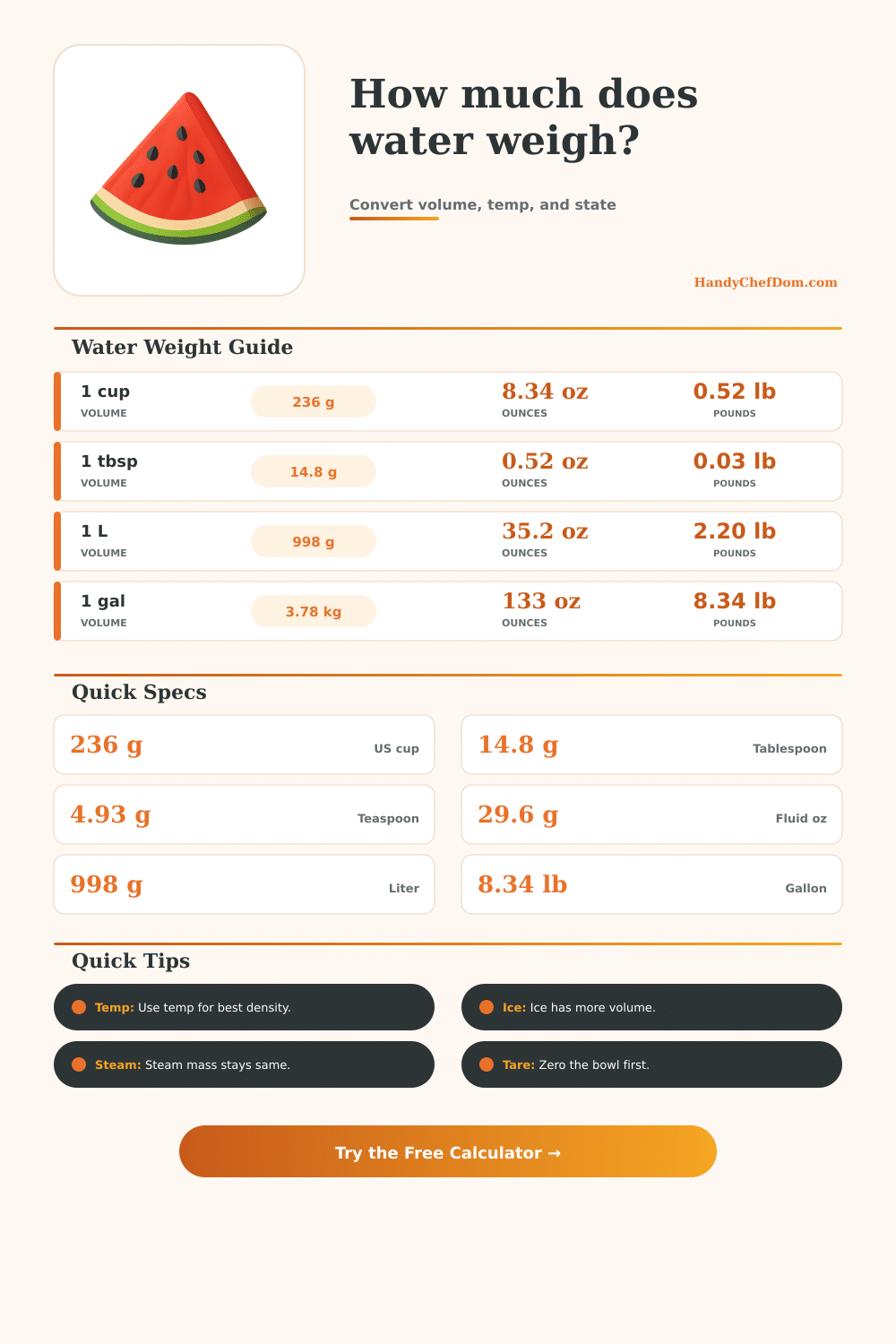
Convert kitchen water volumes into pounds, ounces, grams, and kilograms while adjusting for temperature density, ice volume, and steam volume.
Enter one main water volume or stack the kitchen fields together. The calculator converts everything to milliliters first, then applies density from temperature and the selected water state.
| Temp | g/ml | lb/gal | Note |
|---|---|---|---|
| 32 F | 0.9998 | 8.34 | Near ice |
| 39 F | 1.0000 | 8.35 | Peak |
| 68 F | 0.9982 | 8.33 | Room |
| 100 F | 0.9930 | 8.29 | Warm |
| 160 F | 0.9780 | 8.16 | Hot |
| 212 F | 0.9584 | 7.99 | Boil |
| Unit | mL | Grams | Ounces |
|---|---|---|---|
| US tsp | 4.93 | 4.92 | 0.17 |
| US tbsp | 14.79 | 14.76 | 0.52 |
| US fl oz | 29.57 | 29.52 | 1.04 |
| US cup | 236.59 | 236.16 | 8.33 |
| Liter | 1000 | 998.2 | 35.21 |
| Gallon | 3785 | 3778 | 133.3 |
| Batch | Volume | Weight | Kitchen |
|---|---|---|---|
| Tea mug | 12 oz | 0.78 lb | 1.5 cup |
| Mix bowl | 4 cup | 2.08 lb | 0.95 L |
| Soup pot | 2 qt | 4.16 lb | 8 cup |
| Pitcher | 2 L | 4.40 lb | 8.45 cup |
| Jug | 1 gal | 8.34 lb | 16 cup |
| Stockpot | 6 qt | 12.5 lb | 24 cup |
| State | Density | Shift | Note |
|---|---|---|---|
| Liquid | Temp based | 0% | Normal |
| Ice cube | 0.9167 | -8.3% | Melts down |
| Crushed | 0.58 | -42% | Air gaps |
| Steam | 0.0006 | Huge | 1 atm |
| Condensed | Temp based | 0% | Water mass |
| Boiling | 0.9584 | -4% | Hot water |
Water weighs about eight ounces to a cup, right? That’s the handy little rule of thumb that stays in your brain like a piece of candy. Being not quite correct or just barely incorrect can mean the difference between precision of a careful chemical mix or the fine balance of a finicky sourdough starter. Plug your temperature and volume into the calculator above and let it do the work for you, no guessing at coefficients and conversions that constantly adjust as degrees goes up or down.
Though it appears as a simple liquid to many, water actualy varies greatly in density. Most home cooks aren’t aware of how important temperature are. At roughly thirty-nine degrees Fahrenheit, water is as thick as it gets; it has packed the most amount of itself into the smallest possible space just before freezing. For those who makes dishes that require precise ratios of hydration, pouring boiling water will result in less mass-per-cup compared to what your chart say. It’s not much, maybe a fraction of an ounce-per-cup, but multiply that by a gallon jug and suddenly you’ve lost upwards of three ounces of real stuff.
Why Water Weight Changes With Temperature and State
I know people think this one is wrong because they mistake volume for weight and don’t account for thermal expansion: things expands when heated. When ice freezes, it does so by expanding and forming a structure that leaves more space (air) around each molecule. That’s why a cup of crushed ice will weigh a lot less then a cup of liquid water; you’re largely scooping air. And if you’re batching drinks or making them for an event where they’ll all be served at once, trying to measure the volume of your ice can be risky. To achieve consistency, you want to know the mass. The page has a reference table that makes it clear how density change when moving from one state to another.
It’s not magic: it’s simply physics doing what physics do. Unless recipe says otherwise, most people assume it is a liquid. This results in flat drinks and wet batters. It’s when baking that it really bites people: Why does flour weigh differently from bag to bag? Why do cups measure so wildly different depending on whether you use a scoop or a stirrer? It’s because bread is measured by weight, not volume, and why should there be any other way to hydrate your flour! That water is meant to be the one constant variable in the equation. Get your water measurement wrong, say, because you forgot about its state or temperature, and you’re screwed because it ruins the whole structure of your dough.
With the tool, you can even stack your various units, such as adding tablespoons to main cup measurement. This reflects the messiness of a real kitchen. No, you never have precisely one liter of anything; you’ve got half a jug and then there’s a splash in the measuring spoon. On Steam, there’s yet another wrinkle: The volume increase is staggering. At atmospheric pressure, one gram of water transforms into roughly two thousand times its original size. For any kind of distillation project or pressure cooker that relies on saving mass, this are important. While the steam that fills your pot appears large, that’s only because it’s in a low-density state. When the steam rises, you’re not losing anything, you’ve merely shifted its mass from a solid to a gaseous state until it re-condenses. It’s something to know if you ever want to imitate an industrial process in your kitchen without getting frustrated.
In the results section, you’ll notice that they have a breakdown of what goes into making the final number. What’s the original mass? How does adjusting the temperature change things? How much did the state change contribute? All of this will give you a better idea based off what caused you to fail at the last attempt. Was the ice too fluffy? Was it too warm? All of these little variables is often hidden from you.
Water weight isn’t rocket science (well, maybe it is, but it’s not chemistry). Working with the stuff comes down to understanding what water is and what it can do. Calibrate your equipment. Scale up a soup recipe for a banquet. Know that water behaves different depending on its state and temperature. If you know that, you’re a better operator. Conversions are just something the tool does for you; your intuition helps you key in the right things. Use precise volumes, factor in the heat in the room, and get out of the habit of thinking each cup equals an even eight ounces.
You’ll get more consistent results. Your recipes will be more reliable. You’ll also develop a better sense of how the world works around you. Water is simple; it’s when you examine it closely that it gets interesting.