🍬 Granulated Sugar Cups to Pounds Converter
Convert granulated sugar cups, tablespoons, and teaspoons into pounds, ounces, grams, and bag coverage for baking and pantry planning.
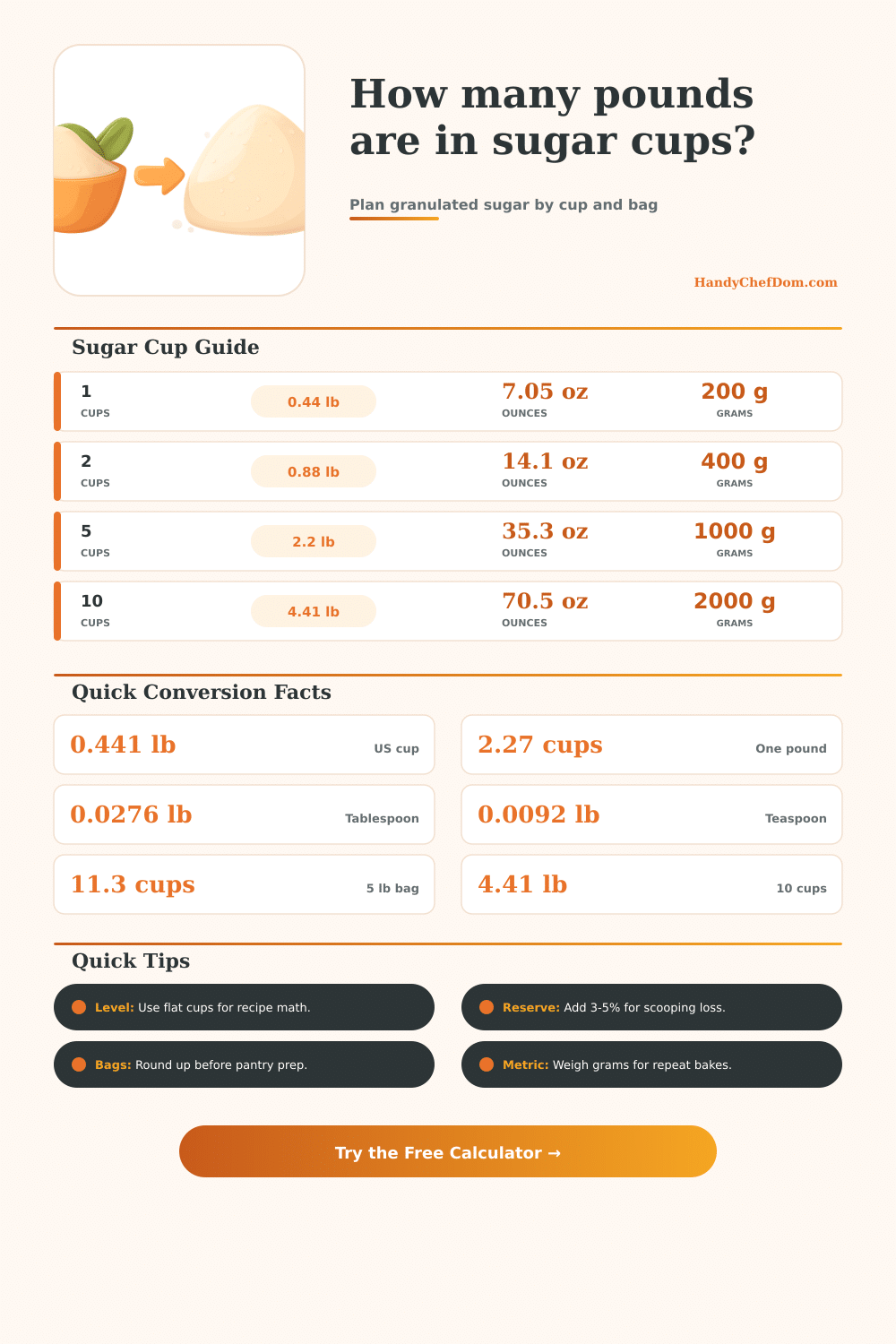
The default kitchen standard is 1 level US cup of granulated sugar equals 200 g, or 0.4409 lb. Change the cup standard, measuring style, batches, and reserve to plan a real sugar pull from the pantry.
| Cup Standard | Volume | Granulated Sugar | Pounds Per Cup |
|---|---|---|---|
| US cup | 236.6 ml | 200 g | 0.4409 lb |
| Metric cup | 250 ml | 211 g | 0.4663 lb |
| Imperial cup | 284.1 ml | 240 g | 0.5296 lb |
| Japanese cup | 200 ml | 169 g | 0.3727 lb |
| US Granulated Amount | Gram Weight | Ounce Weight | Pound Weight |
|---|---|---|---|
| 1 teaspoon | 4.17 g | 0.15 oz | 0.0092 lb |
| 1 tablespoon | 12.5 g | 0.44 oz | 0.0276 lb |
| 1/4 cup | 50 g | 1.76 oz | 0.1102 lb |
| 1/3 cup | 66.7 g | 2.35 oz | 0.1470 lb |
| 1/2 cup | 100 g | 3.53 oz | 0.2205 lb |
| 3/4 cup | 150 g | 5.29 oz | 0.3307 lb |
| 1 cup | 200 g | 7.05 oz | 0.4409 lb |
| Measuring Style | Factor | 1 US Cup Result | Best Use |
|---|---|---|---|
| Level, swept flat | 1.00x | 0.4409 lb | Default baking math |
| Lightly spooned | 0.96x | 0.4233 lb | Gentler cup fills |
| Scooped then leveled | 1.03x | 0.4542 lb | Dense pantry sugar |
| Rounded, not leveled | 1.08x | 0.4762 lb | Loose non-recipe estimates |
| Settled storage cup | 1.05x | 0.4630 lb | Compacted container sugar |
| Pantry Bag | Cups Covered | Tablespoons Covered | Kitchen Note |
|---|---|---|---|
| 1 lb | 2.27 cups | 36 tbsp | Small batch backup |
| 2 lb | 4.54 cups | 73 tbsp | One baking weekend |
| 4 lb | 9.07 cups | 145 tbsp | Common grocery bag |
| 5 lb | 11.34 cups | 181 tbsp | Heavy baking bag |
| 10 lb | 22.68 cups | 363 tbsp | Bulk pantry refill |
| 25 lb | 56.70 cups | 907 tbsp | Event prep sack |
Three cups: What does that mean? When a recipe asks for “three cups,” you look at sugar bag, thinking, do I have enough left? It’s a certain sort of panic. Do you shake the sugar bag? Yes. Do you listen to its rattle? Yes. Is your guess likely incorrect? Usually so. And it’s never a math issue. Density is the issue. Sugar doesn’t weigh the same as volume. That is why a cup of sugar is a cup of sugar. It is about how tightly those crystals fits into that vessel and how they pack together.
The way they pack can change greatly depending on how full you make that cup. A cup isn’t a constant quantity, unlike a second or an inch (which most bakers, who bake at home, tend to thinks of). Once you enter your preferred way of measuring, the calculator does all of the math for you, you don’t need to guess if the scoop was gently levelled off, or pressed down with gravity.
Why Weighing Sugar Is Better Than Using Cups
Are you sweeping the sugar out of bag and dipping your measuring cup straight into it? Or are you spooning ingredients lightly into your cup before leveling them off? If you did the former, you’re probably getting a couple of grams of extra sugar each time. That might not matter when making a few cookies, but on a dozen cakes, it add up to a pound of unnecessary sweetness.
The tool takes all of this into account by letting you choose which type of measurement to use, adjusting the weight to match what you physically use. So what does this mean? Why would you care about weights at all? The reason is that sugar absorbs water. It’s called water-absorbing. Every single crumb react differently to the presence of sugar. It impacts consistency and draws water out off the atmosphere.
If you have too much sugar, then your baked good will become cakey instead of chewy, or it’ll spread too thinly. Not enough sugar? Your baked goods won’t get as golden brown as you want. Baking with weights eliminates human error (i.e. This eliminates weighing instead of scooping flour as a variable. A pound equals a pound, no matter what. Volume (the imprecise way we measure ingredients) becomes exact in terms of mass (the pounds).
Now, if you know how many pounds these cups weigh in your situation, you don’t necessarily have to weighs each individual ingredient; just use your scale to convert cups into pounds. I mean, there’s no reason why you’d ever measure out exactly what you want to use without dumping some down the drain in the process and sticking your finger to the side of the measuring cup, but having a little extra in reserve forces you to plan like a pro, not just follow the directions. Real life happens, so adding a little extra (for waste) makes sense. And it means that you’re prepared if you want to do more than one batch.
For example, say you want to can something: maybe make a batch of jam or several batches of canned fruit? That’s probably going to take ten cups spread out over a couple hours. Knowing that ten cups is about 4.4 pounds allows you to buy just the right size bag. This prevents you from opening the whole thing and exposing all that sugar to humidity it should of been exposed to.
In practice, the most useful takeaway from managing your pantries has nothing to do with fancy science; it’s simply knowing how many bags cover what amount. Sugar doesn’t come in even bag sizes from the grocery store, four or five pounds seems typical. How many cups are in there? What happens if you’re mid-bread recipe and realize you need more sweetener… at midnight? This tells you exactly how much is lurking in each bag.
It is roughly 0.44 pounds per standard (US) cup, though there is a very slight difference different than whether you use imperial or metric cups (volume, not weight). It is a small detail, but it matters if you are trying to translate recipes across regions. When you fill up your car’s tank, you don’t ask for X number of liters. You look at the gas gauge and know that every gallon gets you a certain number of miles.
Similarly, think of sugar in baking terms. A pound of sugar contain slightly more than two cups. If you can get that into your head, you’ll begin seeing sugar in terms of its weight rather then simply being an opaque object inside a plastic bag. Your perspective shifts from reactive guesswork to proactive planning. You stop asking yourself if there is “enough,” because now you trust the numbers. The next time you pick up that spoon, you’ll know the cost in pounds.