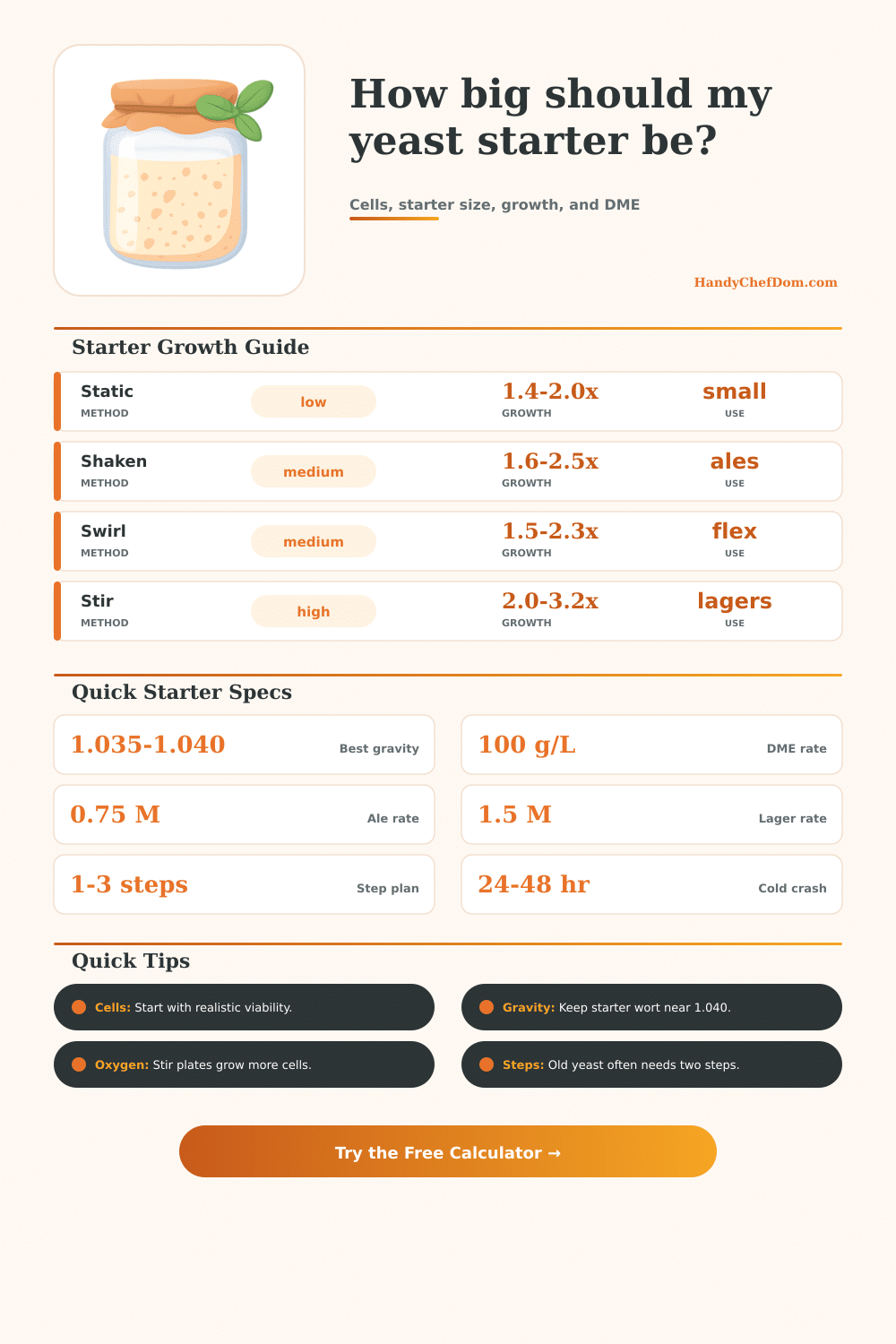
🍺 Yeast Starter Calculator
Estimate target cells, current viable cells, starter volume, starter gravity, stir plate or shaken growth, step starter planning, and DME amount for brewing yeast starters.
Enter your target pitch or have the calculator estimate it from batch size, original gravity, and beer type. Current cells should reflect the yeast package or slurry before viability is applied.
Simple starter with the least oxygen exposure and the lowest growth ceiling.
Manual shaking several times a day improves oxygen and keeps yeast suspended.
A vigorous shake at the start adds oxygen and works well for moderate ale pitches.
Continuous motion gives the highest growth potential and suits lagers or old yeast.
Target cells after the selected buffer and reserve.
Estimated million cells per milliliter per Plato.
Dry malt extract concentration for this starter gravity.
Based on aeration, gravity, cell density, and step plan.
| Method | Typical growth factor | Best starter size | Oxygen pattern | Planning note |
|---|---|---|---|---|
| Static jar | 1.4 to 2.0 times viable cells | 0.5 to 1.5 L | Low after initial mix | Best for fresh yeast and smaller cell gaps |
| Intermittent swirl | 1.5 to 2.3 times viable cells | 1 to 2 L | Repeated manual oxygen pickup | Good fallback when no stir plate is available |
| Shaken starter | 1.6 to 2.5 times viable cells | 1 to 2 L | High at start, then normal | Works well for many standard-strength ales |
| Stir plate | 2.0 to 3.2 times viable cells | 1 to 4 L | Continuous gas exchange | Use for lagers, older yeast, and high targets |
| Starter gravity | DME per liter | Growth effect | Best use | Note |
|---|---|---|---|---|
| 1.020 to 1.029 | 50 to 72 g/L | Gentle but low nutrients | Wake-up step | Useful for stressed or old yeast |
| 1.030 to 1.034 | 75 to 85 g/L | Moderate growth | First step starter | Easy on weaker cultures |
| 1.035 to 1.040 | 88 to 100 g/L | Best balance | Most starters | Standard homebrew target range |
| 1.041 to 1.050 | 102 to 125 g/L | More stress | Only if needed | High gravity starters may reduce growth |
| Plan | Volume split | When to use | Decant cue | Cell planning note |
|---|---|---|---|---|
| Single step | 100% in one flask | Fresh yeast with small gap | Pitch active or crash clear | Fastest path when target is close |
| Two step | 35% then 65% | Old pack or lager target | Crash first step before second | Improves growth without huge first volume |
| Three step | 20%, 35%, 45% | Very low viability | Decant between each step | Builds cells gently from a small culture |
| Auto step | Based on cell gap | When unsure | Use calculator split | Chooses steps from target-to-viable ratio |
| Beer type | Pitch rate | 5 gal at 1.050 | Starter cue | Typical method |
|---|---|---|---|---|
| Standard ale | 0.75 M/mL/P | 175 to 190 B cells | One fresh pack plus starter | Shaken or stir plate |
| Hybrid ale | 1.0 M/mL/P | 230 to 250 B cells | Moderate starter gap | Stir plate preferred |
| Lager | 1.5 M/mL/P | 350 to 380 B cells | Large cell target | Stir plate or two steps |
| High gravity ale | 1.2 M/mL/P | 280 to 320 B cells | Extra buffer is helpful | Two-step starter |
Growth estimates vary with yeast strain, nutrient level, oxygen, flask headspace, temperature, and package age. Use the result as a planning guide, then watch real fermentation cues.
Yeast starters is necessary for homebrewers who use small packet of yeast. The yeast must multiply in number before it are added to the full batch of wort that will be processed. Adding wort to the yeast packet allows the yeast cells to grow in number and provide them with the resources that they need to grow.
If a person dont allow enough time and resource for the yeast cells to grow, the fermentation process may be sluggishly. However, if a person provides enough time and resources for the yeast cells to grow, the fermentation process will result in a vigorous and clean batch of beers. The calculator will display the mathematical results after a person enter the batch size, the original gravity, the current yeast cell count, and the viability of the yeast.
How to Use a Yeast Starter Calculator
The calculator will indicate the gap between the current and the target yeast cell count, as well as the expected yeast growth based on differents aeration methods. The gap between the current and target yeast cell count is the number that will be used to make a decision regarding the number of step that will be necessary to start the yeast. If the current count of the viable yeast cells is close to the target yeast cell count, then the recipe will only require the use of a single starter.
If the current count is significantly less then the target yeast cell count, then the batch will require the use of two or three steps to start the yeast. Viability is the percentage of living yeast cells that come packaged in a yeast pack. The viability of the yeast is not a constant number, however, as the yeast may age in the pack or may be stored at temperatures that reduce the viability of the yeast over time.
Furthermore, the yeast may contain a claim that it contain one hundred billion cells, but the viability of the yeast may indicate that it only has sixty or seventy billion living yeast cell. The calculator will apply the viability percentage to the yeast cell count, and the calculator will use the percentage to determine the actual number of yeast cells that will grow. A yeast pack may appear to be fresh and new, but it may not contain as many living yeast cells as the number that may be reflect on the yeast pack.
Gravity is the measurement of the amount of sugar contained in the yeast starter. The yeast require both sugar and nutrients to grow. Using too much sugar in the yeast starter, however, can lead to osmotic stress for the yeast populations.
Too much osmotic stress can cause the yeast to reproduce at a slow rate. Many homebrewers use a gravity of 1.037 for their yeast starters. This gravity allows for the yeast to grow at an strong rate without experiencing the negative impacts of too much osmotic stress.
The gravity that is selected will determine the amount of dry malt extract that should be used when preparing the yeast starter. Aeration is the addition of oxygen to the yeast starter. Oxygen is require for the yeast to create new yeast cells.
A static jar will introduce oxygen to the yeast starter, but in limited amount. Stir plates will expose the yeast to a continuous supply of oxygen. Adding oxygen to a yeast starter will change the amount of yeast growth.
Furthermore, the growth of the yeast starter will depend upon the aeration method that is use for the yeast. The size of the yeast gap will indicate which aeration method should be used for the brewing process. For instance, if the gap between the current and target yeast cell count is small, shaking the yeast starter may be enough for a standard ale.
However, stir plates is recommended for lagers and older yeast packs. Step starters can be used if adding the amount of liquid that is required to create a yeast starter would be too large for the batch size, or if using that amount of liquid would dilute the yeast culture that come in the yeast packet. The yeast starter calculator will indicate the number of step that will be required for starting the yeast.
Furthermore, it will indicate the volume of the yeast starter that should be split for each step. Between each step, the yeast starter should be chilled and decant from the container. This step is necessary in order to avoid diluting the yeast that has been grown with the liquid used to start the yeast.
The pitch rate is the amount of yeast that are added to the wort. The pitch rate can change based off the different types of beer that are brewed. For instance, different strain of yeast can require different gravity level and different pitch rates.
Ales have lower pitch rates than lagers, for instance, because the yeast is less stressed when brewing the ale. The pitch rate can be changed on the calculator, and the calculator will adjust the target yeast cell count according to the change in pitch rate that is selected. While this calculator is helpful for brewing beer and establishing how many yeast cell will grow, it is not a guarantee that the amount of yeast will grow to the calculated amount.
For instance, variables like the temperature at which the yeast grows, the nutrients contained within the malt, and the temperament of the strain of yeast itself can each potentially change the number of yeast cells that grow. However, if the yeast cell count is close to the target cell count, then the process can likely be successful as established through the calculator. If there is a significant gap between the current and target yeast cell count, then it is suggested that the batch size, number of steps, or aeration method are changed before the brewing process is attempted.
These calculations should of been performed before each batch of beer that is made that use liquid yeast. With the use of this calculator, a homebrewer will eventually become more familiar with the different stages of creating a yeast starter. A homebrewer will eventually understand if their yeast requires a single yeast starter or a two-step yeast starter.
Furthermore, they will understand how much dry malt extract will be needed to start their yeast. Using the yeast starter calculator will allow a homebrewer to prepare for the brew day rather than merely adding the yeast packet to the batch of beer and hoping that the yeast will develop sufficiently.