🥣 Tahini In Hummus Calculator
Calculate tahini cups, tablespoons, grams, lemon juice, garlic, and aquafaba or water for hummus from cooked chickpeas, cans, or drained grams.
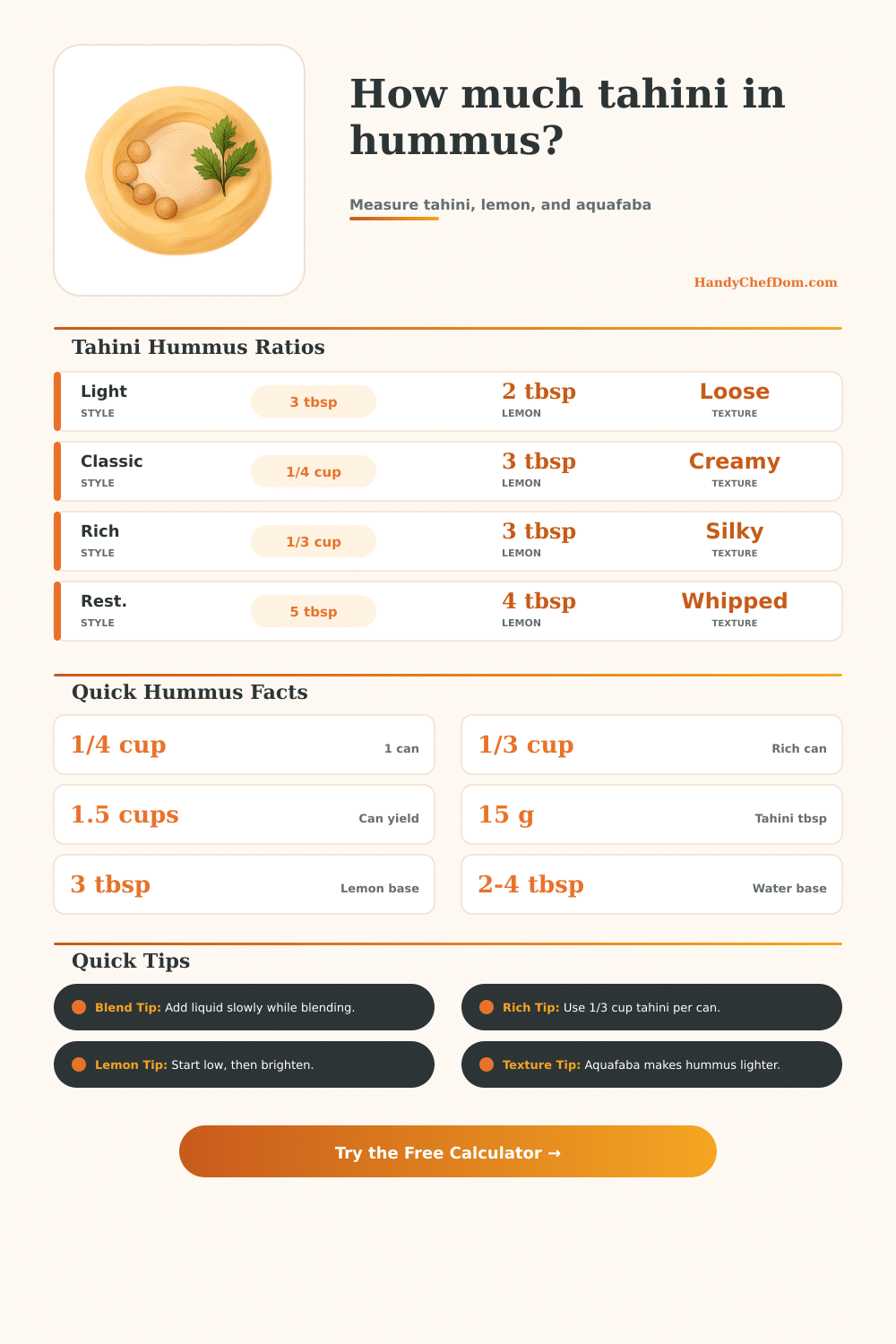
A common starting point is 1/4 cup tahini for one 15 oz can of drained chickpeas. Rich hummus often moves closer to 1/3 cup per can, then lemon and aquafaba adjust the final texture.
| Hummus Ratio | Tahini per 15 oz Can | Lemon Juice per Can | Aquafaba or Water per Can |
|---|---|---|---|
| Light hummus | 3 tablespoons, about 45 g | 2 to 2.5 tablespoons | 2 to 3 tablespoons for a thick dip |
| Classic hummus | 1/4 cup, or 4 tablespoons | 3 tablespoons for balanced brightness | 3 to 4 tablespoons for creamy texture |
| Rich hummus | 1/3 cup, about 5.3 tablespoons | 3 to 3.5 tablespoons | 4 to 5 tablespoons to loosen sesame richness |
| Restaurant-style hummus | 1/3 cup plus a small spoonful | 3.5 to 4 tablespoons | 5 to 6 tablespoons for a whipped finish |
| Chickpea Measure | Cooked Chickpea Cups | Drained Gram Estimate | Classic Tahini Start |
|---|---|---|---|
| 1/2 of a 15 oz can | About 0.75 cup | About 125 to 130 g | 2 tablespoons tahini |
| 1 standard 15 oz can | About 1.5 cups | About 250 to 260 g | 1/4 cup tahini |
| 2 standard 15 oz cans | About 3 cups | About 500 to 520 g | 1/2 cup tahini |
| 1 larger 19 oz can | About 2 cups | About 330 to 345 g | 5.3 tablespoons tahini |
| Cooked from dry beans | Use measured cooked cups | 170 g per cooked cup | 2.7 tablespoons per cup |
| Tahini Measure | Tablespoons | Approx Grams | Best Hummus Use |
|---|---|---|---|
| 2 tablespoons | 2 tbsp | About 30 g | Half-can snack batch or very light hummus |
| 1/4 cup | 4 tbsp | About 60 g | Classic hummus from one 15 oz can |
| 1/3 cup | 5.3 tbsp | About 80 g | Rich one-can hummus or restaurant texture |
| 1/2 cup | 8 tbsp | About 120 g | Classic two-can hummus batch |
| 2/3 cup | 10.7 tbsp | About 160 g | Rich two-can hummus batch |
| Style Setting | Tahini Direction | Texture Direction | Flavor Result |
|---|---|---|---|
| Classic | Use the 1/4 cup per can baseline | Moderate aquafaba or water | Balanced sesame, chickpea, lemon, and garlic |
| Extra creamy | Add roughly 10 percent more tahini | Add a small extra splash of liquid | Soft, rounded, and spreadable |
| Light | Reduce tahini about 20 percent | Keep liquid moderate to avoid thin hummus | Brighter chickpea flavor with less sesame weight |
| Restaurant | Move toward 1/3 cup tahini per can | Use the most aquafaba for a whipped result | Glossy, rich, and very smooth |
Tahini is an essential ingredient in homemade hummus. The amount of tahini that you use will have an impact on the flavor of the hummus that you make. Using too little tahini will make the hummus taste flatly, while using too much tahini will overpower the other flavors of the hummus that contains lemon and garlic.
To create a balanced hummus, the amount of tahini must be balanced with the amount of chickpeas, lemon juice, and garlic that people use in the creation of the dip. The calculator included on the page allow you to enter the quantity of chickpeas that you would like to use, as well as the level of richness that you would like to create with your hummus, so that the calculator can calculate the amount of tahini that should of been used. Typically, people begins with one 15-ounce can of chickpeas.
How Much Tahini to Use in Hummus
One 15-ounce can of chickpeas yields approximately one and a half cup of chickpeas when drained. For one 15-ounce can of chickpeas, a quarter cup of tahini is typically used to create a balanced hummus. Using less tahini than a quarter cup will allow the flavor of the chickpeas to be the most prominent flavor in the hummus.
Using tahini at a ratio of one-third of a cup will create a rich hummus that is similar to restaurant style hummus. In addition to the tahini, the amount of lemon juice and liquid used will also have an impact upon the tahini. Tahini often tends to seize when it is first added to the blender, so you must blend tahini with lemon juice and water or aquafaba.
Adding tahini, lemon juice, and water will allow it to becomes a smooth hummus when blended. Additionally, if you increase the amount of tahini, the amount of liquid will also need to be increased. The amount of garlic that you will use in hummus should be balanced with the amount of tahini that is used in the hummus.
A person that use more tahini may desire more garlic flavors to balance with the tahini flavor. In the opposite direction, if you use less tahini, the amount of garlic will need to be less strongly in flavor so that the other flavors are the most prominent flavors in the hummus. The calculator also allow a person to test tahini and garlic ratios to prevent waste of ingredient in the creation of hummus.
The tables located on the page provides examples of the ratios of tahini, lemon, and liquid that will be required to create different quantities and types of hummus. One table details the amount of tahini, lemon juice, and liquid that will be required to create light hummus, medium hummus, and restaurant-style hummus. Another table details the number of grams or cooked cups of hummus that one can, two cans, or a larger can of chickpeas can create.
These tables help individuals scale the hummus recipe to accommodate more or fewer individuals. The half-can of chickpeas will require half the amount of tahini of a full can of chickpeas; however, the liquid will not necessarily be the half the amount due to difference in thickness of tahini at different volumes. Some of the most common mistake in creating hummus include treating tahini as if it is a secondary ingredient.
For instance, some individuals may add tahini loosely rather then by weight, they may add all of the lemon juice at once rather than gradually, or they may not add the liquid to the tahini gradually. Each of these mistake will lead to hummus that has an incorrect texture or flavor. The use of the calculator will help individuals to avoid these mistake.
Once individuals understands the relationship between chickpeas, tahini, and liquid, it is easier for them to create hummus. By tasting the hummus while it is being blended, individuals will be able to make corrections to the hummus. The calculator will assist in removing the guesswork from creating hummus, so that any adjustments to hummus that are made will be to slight refinements.