🍰 Cake Flour Cup Weight Converter
Convert cake flour cups to grams or grams back to cups using sifted, spooned, scooped, and compacted measuring styles for softer, more precise cakes.
Cake flour is fluffy and low protein, so one cup can change by 35 g or more depending on how it is handled. Choose the measuring style that matches your recipe note, then adjust for cup standard, batch size, and baking precision.
| Measuring style | Weight per US cup | Best cake use | Texture risk |
|---|---|---|---|
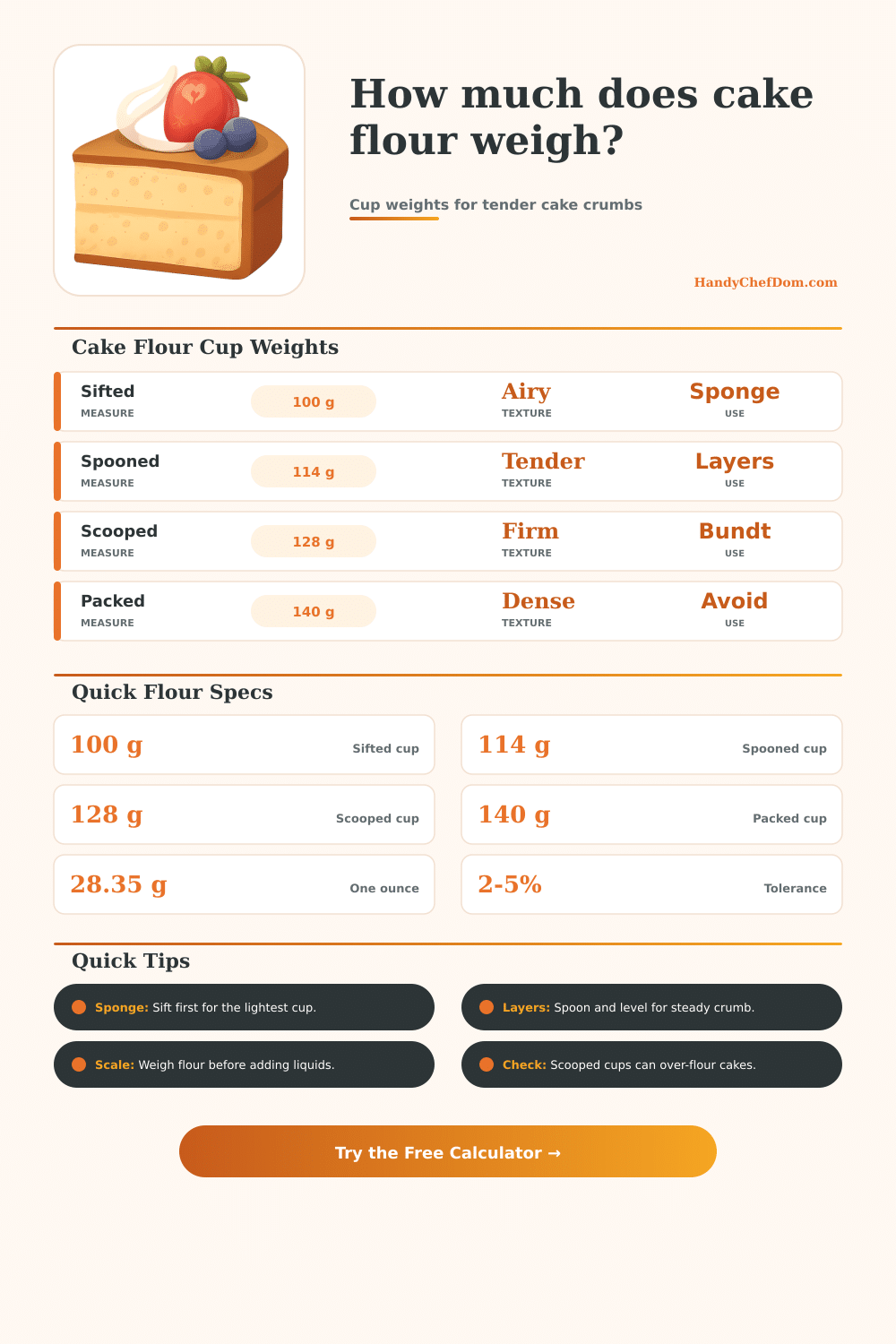
| Sifted first | 100 g / 3.5 oz | Angel food, chiffon, sponge roll | Very light and airy |
| Whisked and light spoon | 108 g / 3.8 oz | Fine crumb cupcakes | Light and tender |
| Spooned and leveled | 114 g / 4.0 oz | Butter layer cakes, velvet cake | Balanced crumb |
| Dipped or scooped | 128 g / 4.5 oz | Older volume recipes tested by scoop | Can bake slightly firm |
| Tapped or compacted | 140 g / 4.9 oz | Rarely recommended for cake flour | Dry or tight crumb |
| Cake flour type | Density factor | Protein feel | Best fit |
|---|---|---|---|
| Bleached cake flour | 1.00x | Lowest and softest | Classic layer cakes |
| Unbleached cake flour | 1.03x | Slightly stronger | Butter cakes needing structure |
| Pastry flour blend | 1.06x | Moderate tenderness | Coffee cake and quick cakes |
| Self-rising cake flour | 1.02x | Soft with leavening | Southern-style tender cakes |
| Homemade AP blend | 1.08x | Substitute blend | Use when cake flour is unavailable |
| Gluten-free cake blend | 0.96x | Starch-based | Delicate gluten-free layers |
| Whole wheat pastry | 1.10x | More absorbent | Rustic tender cakes |
| Starch-heavy tender blend | 0.94x | Very soft | Feather-light sponge cakes |
| Cake project | Common cups | Spooned weight | Precision note |
|---|---|---|---|
| Single 8-inch layer | 1.5 cups | 171 g | Keep within 5 g for even crumb |
| Two 8-inch layers | 2.5 cups | 285 g | Best weighed before mixing |
| Two 9-inch layers | 3 cups | 342 g | Level pans after scaling batter |
| 12 cupcakes | 1.75 cups | 200 g | Avoid scooping for domed tops |
| 10-inch chiffon | 1.25 cups | 143 g | Sifted weight is often lower |
| Bundt cake | 3.25 cups | 371 g | Sturdy batters tolerate more flour |
| Quarter sheet cake | 4 cups | 456 g | Batch multiplier helps scale up |
| Precision choice | Use this tolerance | What it means at 300 g | Cake impact |
|---|---|---|---|
| Competition or wedding tasting | 1-2% | 297 to 306 g | Repeatable crumb and height |
| Everyday layer cake | 3% | 291 to 309 g | Tender and consistent |
| Cupcakes | 4% | 288 to 312 g | Good dome control |
| Bundt or loaf cake | 5% | 285 to 315 g | Forgiving structure |
| Volume-only recipe test | 6-8% | 276 to 324 g | Expect texture variation |
If you’ve ever made a dense, brick-like cake, then you know how crushing it can be: you measured everything by the cup according to directions, yet despite following instructions, the cake didn’t turn out as light and ethereal as the recipe promised. Why? Because there’s a gap between using cups as measurement (volume) versus weighing ingredients in grams (weight).
Cake Flour Volume Weight Sifted 1 cup = ~100g Packed tight 1 cup = ~140g That’s a difference of thirty-five percent, using the exact same measuring device. It is enough to destroy the delicate crumb entirely. Once you choose your technique, the calculator will crunch numbers for you so you won’t spend time wondering about the severity of your scoop strength.
Why Weighing Flour Works Better
The problem started because flour settles in bags. All purpose flours has higher protein than cake flour; they are made to be heavier. You pack the flour down when you scoop it out with a measuring cup right in the bag. It packs up against side of the cup, adding much more starch than the writer of whatever recipe you’re reading probably meant. Most professional bakers actualy spoon their flour into the measuring cup, then use a straight edge to sweep it level across top. With that method, you get roughly 114 grams per US cup, somewhere between fluffy and heavy.
If you sift before measuring, the weight will drop to roughly 100 grams. This results in a texture that’s perfect for angel food cakes and chiffons, where egg whites provide structure instead of gluten. We need to consider air pockets to understand how density changes. Flour is not a solid block. It’s a powder with lots of small voids. Each time you shake the cup or tap the cup these voids compact and push more mass into same space.
That’s what happens when you are told to sift before or after measurement in a recipe. One cup of sifted cake flour means sift first and then measure. Less actual flour will be in your bowl. One cup of cake flour, sifted, means measure first and then sift that quantity. It is a small difference on paper but it makes a big change in how moist your finished product will be. Too much flour sucks up too much liquid and the result is a dry crumbly final product.
Besides just what you pack, other environmental factors can matter. For instance, flour absorbs moisture from its environment, so humidity make a difference in how your flour will behave. Over time, old stock sits heavier then fresh, aerated bags. The tool gives you the ability to adjust based off storage conditions or even based on the humidity where you live. It recognizes that baking is part science, part meteorology.
Depending on the flour itself, there may be other variables that should of been included. Homemade blends, such as those created by mixing some all-purpose flour with cornstarch, aren’t the same as bleached vs. One example is unbleached cake flour. There’s a difference in the weight per cup and the absorption rate when switching among these kinds of flours. Often swapping them out directly doesn’t work unless you make an adjustment.
Some cakes are more forgiving than others when it comes to precision. Dense batter structures such as a bundt cake holds up well to added flour. Delicate sponges like a roll won’t forgive the addition of an ounce. This is why setting a tolerance range allows us to manage expectations. When baking a tier for a wedding or an entry for a competition, you’ll need tight control (within one or two percent). On the other hand, if it’s a batch of cupcakes for a weeknight, you’ll be able to have more wiggle room and stay realistic while still producing a great product. The tables outline these trade-offs nicely, showing which types of cakes lines up with each method.
The weighing out removes the inconsistent variable of people. Sure, cups are nice, but they’re not consistent. People hold them different than. And grams don’t care if you’re in a hurry or taking your time. The right density factor converts volume measurements to weight which means each batch act the same as all previous ones. From then on, baking becomes repeatable instead of a guessing game. Your cakes will rise evenly and keep their shapes. They’ll provide a tender crumb while avoiding any sunken middles or dry edges. Learning this conversion takes little extra effort but it yields a huge jump in results.