🌾 Bulgur Wheat Per Person Calculator
Estimate dry bulgur cups, dry grams, cooked yield, servings covered, and a secondary water amount from guest count, meal role, grind size, appetite, salad or pilaf style, leftovers, and cooked cup target.
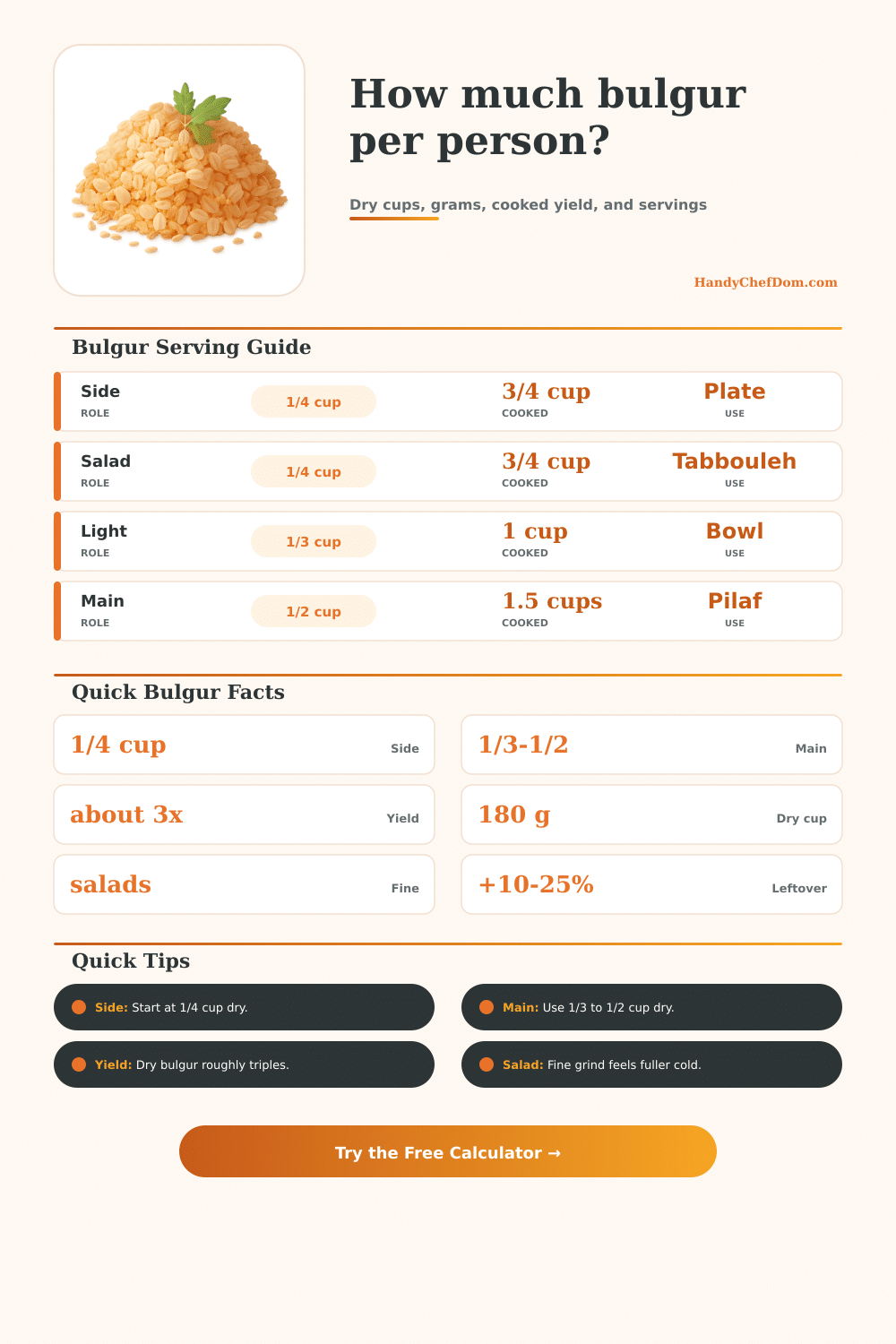
Reference rule: plan about 1/4 cup dry bulgur per person for a side and about 1/3 to 1/2 cup dry per person for a main. Dry bulgur roughly triples after hydration, so water is shown as a secondary planning estimate, not the main result.
Best when bulgur sits beside vegetables, meat, stew, or several other sides.
Fine or medium bulgur expands through herbs and vegetables, so the dry serving stays modest.
Works for lunch bowls, mezze plates, or a grain base with beans, greens, and sauces.
Use for bulgur-forward plates where the grain is the main starch and guests may want seconds.
| Meal role | Dry bulgur per person | Approx cooked yield | Best use |
|---|---|---|---|
| Small side | 3 tablespoons dry bulgur | About 1/2 to 2/3 cup cooked | Mezze plate, several sides, or lighter lunch plate. |
| Standard side | 1/4 cup dry bulgur | About 3/4 cup cooked | Most dinner side dishes and mixed vegetable bowls. |
| Bulgur salad | 1/4 cup dry bulgur | About 3/4 cup cooked | Tabbouleh-style salads where herbs and vegetables add volume. |
| Light main | 1/3 cup dry bulgur | About 1 cup cooked | Lunch bowls, grain plates, or a starch-forward side. |
| Generous main | 1/2 cup dry bulgur | About 1 1/2 cups cooked | Pilaf bowls, hearty vegetarian mains, or active appetites. |
| Grind size | Dry cup weight used | Cooked yield factor | Serving note |
|---|---|---|---|
| Fine bulgur | About 165 grams per dry cup | About 2.8 cups cooked per dry cup | Feels full in cold salads and tabbouleh because small grains spread through add-ins. |
| Medium bulgur | About 180 grams per dry cup | About 3 cups cooked per dry cup | Most versatile choice for sides, bowls, and everyday pilaf planning. |
| Coarse bulgur | About 190 grams per dry cup | About 3.1 cups cooked per dry cup | Better for pilaf and grain bowls where a distinct chewy bite is wanted. |
| Extra coarse bulgur | About 200 grams per dry cup | About 3.2 cups cooked per dry cup | Use slightly more water and expect a heartier plate presence. |
| Dry bulgur | Approx dry grams | Approx cooked yield | Serving planning note |
|---|---|---|---|
| 1/4 cup dry | About 45 grams | About 3/4 cup cooked | Good starting point for one side serving. |
| 1/3 cup dry | About 60 grams | About 1 cup cooked | Good for a light main or larger side serving. |
| 1/2 cup dry | About 90 grams | About 1 1/2 cups cooked | Generous main-bowl amount for one person. |
| 1 cup dry | About 180 grams | About 3 cups cooked | Often serves 4 sides or 2 generous mains. |
| 2 cups dry | About 360 grams | About 6 cups cooked | Useful for 8 side servings or 4 main servings. |
| Grain | Common dry side amount | Typical cooked yield | How it compares |
|---|---|---|---|
| Bulgur wheat | 1/4 cup per person | Roughly 3 cups cooked per dry cup | Quick swelling cracked wheat; this calculator sizes bulgur servings. |
| Couscous | 1/4 cup per person | About 2 1/2 to 3 cups cooked per dry cup | Similar side planning but lighter and smaller in texture. |
| Rice | 1/4 to 1/3 cup per person | About 3 cups cooked per dry cup | Similar yield, but rice often feels softer and denser on the plate. |
| Quinoa | 1/4 cup per person | About 3 cups cooked per dry cup | Comparable volume yield with a different protein and texture profile. |
| Farro | 1/3 cup per person | About 2 1/2 to 3 cups cooked per dry cup | Chewier and usually served in a larger dry portion for mains. |
Bulgur is grain that requires portion planning due to various different factors that will impact teh amount of bulgur that is required for a meal. For instance, the portion of bulgur that is required per person will change based on whether the bulgur is to be a side dish or the main dish of the meal. Additionally, the amount of bulgur that is required will change based on the types of dish in which the bulgur is to be used; hot pilafs will require more bulgur than salads containing bulgur.
Ensuring the correct amount of bulgur for a meal help to balance the meal; preventing either the bulgur from being too small and creating leftovers, or bulgur from being too large and causing the guests to become depleted of their meals. The bulgur calculator require that each person inputs information regarding the meal that is to be prepared that contains bulgur. You must enter the number of guests that will attend the meal, as must the role that bulgur will play in the meal.
How Much Bulgur to Cook for a Meal
Other options that must be selected include the grind of the bulgur to be used in the meal, the appetite level of the guests, whether the bulgur is to be mixed with vegetables, or if it is to be served as a standalone bowl of bulgur. Bulgur can be ground fine or coarsely, and those who select fine bulgur will often include herbs in the dish, or use fine bulgur in a salad to make the meal appear more larger. Coarse bulgur retains some texture when eaten, and is often used as the main starch of the meal.
Additionally, the appetite level can be adjusted to provide more bulgur if the recipe is thought to potentially create leftovers, or if less bulgur is desired to be prepared. The calculator will output three main pieces of information. It will list the amount of dry bulgur that should be measured, the total volume of cooked bulgur will be listed, and how many servings that cooked bulgur will provide.
Additionally, a measurement of the amount of water in which bulgur should be cooked is also provided; however, this is only a recommendation as additional factors like resting times and the addition of oil or vegetables to the cooked bulgur affect the texture of bulgur after cooking. Finally, the information regarding the cooked bulgur is important because the cooked bulgur is usually three times larger in amount then the dry bulgur, so knowing this relationship allows the individual to understand the bulgur calculations. Bulgur differs slightly from other grain.
For instance, bulgur cooks faster than grains like brown rice or farro, yet retains more texture than grains like couscous. Bulgur also absorbs the flavors of the dishes in which it is cooked, yet does not become mushy like other grains. Additionally, the faster cooking time of bulgur indicates why bulgur is best used in meals that are prepared for weeknight dinners, or meals that can be prepared in large batches.
However, the ability of bulgur to cook quickly can also create challenges in the portioning of bulgur; too little bulgur may make individuals feel hungrier after eating, yet too much bulgur can create challenges in feeling satisfied after meals. Many individuals often make the mistake of portioning bulgur for the same amount as they would for rice or quinoa portions. However, using bulgur in this way can create challenges in the portioning of bulgur for individuals; bulgur may become too small or too large for individual meals.
For instance, a salad that contain bulgur and ingredients like tomatoes and herbs may require less bulgur than a pilaf with bulgur, as the bulgur is the main ingredient of the pilaf. In addition to cooking bulgur, it is also useful to know how bulgur may behave after the meal is finished. Bulgur both reheats well, and retain its freshness in refrigeration for several days.
Thus, individuals who prepare bulgur meals may wish to cook an extra portion of bulgur to ensure that there is bulgur left for lunch. The bulgur calculator calculates for this additional portion, which makes use of the freshness of bulgur to calculate the amount of additional bulgur that should be cooked; otherwise, individuals may not understand how much bulgur should be cooked in addition to the bulgur that will be served for the main meal. The main purpose of the bulgur calculator is to turn the idea of the amount of bulgur that is needed for a meal into a specific measurement.
By using the bulgur calculator, individuals will understand how the role of bulgur, the grind of bulgur, and the appetite of the individuals who will enjoy the meal can alter the amount of bulgur that is needed. Thus, individuals will understand how to prepare bulgur meals more quickly, and the cooking process of bulgur will be more consistent.