🥛 Protein in Milk Calculator
Estimate milk protein by dairy type, cups or ml, serving count, dilution, recipe use, and meal protein target.
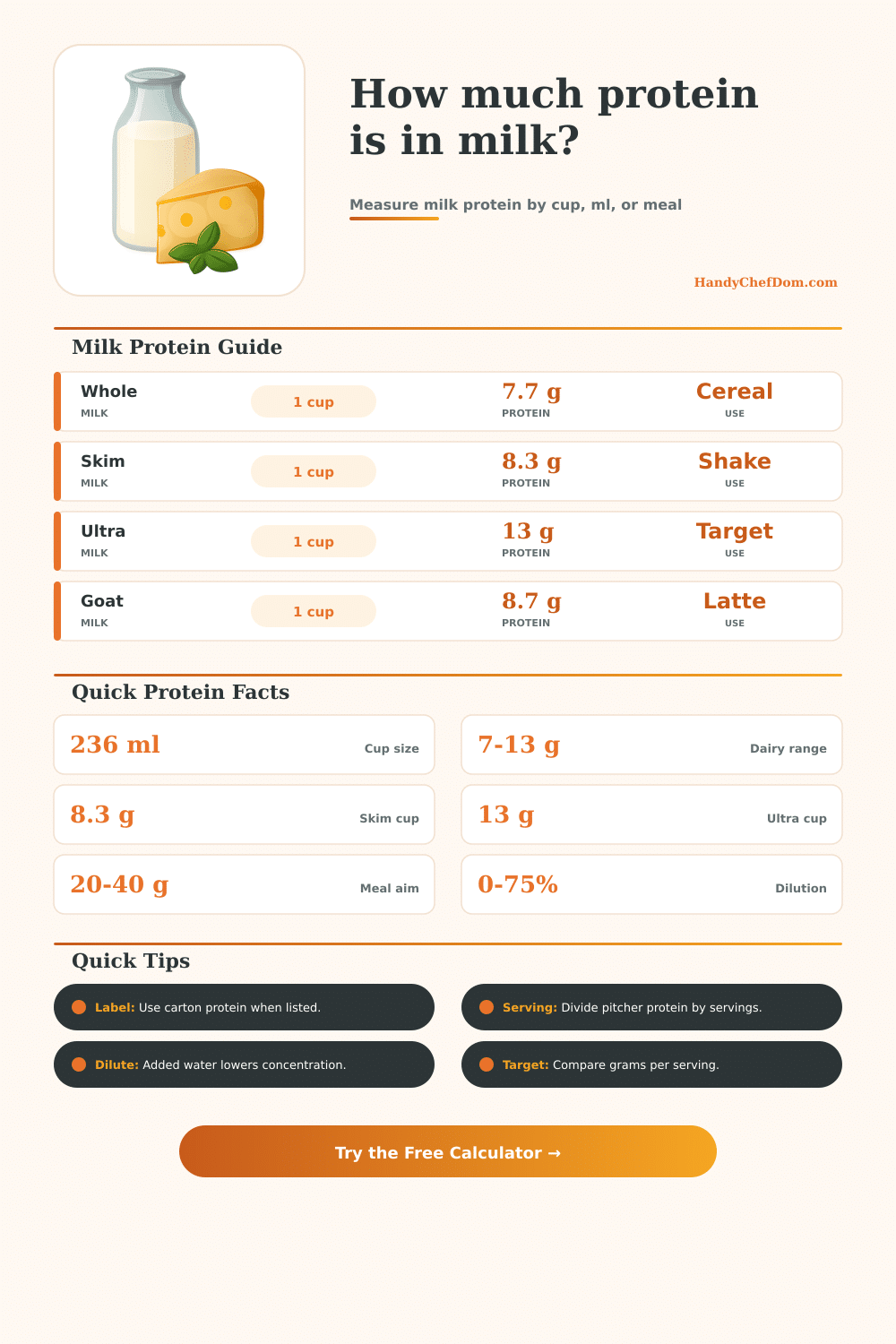
Use typical per-cup nutrition data or enter the exact protein from your carton. Dilution changes protein concentration, not the total grams coming from milk.
Typical nutrition values vary by brand and fortification. Use the override input when the carton lists a different protein number.
| Milk type | Protein per cup | Calories per cup | Best calculator use |
|---|---|---|---|
| Whole dairy milk | 7.7 g | 149 kcal | Cereal, cocoa, sauces |
| 2 percent dairy milk | 8.1 g | 122 kcal | Everyday glass or latte |
| 1 percent dairy milk | 8.2 g | 102 kcal | Smoothies and meal prep |
| Skim dairy milk | 8.3 g | 83 kcal | Higher protein per calorie |
| Lactose-free dairy milk | 8.0 g | 120 kcal | Same math as dairy milk |
| Ultra-filtered dairy milk | 13.0 g | 120 kcal | Protein target meals |
| Goat milk | 8.7 g | 168 kcal | Recipe swaps and drinks |
| Evaporated milk, undiluted | 17.0 g | 338 kcal | Concentrated recipes |
| Recipe use | Protein math | Dilution cue | Target style |
|---|---|---|---|
| Straight glass | Total milk protein divided by servings | Usually none | Snack or meal side |
| Cereal bowl pour | Count the milk you expect to drink | None unless ice added | Breakfast add-on |
| Smoothie or shake | Milk protein plus other ingredients separately | Ice adds volume | Post-workout or meal |
| Latte, cocoa, or tea | Milk protein stays in the cup | Coffee adds volume | Small drink target |
| Baking batter | Divide batch milk protein by pieces | Water does not add protein | Per pancake or slice |
| Soup or sauce finish | Divide by bowls or plates served | Stock lowers concentration | Meal component |
| Meal target | Milk amount with skim | Milk amount with ultra-filtered | Use case |
|---|---|---|---|
| 8 g | About 1 cup | About 0.6 cup | Light snack |
| 15 g | About 1.8 cups | About 1.2 cups | Smoothie base |
| 20 g | About 2.4 cups | About 1.5 cups | Meal helper |
| 25 g | About 3 cups | About 1.9 cups | High-protein bowl |
| 30 g | About 3.6 cups | About 2.3 cups | Large shake |
| 40 g | About 4.8 cups | About 3.1 cups | Batch target |
| Drink or dairy item | Calories | Fat | Carbs |
|---|---|---|---|
| Whole dairy milk, 1 cup | 149 kcal | 7.9 g | 11.7 g |
| 2 percent dairy milk, 1 cup | 122 kcal | 4.8 g | 11.7 g |
| Skim dairy milk, 1 cup | 83 kcal | 0.2 g | 12.2 g |
| Ultra-filtered dairy milk, 1 cup | 120 kcal | 4.5 g | 6.0 g |
| Plain lowfat kefir, 1 cup | 104 kcal | 2.5 g | 11.6 g |
| Unsweetened soy milk, 1 cup | 80 kcal | 4.0 g | 4.0 g |
Milk contains protein and is used in a variety of ways throughout the day. For instance, you can add milk to cereals, coffee, or pancakes or shakes. Since milk are utilized in a variety of meals and snacks throughout the day, the protein content of milk is a factor to consider in the diet of an individual.
The amount of protein that is contained within milk is dependent upon both the type of milk that is utilized and how much the milk is dilute prior to its use in food item. In order to determine the protein content of milk in different recipes, it is first necesary for an individual to understand how the protein in milk is measured. For instance, most milk contain protein measurements per cup of milk.
How to Find Protein in Milk and Recipes
However, an individual dont always use a single cup of milk in there recipe. Thus, an individual can use a calculator to determine the amount of protein in milk by each serving by entering the amount and type of milk that will be used in the recipe. One way that the amount of protein in milk may be altered is through the dilution of the milk.
For instance, you can dilute milk through the addition of water, ice, coffee, or stock to the milk. By adding these liquid to milk, the protein in milk is diluted because the volume of liquid increases without the increase in protein content. For instance, using one cup of milk with one cup of water will increase the total volume of the liquid to two cups of liquid, but the amount of protein will remain the same.
Furthermore, the calculator also accounts for the dilution of milk by asking for the percentage of dilution of milk that will be use in the recipe. Additionally, there are different types of milk that contain different amount of protein. For example, skim milk contains a slightly higher amount of protein than whole milk because skim milk has fat removed from the milk.
Ultra-filtered milk contains more protein than regular milk because the ultra-filteration process remove some of the water and lactose from the milk, thus increasing the protein concentration of the milk. Furthermore, plant based milks also contain different amounts of protein, though the variation between different types of plant-based milks is more pronounced then the variations between different types of dairy milk. For example, oat milk has less protein than dairy milk, but pea-protein milk contains more protein than oat milk.
These different type of milk can be compared in the calculator to determine the effect that each type of milk have on the protein content of the recipe that utilizes that milk. Beyond the type and amount of milk that is used in a recipe, the way in which an individual use the milk in a recipe will also impact the way in which the protein content of milk is calculated. For instance, when an individual pours milk over cereal, some of the milk may remain in the bowl and not be consume by the individual.
In other instances, such as in smoothies, the individual may consume all of the milk and all of the protein contained within that milk. In other instances, such as in baking, the milk may be spread out over a variety of food item, thus requiring calculations of the amount of protein that is contained in each individual food item. The calculator also asks for the use of milk in a recipe to calculate the protein content.
An individual may need to reach a target amount of protein from the milk that is consumed in a meal. For instance, an individual may desire to reach a target amount of 20 gram of protein in a shake. In this case, the shake may contain two cup of milk, but due to the addition of ice and/or water to the shake, the shake may not contain 20 grams of protein.
To increase the protein content of the shake, the individual may opt for using ultra-filtered milk instead of regular milk, or the individual may simply add more milk to reach the desired protein goal. Thus, the protein per serving comparison with the target protein amount remove the need for guesswork in the protein content of milk-based recipes. By performing these calculations prior to shopping for ingredient or cooking, an individual can determine if the milk that is currently in the refrigerator will provide the protein content that is desired, or if the purchase of a different type of milk will provide more beneficial protein content.
Furthermore, the calculation can also help an individual to determine the amount of dilution that can exist in the recipe before the amount of protein per serving becomes too low to be beneficial to the individual that consumes the recipe. By adjusting the recipe based off the information that is gained from the calculator, an individual can ensure that the recipes that is prepared contain the appropriate amount of protein.