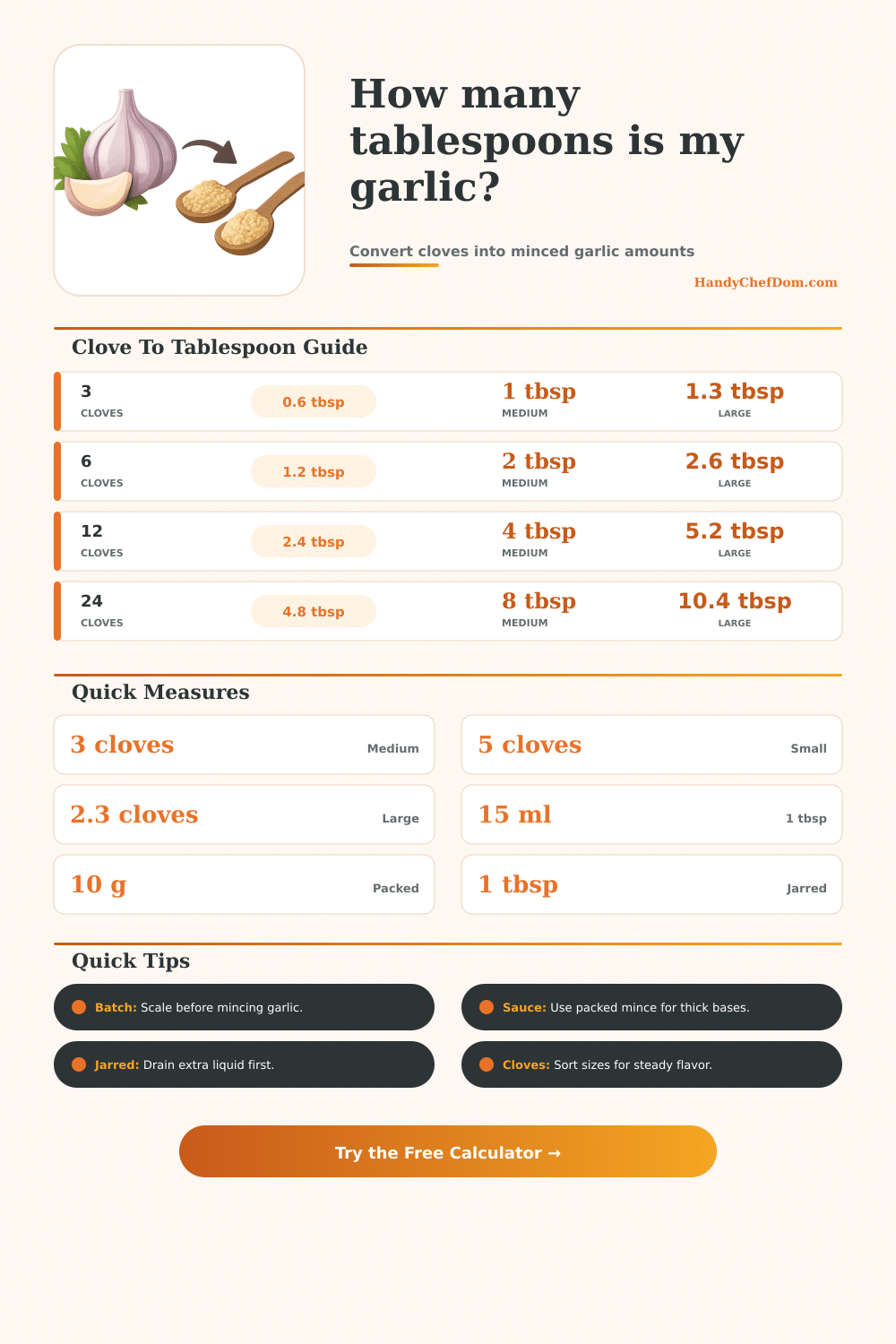
🧄 Garlic Cloves to Tablespoons Converter
Plan minced garlic by the tablespoon for batch cooking, marinades, sauces, clove size swings, mince density, and jarred garlic backup amounts.
Enter the fresh garlic count, choose the average clove size, then tune mince density and batch factors so the tablespoon result fits sauces, marinades, dressings, and prep containers.
| Clove Size | Tablespoons Per Clove | Cloves Per Tablespoon | Best Planning Use |
|---|---|---|---|
| Tiny cloves | 0.16 tbsp | 6.3 cloves | Fine sauces and dressings |
| Small cloves | 0.20 tbsp | 5.0 cloves | Balanced marinades |
| Medium cloves | 0.33 tbsp | 3.0 cloves | Everyday batch cooking |
| Large cloves | 0.43 tbsp | 2.3 cloves | Tomato sauces and stews |
| Jumbo cloves | 0.55 tbsp | 1.8 cloves | Large prep containers |
| Mixed prep pile | 0.30 tbsp | 3.3 cloves | Fast kitchen estimates |
| Mince Style | Density Factor | Typical Weight | Planning Note |
|---|---|---|---|
| Loose hand mince | 0.88x | 7 g/tbsp | Airy spoonfuls need more volume |
| Standard minced garlic | 1.00x | 8 g/tbsp | Good default for batch recipes |
| Fine knife mince | 1.08x | 8.6 g/tbsp | More garlic fits in the spoon |
| Packed spoonful | 1.20x | 9.6 g/tbsp | Best for dense sauce bases |
| Garlic paste texture | 1.35x | 10.8 g/tbsp | Strongest tablespoon impact |
| Jarred minced garlic | 0.94x | 7.5 g/tbsp | Drain liquid for closer match |
| Batch Use | Garlic Level | Adjustment | Tablespoon Planning Note |
|---|---|---|---|
| Balanced all-purpose | Medium | 1.00x | Base converter result |
| Marinade forward | Bold | 1.12x | Helps flavor carry through liquid |
| Sauce base | Rounded | 0.95x | Lets reduction concentrate flavor |
| Dressing or dip | Sharp | 0.82x | Keeps raw garlic from dominating |
| Compound butter | Rich | 1.05x | Works with fat-heavy batches |
| Garlic-heavy prep | Very bold | 1.25x | For recipes where garlic leads |
| Fresh Cloves | Medium Mince | Jarred Match | Container Planning |
|---|---|---|---|
| 6 cloves | 2 tbsp | 2.2 tbsp | Small sauce starter |
| 12 cloves | 4 tbsp | 4.4 tbsp | Family marinade |
| 24 cloves | 8 tbsp | 8.9 tbsp | Meal prep base |
| 36 cloves | 12 tbsp | 13.3 tbsp | Party sauce batch |
| 48 cloves | 16 tbsp | 17.8 tbsp | Catering prep tub |
| 60 cloves | 20 tbsp | 22.2 tbsp | Large prep station |
If you’ve ever measured out three tablespoons of minced garlic and found yourself staring at an oversized-clove bulb then you know what I’m talking about: You squeeze the hell out of those cloves and chop away, getting only two tablespoons’ worth. What’s left is a weak marinade; your sauce have no oomph.
It’s not because you’re a bad knife person, it just isn’t how nature made garlic to spoon up neatley. The calculator solve this, and it will help any cook beyond toast-land.
Why You Need a Garlic Converter
The problem is that “clove” isn’t an actual unit of measure. It’s a fraction of the vegetable itself, and there are variations within plant. A big, bulbous clove will produce more than a little withered thing. Home chefs typically think there must be some straightforward ratio at play, but nope.
To account for these variables, this tool simply ask you to choose how big your garlic usually is. Select “delicate,” and it’ll skew things down. Pick “huge,” and it’ll adjust for your higher volume.
Going too far either way result in bitter bits in your sauce, or worse, it over-minces into something so strong that it will overwhelm whatever else are on the plate. Even the texture enters into equation. Garlic minced to a paste isn’t a solid mass; it’s a loose collection of moist particles that will pack with varying densities based off your chopping technique. A coarsely hacked mince in a hurry occupy less volume than a fine one.
The converter lets you select the style of your mince’s density. Though seemingly insignificant, it makes a large difference in weight. Making compound butter? Do you want eight grams or ten per tablespoon? It makes all the difference between garlicky and too-sharp for the bread.
Another challenge is batch cooking. You don’t want to guess when making marinades for a dozen serving. You want them consistent. Enter the batch multiplier (along with trim loss). A digitization of practical kitchen knowledge. The calculator allow you to account for trim loss. The garlic you always lose while peeling it and when transferring it from board to bowl.
If you ignore that eight percent loss, then each batch thereafter will have less than what was intended. Compound that over several batches and it’ll add up to a noticeable lack of flavr for everything you made all day long.
A lot of people hate on all-purposed minced garlic in a jar, but sometimes unfairley. Usually it’s been pasteurized and put into a vinegar or oil mixture, so the concentration isn’t like raw mince. There’s also a jarred alternative check built into the tool, which subtracts the volume of liquid from formula. So you can see whether one tablespoon of your leftover jarred garlic matches up with three cloves of fresh garlic. Rarely ever will it be one-to-one without tweaking. And the calculator tell you how much of a bump you’ll need to get there. It eliminates guesswork when you have leftovers instead of needing to peel another head.
Cooking’s an act of science disguised as art. The weather that made your garlic grow? Beyond your control. But the way you chop it up? That’s something you can control. Standardize density and size and take one of the variables responsible for taste variability out of the equation. Turn a chaotic heap of garlic cloves into an ingredient whose behavior you can predict.
Stop guessing and start making things confidentely. When your garlicky sauce hits the intended spot on the first spoonful, you’ll understand.