🫘 Beans in Water Soaking Time Calculator
Estimate bean soaking time, water volume, brine salt, ready time, container space, and cooked yield from real bean kitchen ratios.
Enter the dry bean amount, choose the soak style, and adjust for temperature, salt, bean age, altitude, and the texture you want after cooking.
| Bean Type | Dry Cup Weight | Classic Soak | Cooked Yield |
|---|---|---|---|
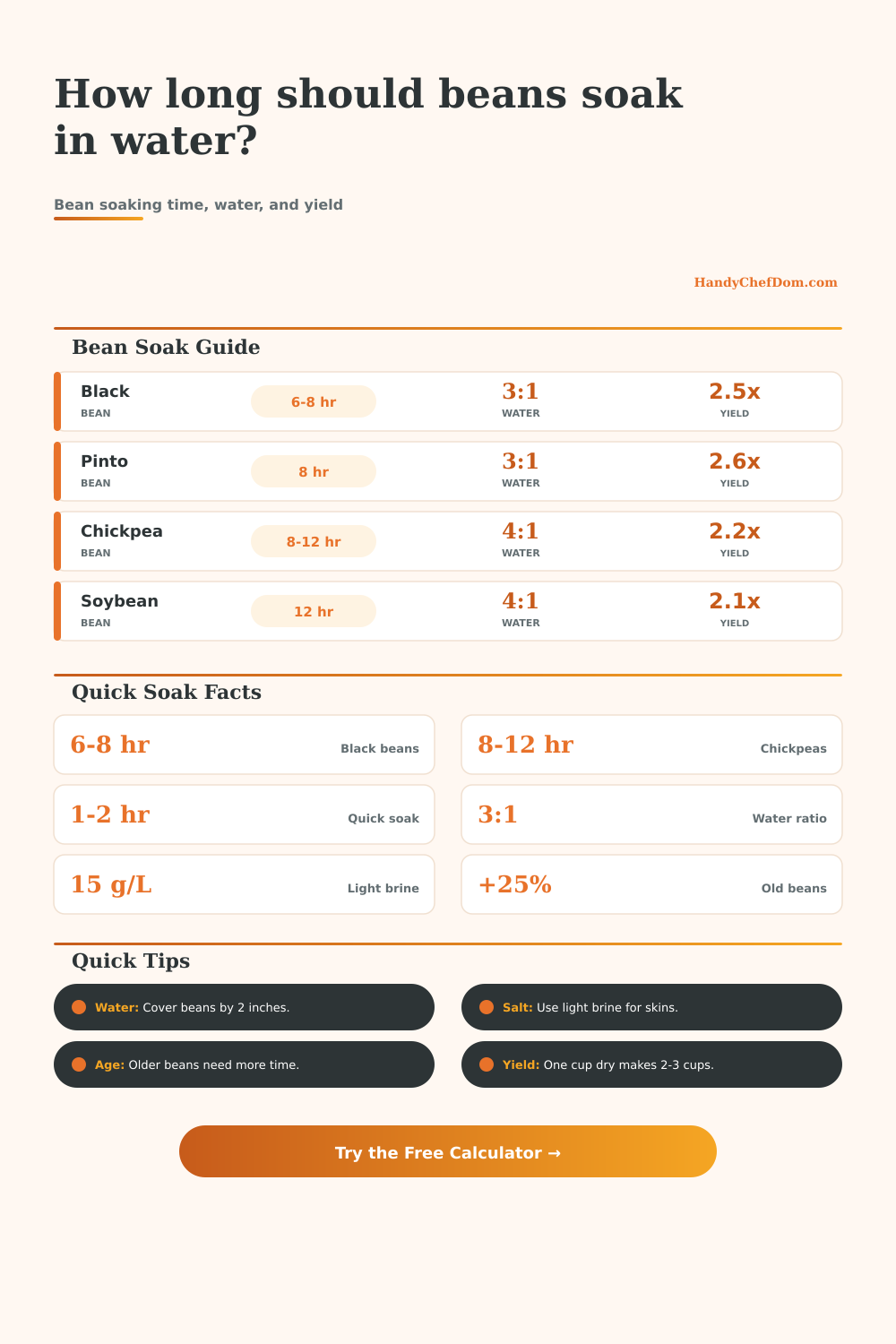
| Black beans | 180 g | 6 to 8 hr | 2.5 cups |
| Pinto beans | 185 g | 8 hr | 2.6 cups |
| Red kidney beans | 184 g | 8 to 12 hr | 2.7 cups |
| Chickpeas | 200 g | 8 to 12 hr | 2.2 cups |
| Navy beans | 190 g | 6 to 8 hr | 2.7 cups |
| Cannellini beans | 190 g | 8 hr | 2.5 cups |
| Great Northern beans | 188 g | 8 hr | 2.6 cups |
| Large lima beans | 180 g | 8 to 12 hr | 2.4 cups |
| Soybeans | 190 g | 10 to 12 hr | 2.1 cups |
| Brown or green lentils | 192 g | Rinse only | 2.3 cups |
| Method | Typical Time | Water Ratio | Best For |
|---|---|---|---|
| Classic overnight | 6 to 12 hr | 3:1 | Most dry beans |
| Quick hot soak | 1 to 2 hr | 4:1 | Same day cooking |
| Hot covered soak | 3 to 4 hr | 4:1 | Older beans |
| Short room soak | 2 to 5 hr | 3:1 | Fresh beans |
| No soak | 0 hr | Cooking pot | Lentils, split peas |
| Light brine soak | 6 to 12 hr | 3:1 | Creamy centers |
| Choice | Kitchen Ratio | Use | Calculator Effect |
|---|---|---|---|
| Minimum cover | 2.5:1 | Small beans | Less extra water |
| Standard soak | 3:1 | Most beans | Balanced volume |
| Large bean soak | 4:1 | Chickpeas | More swelling room |
| Light brine | 10 g/L | Tender skins | Slight time cut |
| Standard brine | 15 g/L | Even texture | More salt listed |
| Warm start | 90 to 110 F | Quick hydration | Shorter estimate |
| Factor | Setting | Time Change | Kitchen Note |
|---|---|---|---|
| Fresh crop | Under 6 mo | -15% | Hydrates faster |
| Pantry beans | Typical | Base | Use normal range |
| Older beans | 1 to 2 yr | +25% | Check texture |
| Very old beans | 2 yr plus | +50% | May stay firm |
| High altitude | 3,000 ft+ | +8% | Longer cook follows |
| Firm target | Salads | -15% | Stop before split |
| Bean | Calories | Protein | Carbs |
|---|---|---|---|
| Black beans | 114 | 7.6 g | 20 g |
| Pinto beans | 122 | 7.7 g | 22 g |
| Kidney beans | 112 | 7.7 g | 20 g |
| Chickpeas | 134 | 7.3 g | 22 g |
| Navy beans | 128 | 7.5 g | 24 g |
| Lentils | 115 | 8.9 g | 20 g |
With the best of intentions, you reach into the pantry for a bag of dry beans, but in just forty-five minutes it’s time for dinner. The directions on the bag is vague, and who can remember how long they said to soak them for?
To soak beans, manage the hydration. Hydrate a dormant seed, coaxing it back to life. Make it drink its weight in water. Patience are required. A plan is necessary if you want total control over end result.
How to Soak Beans Perfectly
After selecting your preferred method and type of bean, plugging them into the calculator lets it do the work for you. No need for conversions or coefficients; they’re saved for you. The calculator even consider those factors that many home cooks forget about, such as the age of the beans and your elevation.
Those two play a role. Higher elevation mean lower atmospheric pressure, leading to a lower boiling point of water (meaning slower cook time). Plan for an extended soak if you live at higher altitudes, or just be prepared for a long simmer.
And then there’s the age of the bean itself. An eighteen-month-old bean from some store warehouse isn’t going to have the same soft, tender seed coat that a bean harvested last spring do. That older bean requires additional soak time to break through its shell before it’ll get tender.
Another frequent pitfall is amount of water needed. When it comes to soaking, many folks greatly under-estimate volume of swollen beans. One cup of dried black beans almost triples when soaked. And if you don’t leave sufficient headspace above the beans in whatever container you’re using, your water won’t cover all your seeds… And you’ll be depriving the beans of hydration, while also creating a water-based mess all over your counter.
According to the device, a typical three-to-one ratio works for most types; however, bigger beans (such as soybeans or chickpeas) tend to prefers a four-to-one solution. More water means each bean has more wiggle room to swell up (instead of bumping against its neighbor), resulting in even cooking down the line.
The food world is divided on whether to use salt in the soaking water. Cooks have been instructed for decades that adding salt will toughen up the skins of the beans. That is not quite right. In fact, salt softens the cell walls by breaking down their pectins, resulting in a more intact skin and creamier interior.
If you’re cooking beans that you intend to serve as dips or a salad, where you’d like them to keep their shape, using a slight brine makes a noticeable difference in texture. And now, with the calculator you’ll be able to know exactly how much to add (for a typical brine concentration), instead of actualy turning your soaking water into a pickle brine. It is an exact measure of what used to be a vague instinct.
But what if you forgot to plan ahead? The trick with quick soaking will do something similar, bringing the beans to a boil and allowing them to sit off the heat for an hour or so. This would of been quite as good as a proper overnight soak (the sudden shift in temperature can occasionally stress the seed coat), but it’s still much better than no soak at all.
Split peas and lentils are the exception: They’re so small and without that tough outer skin that they really don’t require any soaking whatsoever. A good rinse goes a long way.
When you understand those factors, it makes the whole cooking process so different than before. It’s no longer just an unpleasant chore; now it is part of the cooking process. The beginning of bringing out flavors and controlling textures. Removing all the worry from “will my beans be ready in time?” and replacing it with “what kind of spice mix will really bring this dish to life?”
*Soaking times are only estimates. Actual timing will depend on several factors including your altitude (higher = slower), which bean type you’re using, and even how old the beans is.
What you get is a plate of beans that doesn’t feel rushed or hastily assembled. They’re still intact, but they’re tender. They’re creamy but not falling apart. They’re just the right amount of moist, all the way through. It takes a little effort up front for a payoff in each bite. You get a deep, rich flavor you can only achieve with a good soak. You also get that pleasing pop when one of those soaked-and-cooked-to-perfection beans surrenders to your tongue. This is proof that even the most basic pantry staple can become something realy special thanks to a little forethought.