🌿 Dried to Fresh Oregano Converter
Convert dried oregano into fresh chopped leaves, sprigs, or a reverse dried amount for Italian sauces, Greek salads, marinades, and long simmers.
Start with either dried or fresh oregano, then tune the conversion for crushed versus whole dried leaf, fresh chopped leaves or sprigs, dish style, oregano strength, and simmer time.
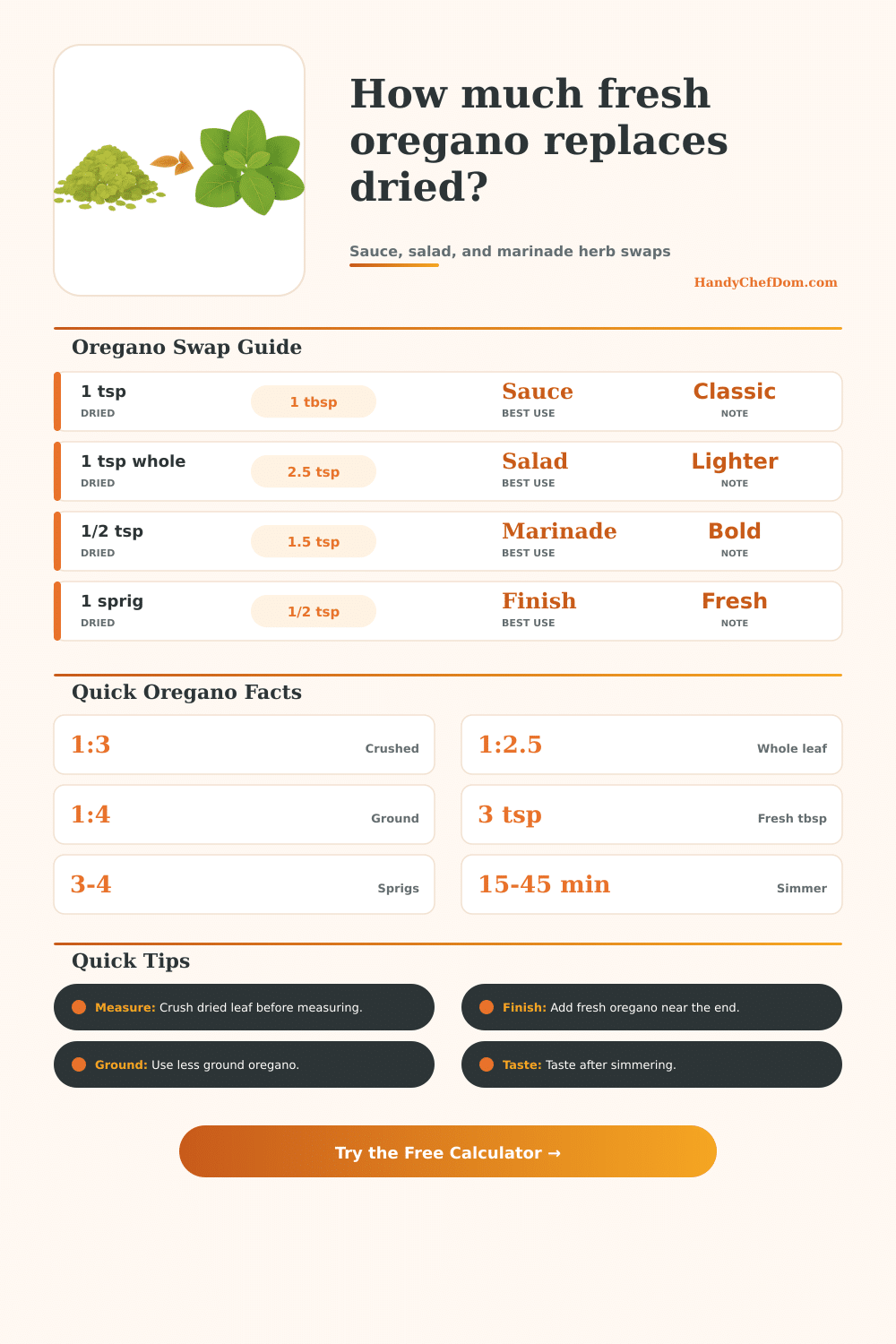
| Oregano Form | Equivalent to 1 tsp Crushed | Best Use | Flavor Note |
|---|---|---|---|
| Dried crushed oregano | 1 tsp | Italian sauces, stews | Balanced pantry standard |
| Dried whole leaf oregano | 1.25 tsp | Greek salads, finishing rubs | Rub first for more aroma |
| Ground dried oregano | 0.75 tsp | Marinades, spice blends | Fast and stronger on the tongue |
| Fresh chopped leaves | 1 tbsp | Fresh sauces, salads | Classic dried to fresh swap |
| Fresh loose leaves | 1.5 tbsp | Salads, bowls, garnish | Looser measure than chopped |
| Fresh oregano sprigs | 3 to 4 sprigs | Simmering, oils, marinades | Depends on sprig length |
| Dish Context | Oregano Style | Adjustment | Practical Target |
|---|---|---|---|
| Italian tomato sauce | Dried crushed early | 1.00x | Bloom in oil or simmer 15 minutes |
| Greek salad or feta bowl | Whole dried or fresh leaves | 0.90x | Keep aroma sharp and not dusty |
| Lemon garlic marinade | Ground or crushed dried | 1.10x | Acid and oil soften the herb edge |
| Pizza sauce or topping | Crushed dried plus fresh finish | 0.95x | Use less if cheese and olives are salty |
| Roasted vegetables | Crushed dried or chopped fresh | 1.15x | Heat mutes fresh leafy aroma |
| Beans, lentils, or stew | Dried crushed early | 1.20x | Long cooking needs a firmer hand |
| Focaccia oil or bread dip | Fresh chopped or whole dried | 0.85x | Surface oregano reads stronger |
| Tomato soup or broth | Crushed dried mid-simmer | 1.05x | Round but still noticeable |
| Simmer Time | Dried Oregano Behavior | Fresh Oregano Behavior | Converter Adjustment |
|---|---|---|---|
| No heat | Can taste dusty unless rubbed | Bright and leafy | Reduce dried or use fresh finish |
| 5 to 10 minutes | Starts to bloom | Still fairly bright | Use classic ratio |
| 15 to 30 minutes | Balanced sauce flavor | Some aroma fades | Add a small fresh lift |
| 45 to 60 minutes | Mellows into tomato and oil | Leafy aroma drops | Increase fresh if added early |
| 90 minutes or longer | Deep background herb note | Best saved for the end | Split dried early and fresh late |
| Fresh Measure | Approx Chopped Leaves | Sprig Estimate | Kitchen Note |
|---|---|---|---|
| 1 tsp fresh chopped | 0.7 g | 1 small sprig | Good for a single salad bowl |
| 1 tbsp fresh chopped | 2 g | 3 to 4 sprigs | Matches about 1 tsp dried crushed |
| 2 tbsp fresh chopped | 4 g | 6 to 8 sprigs | Good for a family sauce pot |
| 1/4 cup fresh chopped | 8 g | 12 to 16 sprigs | Use for large marinades or trays |
| 1/2 cup loose leaves | 7 g | 10 to 14 sprigs | Loose leaves compact when chopped |
Or maybe you’re making a recipe that requires fresh oregano, yet you’ve only got some dried oregano in a jar. The usual solution on the internet is to use one-third as much. This isn’t exactly wrong, but it doesn’t consider how these herbs works in a dish or how they differ from each other. Fresh oregano isn’t merely shriveled-up dry oregano. It’s bright and immediate, but also delicate. The dried version is the concentrated essence of that flavor, something that requires time and heat to let its oil unfold.
Swap one for the other without taking cooking method into account, and you’ll end up with a flat-tasting or aggressively medicinal sauce. Enter the tool at top, which accounts for factors such as herb potency and simmering time, and stops you in your tracks so you can cook confidently, rather than guessing.
How to Use Fresh and Dried Oregano
Most folks don’t think about the fact that how a dried herb is made does make a difference. One teaspoon of dried whole leaf oregano are light and fluffy; one teaspoon of crushed oregano is packed tightly and releases its flavors fast. If you use one instead of the other, you may need to adjust for the difference in volume. If you use too little of the wrong kind, your dish will probably be underseasoned. The calculator factors in this variation so you’re not accidentally shorting yourself on sauce based off how your dried herb arrived at your pantry. It is a tiny difference, but it changes finished taste.
Another quiet variable is simmer time. A few minutes in hot tomato liquid (or even oil) is not enough to soften the rough edges of dried oregano and make it bloom. You’ll get something that tastes dusty and harsh. Use only dried oregano if there’s enough cooking time, like fifteen or maybe thirty minutes on the hob so you can simmer it in your sauce. For longer-simmered stews, where lots of volatile aroma has cooked off after an hour or more, recipe requires more dried herb. On the opposite side of the spectrum, if you are doing a quick five-minute sauté, fresh is the better choice, even if you have to buy it. The tables on the page spells this out, making clear when a heavy hand is called for (a bean stew) versus when a light one (quick marinade).
Unlike some fresh herbs (oregano, for example), which bring brightness and texture but no real depth of earthy flavor, other kinds really need to go in at the last minute. In general, adding fresh herbs too soon will allow the heat to blunt their taste and fade their bright green to a sad olive-drab shade. If you’re tossing fresh herbs into something like a finished sauce, as with these two recipe, mince them well so that they release even more smell and have maximum surface area.
Use the converter to figure out just how many fresh herbs you’ll need to substitute for all that concentrated dried goodness, whether you’re seasoning a pot of Sunday marinara or a big Greek salad, and never be thrown off-balance again when it comes to flavor.
Jarred: There’s also something about potency that jars don’t really tout. Fresh Greek oregano from a new jar will smell much stronger than a cheap Italian blend that is years old. Since any dried stash has become weaker with age, you’ll have to adjust the conversions downward to account for that loss of strength. You might add extra volume to achieve same punch, or just admit that this one requires fresh herbs and can’t be saved in the pot.
Taste while you work, as always: The gold standard of cooking rules. In the end, though, it’s all about taste balance, not simply mathematics. Remember that oregano is an assertive, bold flavor; too much can be overpowering. Consider also what role you’re playing with the herb (fresh as a finish, or dried leaves added at depth) and whether it will remain in the pot throughout its entire cooking time.
Understanding these details turns a simple substitution into a conscious decision-making process that enriches your dish with the herbal depth it should of. And not dominate the rest of the flavors on the plate.