🧅 Onions Per Pound Calculator
Estimate onion count, usable cups, and recipe-ready weight for yellow, red, sweet, white, and pearl onions.
Choose the onion style, average size, and what you are starting from. The calculator estimates onions per pound, total onions needed, peel and trim loss, and chopped or sliced cups for soup, salsa, or saute prep.
| Onion Type | Common Size | Average Each | Approx Per Pound |
|---|---|---|---|
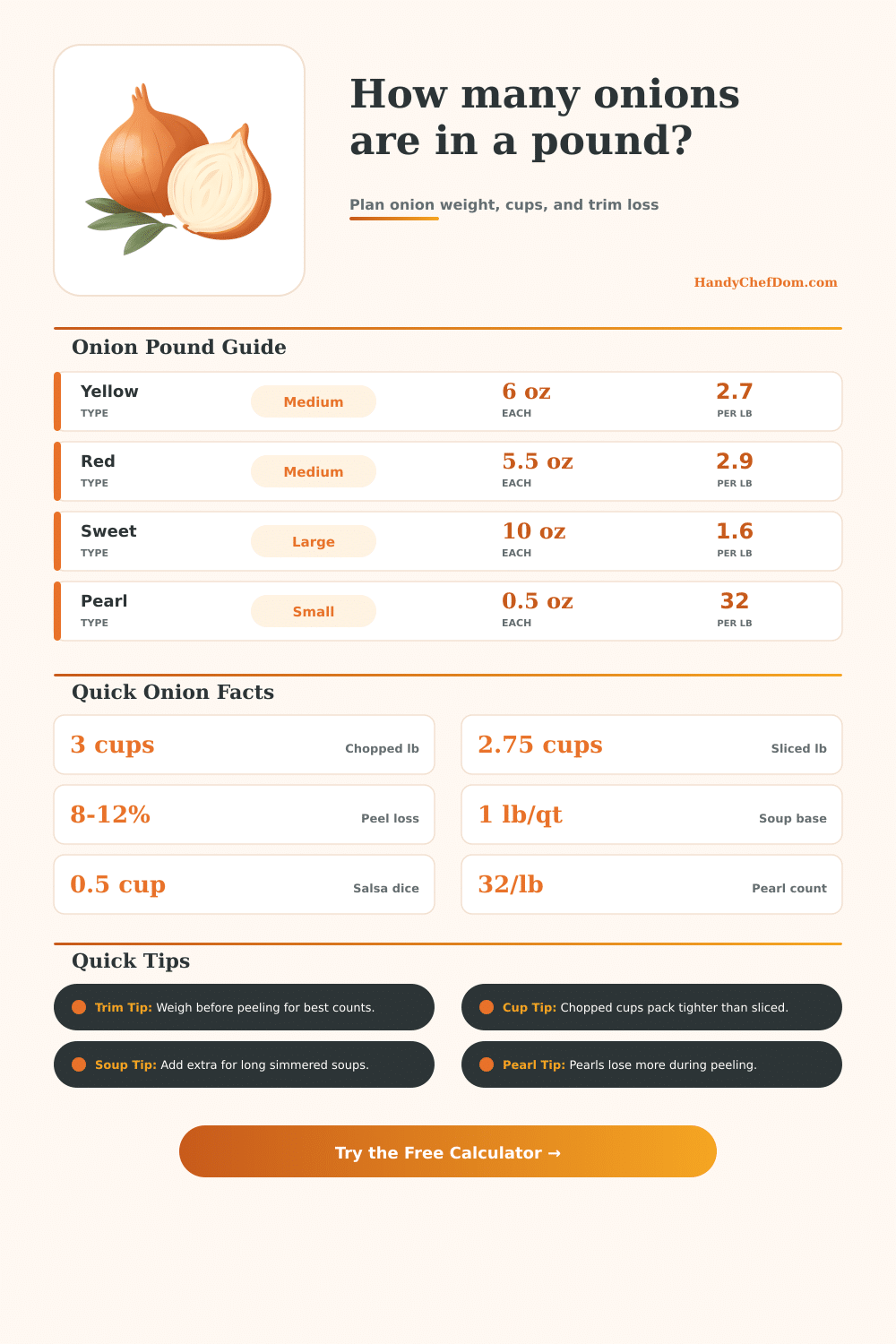
| Yellow cooking onion | Small | 4 oz / 113 g | 4 onions |
| Yellow cooking onion | Medium | 6 oz / 170 g | 2.7 onions |
| Yellow cooking onion | Large | 10 oz / 283 g | 1.6 onions |
| Red salad onion | Medium | 5.5 oz / 156 g | 2.9 onions |
| Sweet onion | Large | 10 oz / 283 g | 1.6 onions |
| White onion | Medium | 5 oz / 142 g | 3.2 onions |
| Pearl onion | Small | 0.5 oz / 14 g | 32 onions |
| Cut Style | Cups Per Raw Pound | Best Use | Yield Note |
|---|---|---|---|
| Chopped or diced | 3.0 cups | Soup, chili, stuffing | Standard cup measure |
| Sliced | 2.75 cups | Fajitas, saute, sandwiches | More air between pieces |
| Minced | 3.25 cups | Salsa, relish, sauces | Packs slightly tighter |
| Thin rings | 2.5 cups | Burgers and salads | Loose volume |
| Sauteed | 1.5 cups | Toppings and skillet meals | Moisture cooks off |
| Caramelized | 0.85 cups | Deep onion topping | Heavy cookdown |
| Whole peeled | 0 cups | Pearls and roasting | Use count instead |
| Recipe Use | Typical Onion Amount | Preferred Type | Calculator Adjustment |
|---|---|---|---|
| Soup or stew base | 0.35 lb per serving | Yellow or sweet | Adds simmer buffer |
| Fresh salsa | 0.08 lb per serving | Red or white | Smaller raw bite |
| Sauteed topping | 0.18 lb per serving | Yellow or sweet | Allows cookdown |
| Stock aromatics | 0.22 lb per serving | Yellow | More trim tolerance |
| Stuffing or casserole | 0.12 lb per serving | Yellow or white | Balanced dice |
| Burger topping | 0.05 lb per serving | Red or sweet | Thin-slice volume |
| Fajita skillet | 0.16 lb per serving | Sweet or yellow | Accounts for strips |
| Raw Weight | Medium Yellow Count | Chopped Cups | Suggested Prep |
|---|---|---|---|
| 0.5 lb / 227 g | 1 to 2 onions | 1.5 cups | Small salsa or topping |
| 1 lb / 454 g | 3 onions | 3 cups | Family dinner base |
| 2 lb / 907 g | 5 to 6 onions | 6 cups | Soup pot or meal prep |
| 3 lb / 1.36 kg | 8 onions | 9 cups | Party saute tray |
| 5 lb / 2.27 kg | 13 to 14 onions | 15 cups | Large batch cooking |
| 10 lb / 4.54 kg | 27 onions | 30 cups | Event prep batch |
The recipe calls for 3 cups of chopped onion. You open your produce bag and find five medium yellow onions. You know how to do the math in your head; you pick ’em up and start chopping, and before you’ve reached bottom of the pile you realize you’re out by a half-cup. And then it hits you: Raw weight is not the same thing as usable yield, which is not the same thing as cooked volume, right? These three measurements almost never acts alike in the kitchen. Eventually we all make this mistake.
The tool above do the math for you. You can stop guessing whether two big sweet onions will actualy last through a batch of soup or dissapears halfway through simmering.
Why Onion Measurements Are Different
Here’s where it gets really crazy: Each type of onion has a wildly different count-per-pound. For example, yellow onions (the kind I’d consider your “standard” onion) is generally pretty heavy; they average about six ounces each, and therefore three-ish onions to the pound. Red salad onions are going to be a little lighter and you may get closer to three onions per pound. Sweet onions (Walla Walla, Vidalia) are GIANT things; some may weighs as much as 10 ounces apiece, and quite commonly equal a half-pound or more each. Then there are pearl onion, an entire category unto themselves, because you don’t buy them singly, but in bags of hundreds. So the type of onion determine how much actual produce you’ll purchase raw.
The type of onion you choose and how thick you cut it changes the amount. Chopped onions settle into each other in a measuring cup so they fits really well. Sliced onions have more airspace between layers, so they will yield fewer cups per pound different than chopped ones. Minced onions tend to be about as dense as chopped ones, though a finer mince may seem even denser. This matters when you are making something like salsa. You wouldn’t want the onion floating on top while the tomato sink to the bottom of the bowl.
This tool takes care of those different-packaging issues for you and gives you an estimate of how much onion you’ll get based off what’s realistic, not ideal geometrically. But once we cook them, it’s all different. The water inside the onions escape during heating. When sautéed, onions shrinks by quite a lot as their cell walls release moisture. Cook ’em some more (caramelizing onions) and they becomes a shrunken, delicious little heap of themselves. A recipe requiring “two cups” of caramelized onions could actualy require upwards of two pounds of raw onions to yield those two cups. Measuring out needed onions by raw-volume-only means you’ll get much less flavorful results then desired. And it’s the distinction between being able to taste that onion or having the onion be in charge.
The silent killer of accurate prep work is Trim Loss. Before your first knife even touches the flesh, most folks will of peeled away dry outer layers and trimmed off the root end; which really weighs something! Yield charts assumes roughly 8-12% loss in terms of peel and roots… But that’s dependent on how fresh they are. Fresher onions loses less weight from old papery skin, while old onions lose much more weight than fresh ones from the farmers market. Because pearl onions are so tiny, blanching and peeling them off wastes such a huge percentage of their small mass, so they’re notorious for having high trim ratios. Having an accurate estimate of how much you expect to lose keeps you from being caught short when you go to grab the final scoopful of ingredient.
Before you grab the knife, think of what you’re creating with it. A heavier hand is good for soup bases since the onions dissolves in the liquid anyhow. However, use precise dice for salsa so the pieces can stands up to tomatoes and peppers. For burger toppings, cut thin rings that will stack nicely on the burger without falling off the bun. The calculator gives you an option to choose how you intend to use the onion, adjusting the suggested amounts to fit those cooking facts instead of assuming every application of onion is created equal.
It is all about balance. Onions forms one of the bedrock layers for so many dishes. Finding the right amount ensures that the onion taste goes with the dish instead of taking over. It should stand out enough to be noticed without vanishing altogether. Buy confidently. Prepare with purpose. Serve something proudly that not only tastes good but tastes like what you meant it to be.
It may feel dry and moddern now, but this is the kind of math that prevents your kitchen from feeling like a wasteland of guesswork and spoiled goods. Weigh before peeling, trust the yield adjustments, and let those numbers do the work while you get down to business: the heat.