🥚 Silken Tofu Egg Substitute Calculator
Replace eggs with smooth silken tofu in brownies, cakes, muffins, quick breads, and vegan batch scaling with moisture and batter density adjustments.
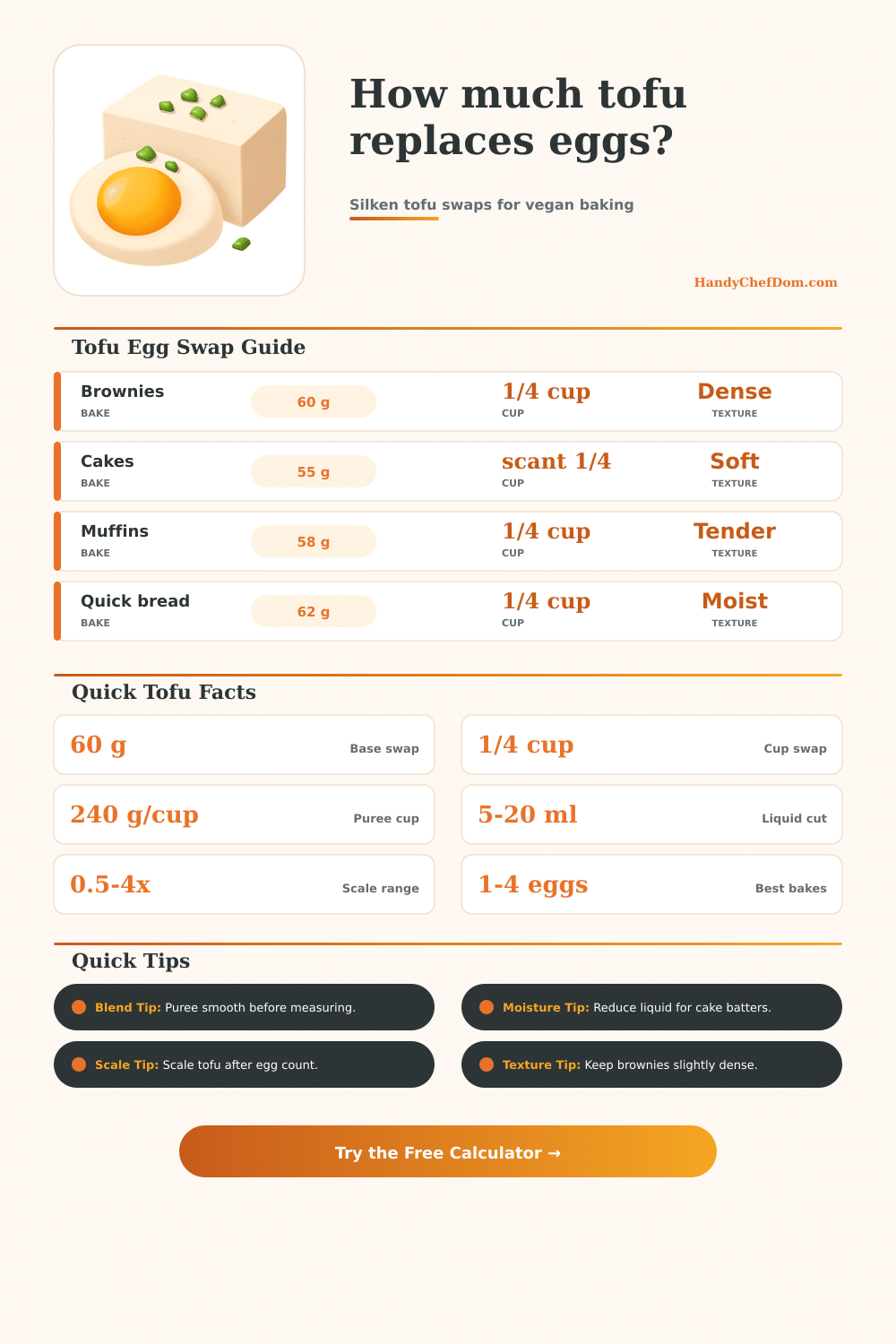
Use smooth pureed silken tofu for egg moisture and body. The calculator starts from the common baking swap of about 60 g, or 1/4 cup, tofu puree per large egg, then adjusts for recipe style, tofu texture, draining, and batch scale.
| Baked Good | Tofu Per Egg | Cup Measure | Moisture Move |
|---|---|---|---|
| Fudgy brownies | 60 g | 1/4 cup | Reduce 5 ml |
| Cakey brownies | 56 g | Scant 1/4 cup | Reduce 8 ml |
| Layer cake | 55 g | Scant 1/4 cup | Reduce 12 ml |
| Chocolate cake | 58 g | 1/4 cup | Reduce 10 ml |
| Muffins | 58 g | 1/4 cup | Reduce 8 ml |
| Quick bread | 62 g | 1/4 cup plus 1 tsp | Reduce 15 ml |
| Tofu Texture | Best Use | Factor | Texture Note |
|---|---|---|---|
| Soft silken | Cakes, muffins | 1.00x | Smooth and light |
| Firm silken | Brownies | 1.04x | More body |
| Shelf stable silken | Quick breads | 1.02x | Consistent puree |
| Regular soft tofu | Dense bakes | 1.08x | Blend very smooth |
| Strained puree | Fudgy bars | 0.94x | Less free water |
| Whipped silken | Tender crumb | 0.98x | Airier measure |
| Eggs Replaced | Base Tofu | Approx Cups | Liquid Cut |
|---|---|---|---|
| 1 egg | 60 g | 1/4 cup | 5 to 15 ml |
| 2 eggs | 120 g | 1/2 cup | 10 to 30 ml |
| 3 eggs | 180 g | 3/4 cup | 15 to 45 ml |
| 4 eggs | 240 g | 1 cup | 20 to 60 ml |
| 6 eggs | 360 g | 1 1/2 cups | 30 to 90 ml |
| 8 eggs | 480 g | 2 cups | 40 to 120 ml |
| Batter Goal | Density Index | Dry Buffer | Result Cue |
|---|---|---|---|
| Light cake | 82 to 94 | 3 to 6 g | Ribbon batter |
| Tender muffin | 94 to 106 | 5 to 8 g | Slow drop |
| Quick bread | 104 to 118 | 6 to 10 g | Thick spoon |
| Fudgy brownie | 112 to 130 | 8 to 14 g | Scoopable |
| Very moist loaf | 100 to 116 | 4 to 8 g | Glossy mound |
| Dense bar | 120 to 138 | 10 to 16 g | Holds shape |
Tofu: Using Silken Tofu as an Egg Substitute Everyone thinks tofu is simply solidified egg white. Nope. They share some of the same chemical makeup, but you can’t substitute one for another and expect the same structure (lift) or even binding properties. While silken tofu adds moistness and binds, it doesn’t has the protein network formed upon heating an egg. That difference affect how your batter behaves in the oven. Knowing that change makes all the difference between a tender crumb and a soggy mess is important.
Once you enter your tofu type and your desired recipe style into the calculator above, it will crunch the numbers for you, saving you from having to guess at conversion and factor rates.
How to Use Silken Tofu Instead of Eggs
So how do you deal with it? The trick is to manage moisture: Water comes out of eggs as they cook, creating steam and helping to leaven whatever you’re baking. But tofu curds holds onto their water tightly. If you don’t take that into account, your batter will be too runny, which makes the texture gummy or the centers dense. To counteract, reduce some of the other liquid ingredients in the recipe.
How much? That varies based off what you’re baking. For example, a dense brownie has room to absorb extra moisture from tofu. Because you want brownies to be fudgy, they can tolerate more moisture. On the other hand, a delicate layer cake requires less liquid or else it won’t keep its airy structure. Striking this balance is where home bakers tend to falter.
Weight is important; so is texture Silken tofu isn’t one-size-fits-all. You’ll see some labeled as either “soft” or “firm.” Within each type, you can find a huge range of moisture contents from brand to block to brand again. Some come sealed in whey, others in liquids of calcium sulfates. When you go to blend it up, that means your puree may contain more or less of the actual stuff than another block of tofu.
You can choose the texture of your tofu. The tool will then automatically adjust the grams based on the actual amount of solid food, not just the water clinging to it, to ensure you’re measuring accurately. No need to over-substitute.
Another thing that many guides don’t mention: Drainage level also matters. Tofu that’s been left in its juice will add more water to your blend. If you blot tofu against a towel, it’ll lose some moisture. If you strain it using cheesecloth, you’ll end up with a denser and therefore more concentrated paste. This changes the density index of your resulting batter. The page contains some handy reference tables that explain how varying levels of drainage affect amount of tofu you need. Experiment with whichever method works best for you and go from there.
There are risks at scale. If a recipe says “one egg,” then a touch too much moisture isn’t fatal. But when the batch is six eggs, it’s six times more bad. The calculator lets you change number of eggs based on the batch size so that the ratios stays right. It also accounts for leavening help: because tofu doesn’t give rise, you could of added just a bit more soda/baking powder to ensure nothing flattens out. That’s key to getting good structure, though it’s a subtle change.
There are supporting actors in this recipe, namely dry ingredients. If you found yourself with particularly moist tofu, it’s a good idea to add a tiny bit of dry mix to soak up some of the liquid. Why? It acts as an insurance policy for soggy crumble. The adjustment is so easy and has such a huge impact on the end result. Think of it like adjusting the dial on the specific day and brand you have at hand, until you find the right fit.
Baking vegan isn’t so much about following a list of must-do’s as it is knowing what each ingredient does. Eggs provide richness, lift, and binding. Tofu is mostly just about moisture and binding. What richness and lift are lacking must be made up for throughout the rest of the recipe. That’s the dynamic that makes the substitution second nature once you get your head around it. Instead of seeking a one-for-one replacement, you think in terms of balance.
Silken tofu is neutral, which means no dominating flavor from things like flax or chia seeds. Instead it lets the fruit, vanilla, chocolate, etc., come to the front while still giving it structure. If done well, it makes a moist, tender product that holds up to more traditional methods. Aim for something different than perfect egg replacer, but instead use its traits to make something tasty on its own terms. Follow the math, tweak for your kitchen situation, and let nature take its course. If you did it right, your oven will let you know.