🦫 Yeast Viability Calculator
Estimate remaining yeast viability from manufacture or harvest date, storage temperature, pack or slurry type, decay rate, live cells, starter needs, and age risk.
Use the date printed on a commercial pack or the harvest date for slurry. The fresh-cell override lets you enter a known cell count when the pack, lab note, or harvest estimate is more specific than the preset.
| Yeast source | Fresh cells basis | Initial viability | Base decay | Planning note |
|---|---|---|---|---|
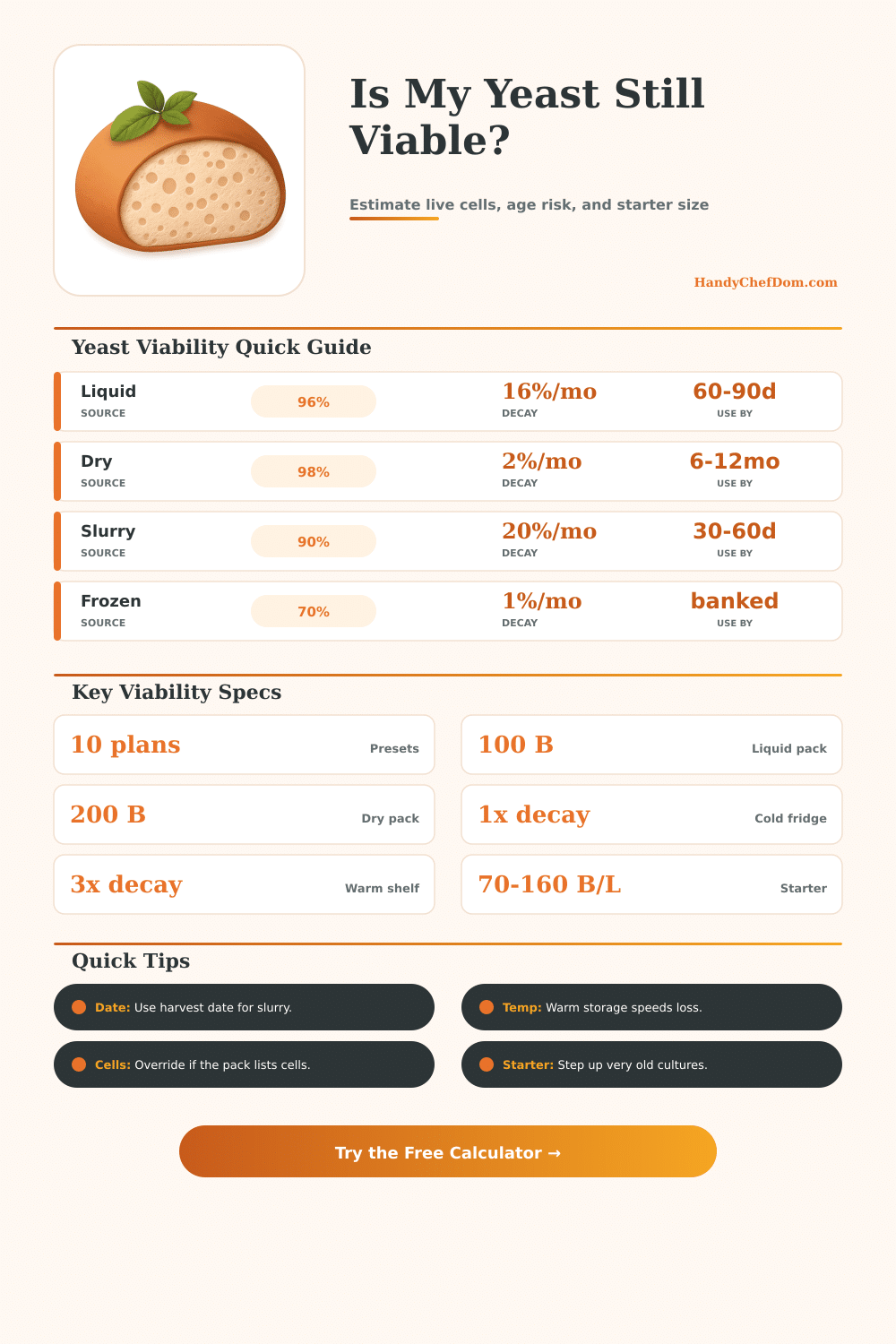
| Liquid ale pack | 100 billion per pack | 96% | 16% per month | Good benchmark for fresh refrigerated pitch planning. |
| Liquid lager pack | 100 billion per pack | 96% | 18% per month | Use a higher target cell count for large cold fermentations. |
| Dry yeast pack | 200 billion per 11 g pack | 98% | 2.2% per month | Dry yeast holds viability much longer when kept cold and sealed. |
| Fresh yeast cake | 120 billion per cake | 95% | 24% per month | Shorter-life pressed yeast needs a closer date check. |
| Thick harvested slurry | Slurry density per ml | 92% | 18% per month | Best when the jar is recent and compacted. |
| Thin or rinsed slurry | Slurry density per ml | 88-90% | 22-24% per month | More liquid and handling lowers confidence. |
| Kveik slurry | Slurry density per ml | 93% | 10% per month | Hardy cultures still benefit from age tracking. |
| Frozen bank culture | Fresh-cell override preferred | 70% | 1.2% per month | Use a small staged starter plan for revival. |
| Average storage | Decay multiplier | What it means | Calculator handling |
|---|---|---|---|
| Near freezing, 30-34°F / -1-1°C | About 0.75x | Very slow metabolism and lower decay. | Reduces the monthly loss rate. |
| Refrigerator, 35-40°F / 2-4°C | About 1.00x | Normal cold storage benchmark. | Uses the source base decay rate. |
| Cool room, 50-59°F / 10-15°C | About 1.6-2.2x | Loss accelerates compared with fridge storage. | Raises starter likelihood for older yeast. |
| Room temperature, 68-75°F / 20-24°C | About 2.8-3.5x | Age matters quickly for liquid yeast and slurry. | Compounds decay more sharply. |
| Warm shelf, 80°F+ / 27°C+ | About 4x or more | Viability estimates become less certain. | Flags high risk sooner. |
| Result band | Viability range | Age risk | Recommended response |
|---|---|---|---|
| Fresh and strong | 80% or higher | Low | Direct pitch if live cells meet the target. |
| Aging but usable | 60-79% | Moderate | Small starter if the target coverage is close. |
| Weak reserve | 35-59% | High | Starter recommended before relying on the culture. |
| Severely aged | Under 35% | Critical | Use a stepped starter or replace the yeast source. |
| Old slurry | Any low-coverage result | Variable | Trust cell count, smell, and starter response together. |
| Cell shortfall | Starter setting | Planning output | Use when |
|---|---|---|---|
| 0-20 billion | Direct pitch or tiny wake-up | 0-0.25 L | Cells meet target but viability is near your minimum. |
| 20-80 billion | Gentle or standard starter | 0.25-1.0 L | A pack is slightly old or target is only a little short. |
| 80-180 billion | Standard starter | 0.8-2.0 L | Liquid yeast or slurry needs a normal cell boost. |
| 180-350 billion | Well-aerated starter | 1.5-3.0 L | High-gravity, lager-size, or older slurry pitch plans. |
| 350+ billion | Stepped starter | 2 stages or more | Very old, very small, or revived bank cultures. |
This calculator estimates yeast viability for planning. Actual performance can vary with strain, packaging, oxygen exposure, sanitation, nutrient level, wort or dough composition, and how the yeast was handled before storage.
A yeast viability calculator allow brewers to calculate the number of live yeast cell in a yeast sample. Yeast cells has a natural tendency to die over time. If there isnt enough live yeast cells, the fermentation process may not succeed.
The age of the yeast can be use to calculate the number of live yeast cells. The yeast viability calculator will ask for the date of the yeast product. For commercial yeast products, the manufacture date will be found printing on the foil packaging.
How to Use the Yeast Viability Calculator
For yeast slurry, the calculator will use the harvest date, which is the date from which the yeast were harvested from a previous batch of beer. The difference between the manufacture or harvest date to the brew day will reveal the amount of time that has passed and the decayed number of yeast cell over that time. The temperature at which the yeast was stored will also be required.
Yeast cells die more slow at refrigerator temperatures than in warm areas such as a car or pantry. The viability calculator will use this information to calculate the decay of the yeast cells on a monthly basis. In addition to the date and temperature information, storage condition will be asked of.
A yeast pack that is stored in a refrigerator and is seal behaves differently than yeast that has been opened and stored in different conditions. Opening a yeast pack introduces the yeast to air, which kills yeast cell, and exposes the yeast to different temperatures that may kill the yeast as well. The yeast viability calculator will provide a selection of storage condition categories to select from.
Care must be taken to select the proper storage condition as many people do not use their refrigerator enough to know how often the door is opened or how warm the refrigerator shelf is. The type of yeast that is being used can also impact the viability of the yeast. For instance, liquid ale yeast packages will have a different viability and decay rate then liquid lager yeast packages.
Dry yeast packages will typically contain yeast that can last longer than liquid yeast packages because of the lack of moisture of the yeast. Yeast slurry packages can have a higher viability or lower viability depending upon the yeast and the amount of beer that is contained within the slurry package. Each type of yeast will have a baseline viability rate in the yeast viability calculator.
The viability calculator will use the age, temperature, and storage information to adjust the yeast viability rate to reflect the expected number of live yeast cells. The yeast viability calculator will provide several piece of information based off the information that is entered. The viability of the yeast will be calculated in the form of a percentage.
The yeast calculator can also provide the number of live yeast cells that will be available. If the number of live yeast cells is lower than the amount that is required to successfully ferment the beer, the yeast viability calculator will provide recommendations regarding the amount of yeast starter that should be used. The size of the yeast starter will be based upon the number of yeast cells that is required and the viability of the yeast that will be used in the brewing process.
Low viability of yeast means that the yeast cells are stressed out; thus, a larger starter will allow for the yeast to recover prior to add the yeast to the wort. Lastly, the yeast viability calculator will provide a visual representation of the risk of yeast cells dying. This risk is based upon the viability, the area of the yeast culture that is covered by the yeast, and the amount of time that has passed since the yeast was fresh.
The reference tables that come with the yeast viability calculator provide information regarding the logic of the calculations that are performed by the yeast viability calculator. The reference tables show the viability of different yeast packages under ideal condition. Additionally, these tables illustrate the impact of temperature upon the monthly decay of the yeast cells.
The tables can explain how a dry yeast package that is stored at room temperature will have a faster rate of yeast cell decay than dry yeast that is stored in a cold environment. Additionally, the reference tables can illustrate the reason that yeast slurry packages that are thin will have a faster rate of yeast decay than thick yeast packages. Even with the information that is included in the yeast viability calculator, there are additional variable in brewing that will impact yeast viability and performance.
The amount of oxygen that is exposed to the yeast after the yeast is removed from the beer batches may impact yeast viability. Additionally, the nutrients in the yeast starter will impact yeast performance. Even if the yeast package is healthy and has a high rate of viability, the yeast could be mishandled during its shipping from the manufacture to the brewers establishment.
Thus, the yeast viability calculator is merely a baseline from which to start thinking about yeast viability. Additional experience and knowledge about yeast and brewing can be used to create a complete understanding of the yeast that will be used in the brewing process. Yeast viability should be considered along a spectrum from high to low viability rather than a simple question of whether the yeast is good or bad.
If the yeast viability calculator indicates that there will be a shortfall in yeast cells, a starter can be used to help compensate for that shortfall. If the viability of the yeast is in a moderate risk range, it may be appropriate to provide extra aeration to the yeast prior to the brewing process. If the yeast viability calculator indicates that there will be very low viability of the yeast, the brewer can decide to either use a larger amount of yeast starter to allow the yeast to recover from its low viability or to use a fresh yeast package.
One way to improve the use of the yeast viability calculator is to create a log of the yeast that is purchased. Each time a package of yeast is purchased, the date of purchase and storage location can be logged. Using this log, the viability calculator can be used in a way that makes it easier to determine yeast viability over time.
For instance, the log can be used to determine if yeast that is dry lasts longer than liquid yeast. Additionally, the yeast can be logged in such a way that yeast stored in the refrigerator door will last longer than yeast stored in the back of the refrigerator. By creating such a log, the yeast viability calculator will be more accurate in its calculation.
The goal in using the yeast viability calculator is to remove uncertainty in brewing decision regarding yeast. Its use will allow for decision to be made based off estimates rather than guesses.