🍗 Chicken Breast Protein Calculator
Estimate protein, calories, fat, cooked yield, and meal prep portions from raw or cooked chicken breast weight.
Enter raw package weight or cooked meal prep weight. Bone-in and trim settings adjust edible meat before protein, calories, fat, and portions are split.
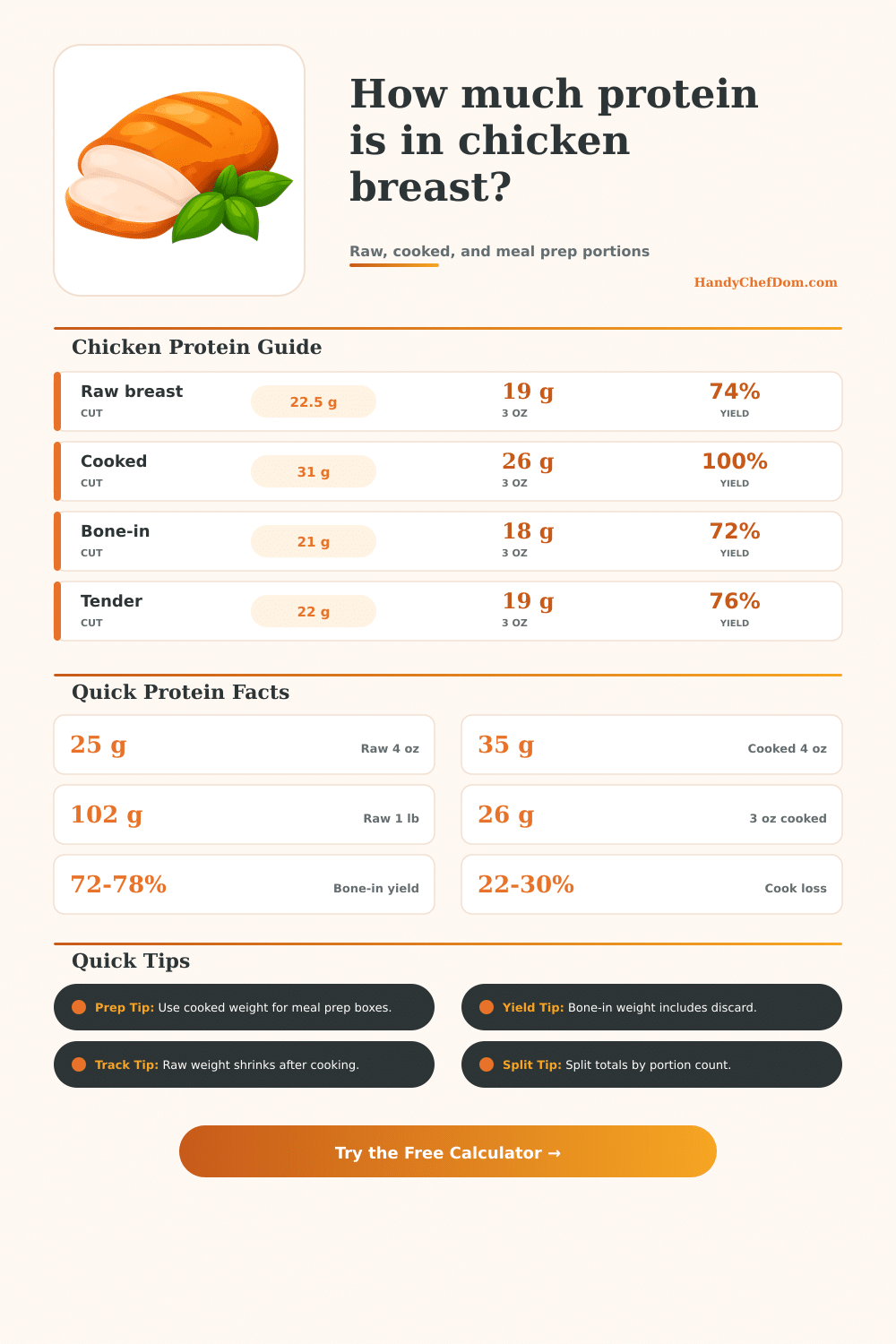
| Chicken breast form | Protein per 100 g raw | Protein per 100 g cooked | Best basis |
|---|---|---|---|
| Boneless skinless breast | 22.5 g | 31.0 g | Raw or cooked |
| Bone-in skinless breast | 22.5 g edible | 30.5 g edible | Raw package |
| Split breast, skin removed | 22.2 g edible | 30.5 g edible | Raw package |
| Chicken tenderloins | 22.7 g | 31.2 g | Raw or cooked |
| Thin breast cutlets | 22.5 g | 31.0 g | Raw package |
| Cooked grilled breast meat | 22.5 g raw est. | 31.0 g | Cooked weight |
| Starting form | Edible factor | Cooked yield | What it means |
|---|---|---|---|
| Boneless skinless breast | 100% | 74% | 1 lb raw gives about 12 oz cooked |
| Bone-in skinless breast | 78% | 72% | Bone weight is removed first |
| Split breast, skin removed | 76% | 70% | More discard than boneless breast |
| Chicken tenderloins | 100% | 76% | Usually a little less shrink |
| Thin sliced cutlets | 100% | 73% | Thin pieces lose moisture faster |
| Cooked breast meat | 100% | 100% | Already weighed after cooking |
| Meal prep goal | Cooked breast per box | Approx protein | Approx calories |
|---|---|---|---|
| Light lunch box | 3 oz | 26 g | 140 kcal |
| Standard prep box | 4 oz | 35 g | 187 kcal |
| High protein box | 5 oz | 44 g | 234 kcal |
| Large training box | 6 oz | 53 g | 281 kcal |
| Family plate serving | 4.5 oz | 40 g | 211 kcal |
| Small bowl topping | 2 oz | 18 g | 94 kcal |
| Raw boneless amount | Cooked yield estimate | Total protein | Prep split idea |
|---|---|---|---|
| 8 oz raw | 5.9 oz cooked | 51 g | 2 small portions |
| 1 lb raw | 11.8 oz cooked | 102 g | 3 lunch portions |
| 1.5 lb raw | 17.8 oz cooked | 153 g | 4 regular portions |
| 2 lb raw | 23.7 oz cooked | 204 g | 5 prep portions |
| 3 lb raw | 35.5 oz cooked | 306 g | 8 prep portions |
| 5 lb raw | 59.2 oz cooked | 510 g | 12 large portions |
You buy chicken breast, most of us go in with good intentions. You’re walking up to the counter, intending to reach some specific protein goal for the next few days worth of meals. You whip out that vacuum-sealed package of boneless skinless breast, then remember that you don’t actualy know how much of this raw meat will end up on your plate after you cook it.
Yes, you weighed it on scale before shoving it into the pan, but the shrinkage is real. And it’s fickle enough to throw off even your most carefully planned meals if you don’t pay attention. This isn’t simply a matter of weighing the package before you put it in the pan, but rather knowing what’s going to happen to all that water inside the chicken’s muscles as soon as the heat turn on.
How to Get Accurate Protein Numbers
To help you make up the difference, this little number does math for you and turns your uncooked food into an accurate estimate of the amount of protein in there. And it takes into consideration how much moisture is lost when you start from scratch with raw versus cooked meat: For example, most meats, such as a raw chicken breast, loses roughly a quarter of their original weight when they’re cooked, about twenty-six percent. So if you were planning on eating eight ounces of raw chicken, don’t expect eight ounces of cooked meat on your plate. More like six. Probably. Maybe? Who knows without doing some math? The calculator factor all of this into account for you. No need to guesstimate how many grams of protein are in your lunchbox. Is it thirty? Or is it forty?
The second feature that’s important (which few home cooks know) is choosing the correct type of chicken. For example, bone-in breasts weigh more because they include bone weight that will end up going into the trash different than onto your plate. To adjust for this, the calculator automatically account for how much bone weight needs to be thrown away. If you choose bone-in breasts, it lowers the estimated amount of edible meat you’ll have. Tenderloins or split breast also work differently; their shape and size mean they tend to hold a bit more moisture then thicker, whole cut breasts. This is a small difference, but over time it can really add up when you are prepping food for an entire week.
Embedded in the tool are reference tables that help you quickly sanity check what numbers you’re feeding into the calculator. You’ll see standard protein amounts for different preparations (per 100g). This can help you ensure that even though you’ve batch cooked some things, you haven’t somehow screwed up. A cooked chicken breast will have far higher protein per gram than its raw counterparts (the water has been removed). Maybe you cut off too much lean meat during preparation? Or maybe you’re measuring your chicken when it’s still steaming hot, still full of juiciness?
For example: Meal prepping can get you in the habit of just “eyeballing” your portions after they’ve been placed in container. That means you might eat inconsistently day-to-day making it almost impossible to track macros. With the portion and serving options in the calculator, you’re able to divide a big batch into exact individual servings. If you want five boxes at thirty-five grams of protein per box, it will tell you precisely how much raw chicken you’ll need to begin with (after accounting for cooking loss). It removes the “will I or won’t I” uncertainty you feel during Wednesday’s lunch compared to Monday’s.
If you value efficiency over absolute precision, then adding a buffer percentage is also a good idea. A few percentage points can change your yield based off small changes in meat thickness. It also depends on cooking variables like fluctuating oven temperatures. That’s why I add a five percent buffer. This way I wouldn’t of get halfway through dividing my shredded meat into containers only to be met with an empty spot in my Tupperware. Better to have some spare sauce/meat for future use than none at all.
Finally, precision in nutrition isn’t about obsessively counting every calorie. Nutritional precision isn’t about being obsessive; it’s about reducing inconsistency enough so that you can trust your numbers. If you have a clear idea of the amount of fuel going into the tank, then you stop guessing and start dialing-in results. If you’re cutting weight, bulking-up, or simply eating cleaner but not wanting to spend hours with a knife after-midnight, you’ll be sure of your numbers. You purchase what you need, prepare food effectively, and eat with intention. The scale transitions from a place of stress into a tool for clarity.