Bread Slice Carb Calculator
Estimate total carbs, net carbs, fiber, spread carbs, per-serving bread carbs, and how your slices compare with the rest of the loaf.
Your bread slice carb estimate
| Bread type | Typical slice weight | Total carbs per slice | Fiber per slice | Net carbs per slice |
|---|---|---|---|---|
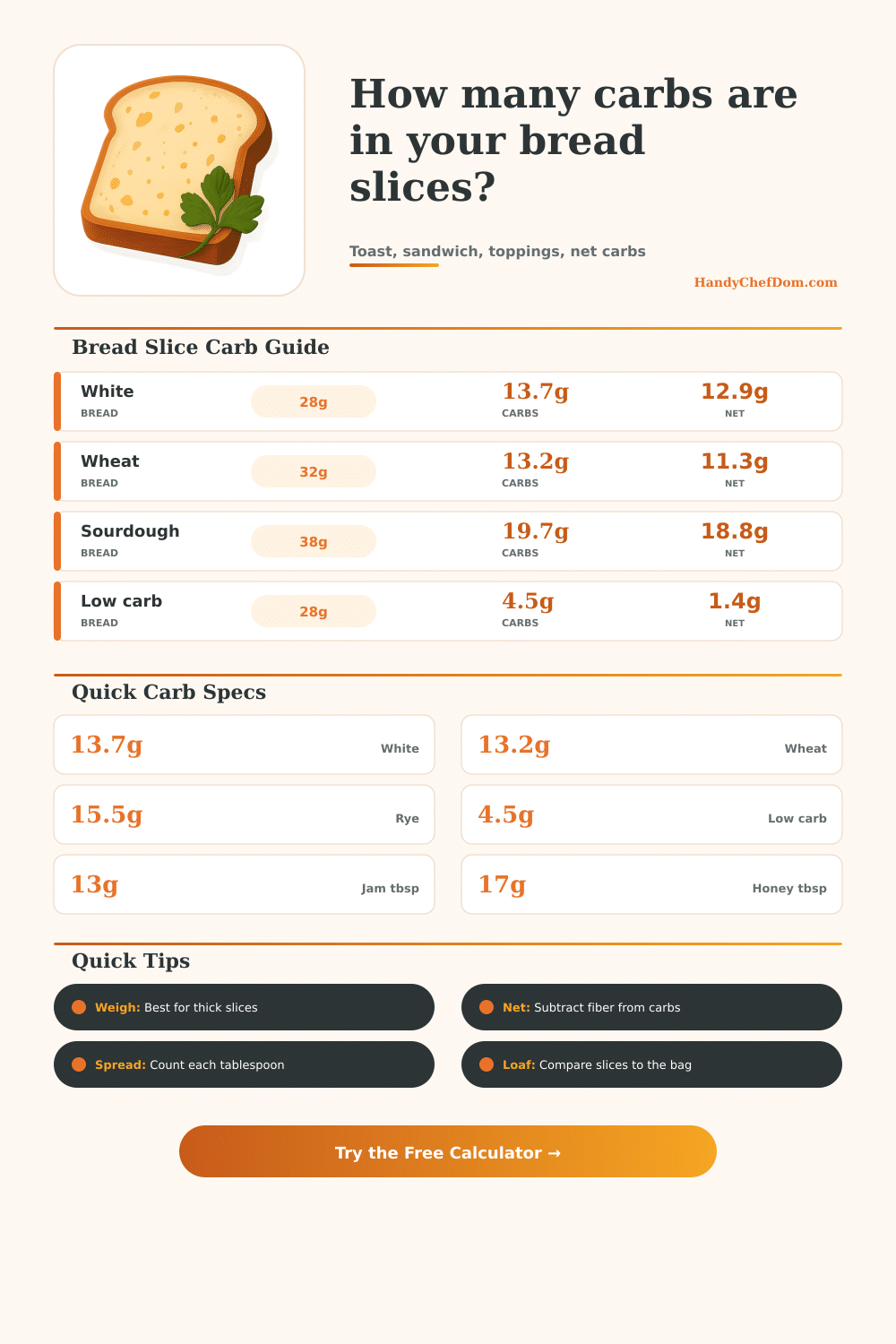
| White sandwich bread | 28 g / 1.0 oz | 13.7 g | 0.8 g | 12.9 g |
| Whole wheat sandwich bread | 32 g / 1.1 oz | 13.2 g | 1.9 g | 11.3 g |
| Sourdough boule slice | 38 g / 1.3 oz | 19.7 g | 0.8 g | 18.8 g |
| Rye bread slice | 32 g / 1.1 oz | 15.5 g | 1.9 g | 13.6 g |
| Multigrain seeded bread | 35 g / 1.2 oz | 15.2 g | 2.5 g | 12.7 g |
| Sprouted grain bread | 34 g / 1.2 oz | 11.7 g | 2.3 g | 9.4 g |
| Low-carb high-fiber bread | 28 g / 1.0 oz | 4.5 g | 3.1 g | 1.4 g |
| Gluten-free sandwich bread | 35 g / 1.2 oz | 15.8 g | 1.4 g | 14.4 g |
| Brioche sandwich slice | 38 g / 1.3 oz | 17.2 g | 0.7 g | 16.5 g |
| Topping or spread | Calculator unit | Total carbs | Fiber | Net carbs |
|---|---|---|---|---|
| Butter | 1 tablespoon | 0.0 g | 0.0 g | 0.0 g |
| Peanut butter | 1 tablespoon | 3.5 g | 1.0 g | 2.5 g |
| Jam or jelly | 1 tablespoon | 13.0 g | 0.1 g | 12.9 g |
| Honey | 1 tablespoon | 17.0 g | 0.0 g | 17.0 g |
| Hummus | 1 tablespoon | 2.4 g | 0.6 g | 1.8 g |
| Mashed avocado | 1 tablespoon | 2.0 g | 1.5 g | 0.5 g |
| Cream cheese | 1 tablespoon | 0.8 g | 0.0 g | 0.8 g |
| Chocolate hazelnut spread | 1 tablespoon | 11.0 g | 1.0 g | 10.0 g |
| Banana slices | 1 half-banana | 13.0 g | 1.5 g | 11.5 g |
| Use case | Typical slices | Whole wheat net carbs | Low-carb net carbs | Sourdough net carbs |
|---|---|---|---|---|
| Single toast snack | 1 slice | 11.3 g | 1.4 g | 18.8 g |
| Two-slice toast plate | 2 slices | 22.6 g | 2.8 g | 37.6 g |
| Half sandwich | 1 slice | 11.3 g | 1.4 g | 18.8 g |
| Full sandwich | 2 slices | 22.6 g | 2.8 g | 37.6 g |
| Four sandwiches | 8 slices | 90.5 g | 11.2 g | 150.5 g |
| Party tray, 12 sandwiches | 24 slices | 271.8 g | 33.6 g | 451.7 g |
| Loaf size | 1-slice share | 2-slice sandwich share | 8-slice meal prep share | Loaf planning note |
|---|---|---|---|---|
| 14 slices | 7.1% | 14.3% | 57.1% | Small bakery loaf |
| 18 slices | 5.6% | 11.1% | 44.4% | Common sandwich loaf |
| 20 slices | 5.0% | 10.0% | 40.0% | Large sliced loaf |
| 24 slices | 4.2% | 8.3% | 33.3% | Party tray friendly |
All loaves are not created equal. A single loaf of bread may have some slices that weigh 20 grams while others weighs 40. And that can double the carbs in a sandwich if you don’t account for it. While most people simply count their slice (since that’s convenient), you need to know that thicker slices will mean different numbers then too. This calculator takes all of that into account and allows you to change type and weight instead of just counting out wrappers.
To do this accuratly, you need to choose the correct bread profile. Low-carb loaves aren’t equal to a piece of dense sourdough. And the same goes for white sandwich bread: standard white bread contain around thirteen grams of carbs per slice, assuming a standard supermarket thickness. Cut thicker slices like Texas toast and you’re over twenty grams per slice. The app allows you to select your bread type, accounting for thickness of cuts.
Why You Need to Count Bread Carbs Carefully
Because many food labels often underreport carbs slightly to stay within legal rounding limits, the tool bridges the gap between label on the bag and what is actualy on your plate. A slight buffer added to your guess will ensure your daily count remain honest.
Then there’s the topic of toppings. If you’re careful about what you eat, it makes sense to use something “healthy” (e.g., a slice of wheat bread). But then that piece of toast has almost thirty grams of sugar in jam/honey, poof, gone is all the fiber benefit of the grain swap. Peanut butter will contribute some; again, it depends on which kind you get; avocado/butter won’t add more than a tiny bit of carbs. These are broken out into their own categories in the calculator; this way you can quantify just how many grams comes from the bread itself vs. How many come from the topping.
And remember, sandwiches is a collection of ingredients, and even little things adds up quickly when preparing meals. Those eight slices for your dinner may not feel like anything… until you notice you’ve added eight tablespoon of condiment, too.
Many people are confused by “net carbs.” Fiber is part of total carbohydrate. It is the type of carbohydrate that doesn’t get digested as sugar or starch. Net carbs is total carbs minus fiber, which affect blood glucose more directly. When low-carb breads tout low net carbs, it’s because they are using alternative flours plus fiber to bulk up the product. So the total carb per slice may be five grams but the net carbs are one and a half grams once three grams of fiber are subtracted.
Knowing what counts will help you make smart decisions… While still eating bread! There is no need to give it up completely, only select options where the fiber go to work for you.
The last thing is to plan your loaves. Having an idea of how many total slices are in the bag allows you to know what’s left and what you’ve already consumed. So if a loaf contains 20 slices and you ate two, you just consumed 10 percent of that day’s carb source. That changes how we think about carb counting from a one-off calculation to a daily budget.
It’s not so much “no, I can’t have this bite!” Instead, it’s “oh hey, I’m realizing my pattern with morning toast realy adds up.” Or, “hmmm I didn’t realize thinner slices save me room for a heartier dinner.
This isn’t about being perfect. This is about clarity. Bread is a food we’ve all eaten… It’s not the enemy, it simply require understanding. Once you understand exactly what you’re eating (whether it’s light white wheat bread or dense rye), you can confidently savor it without wondering if it aligns with your goals.
Because you know. And knowing shifts your relationship with food, replacing indecision with something easy and achievable for your day-to-day routine.