🥣 Cottage Cheese Protein Calculator
Estimate protein, calories, fat, sodium, cups, grams, bowl servings, snack portions, and recipe yields from curd style and fat percentage.
Choose whether you are entering cups, grams, or servings. The calculator converts cottage cheese density by curd style and estimates total plus per-serving nutrition.
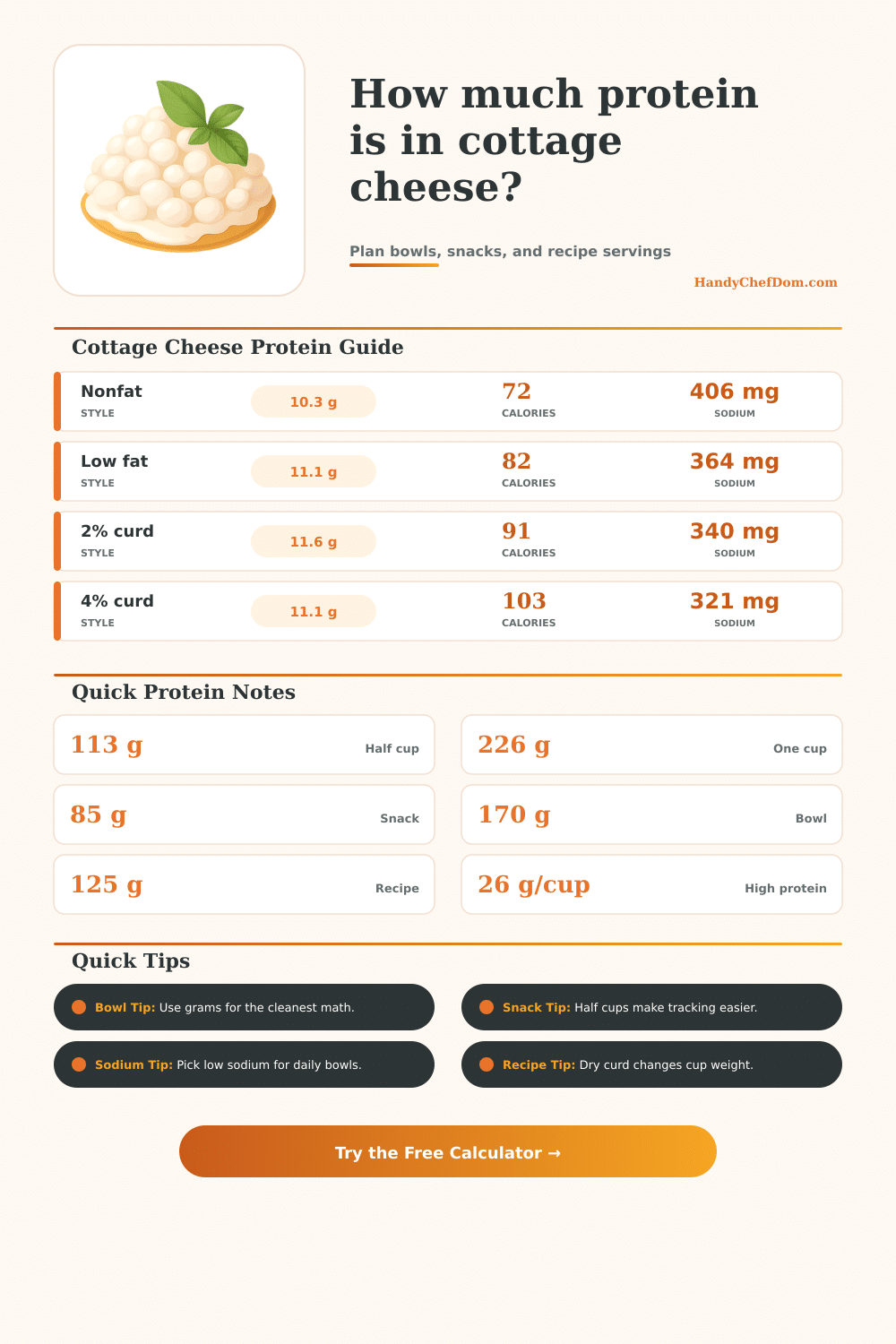
| Cottage cheese label | g per cup | Protein per 100 g | Best use |
|---|---|---|---|
| Nonfat small curd | 226 | 10.3 g | Lean bowls |
| 1% low-fat small curd | 226 | 11.1 g | Daily snacks |
| 2% small curd | 226 | 11.6 g | Balanced bowls |
| 2% large curd | 218 | 11.2 g | Chunky sides |
| 4% whole milk small curd | 226 | 11.1 g | Creamy snacks |
| 4% whole milk large curd | 218 | 10.9 g | Savory plates |
| Whipped cottage cheese | 210 | 10.5 g | Dips and toast |
| Dry curd cottage cheese | 145 | 17.0 g | Recipe filling |
| Serving style | Target grams | Approx cups | Protein range |
|---|---|---|---|
| Mini side | 60 g | 0.27 cup | 6-10 g |
| Snack | 85 g | 0.38 cup | 9-14 g |
| Half cup | 113 g | 0.50 cup | 12-19 g |
| Recipe serving | 125 g | 0.55 cup | 13-21 g |
| Bowl | 170 g | 0.75 cup | 18-29 g |
| Large bowl | 226 g | 1.00 cup | 23-38 g |
| Measure | Small curd | Large curd | Dry curd |
|---|---|---|---|
| 1/4 cup | 57 g | 55 g | 36 g |
| 1/3 cup | 75 g | 73 g | 48 g |
| 1/2 cup | 113 g | 109 g | 73 g |
| 3/4 cup | 170 g | 164 g | 109 g |
| 1 cup | 226 g | 218 g | 145 g |
| 2 cups | 452 g | 436 g | 290 g |
| Sodium choice | Calculator factor | When to use | Per bowl note |
|---|---|---|---|
| Standard label | 1.00x | Use label as-is | Full sodium |
| Low-sodium label | 0.55x | Low-salt tubs | Nearly half |
| Drained | 0.85x | Liquid poured off | Slightly lower |
| Rinsed and drained | 0.65x | Recipe prep | Moderate cut |
| Dry curd | 0.42x | Pressed curds | Lowest style |
| Blended dip | 1.00x | Whole tub used | Track total |
Cottage cheese is the generic white blob you pick out of fridge. Any old tub will do; just make sure it’s not terrible, right? But if you’re tracking honest macros or protein spesifically for muscle repair, there’s just too much left to chance. A couple of times over the course of a week, stacking those bowl makes all the difference.
There is a huge difference between dry large curd and nonfat small curd. It affects how many grams of protein you’ll score from a normal cup, as well as calories and sodium you consume per serving. Once you enter how much and what kind, the calculator do the rest (see above). No more wondering if that cup of cottage cheese contain 12 grams of protein or 22.
Why Every Cup Is Different
Sure, you may think that cottage cheese is cottage cheese, so a cup is a cup, right? Wrong. Curd size, brand and even type (there’s whipped) make moisture content change a lot. Whipped contains air that has been beaten into the cheese; this results in a lighter per-volume weight than something like a dense small curd. Two cups appear the same sitting on kitchen counter yet will provide very different amounts of nutrition.
The key is to change input mode to grams, and suddenly everything changes. Weight doesn’t lie. Because volume depends on density, getting out your scale provides an accurate starting point for each nutrient. If you’re tempted to go for the nonfat choice, take a moment to weigh your options. Fat reduces fullness: it slows down the emptying of the stomach, so going with zero-fat might make you feel hungry sooner, though it’s leaner calorie-wise.
If you can get over the chalky taste, the no-fat option is probably your best bet. But something like a 2 percent or 4 percent curd has more fuel per gram and also coats your mouth, making you feel fuller faster. Use the tool to override the default fat percentage if your specific brand tend to be richer or leaner than average. Most run close to the typical numbers. The outliers tends to be the artisanal brands.
If you’re not accounting for this variation, your numbers will slowly creep out of range, and you won’t know why. So let’s take a look at sodium, the hidden wildcard in most diets. Cottage cheese in its typical form has as much (or more) salt than a burger at a fast-food joint.
And then there’s the sodium adjustment dial. That’s based on how you prepare the stuff. If you rinse and drain the curds when serving it up, you remove much of that surface-level salt. Yeah, yeah, yeah…wasting water washing your dinner doesn’t seem too appealing. But it reduces your overall sodium load by about two-thirds without reducing the protein. Big deal? For those monitoring their blood pressure, sure. For others who just want to sidestep bloating in the afternoons, absolutely.
A quick glance at the reference chart on the page show you what happens when you rinse versus eat straight from the tub. And then there’s portion size. Our intuitions fail us here too: We’re likely used to snacking on an eighty-five-gram cup, but a full bowl serves up one hundred seventy. That’s essentially doubling your protein intake, and if you aren’t careful, can send you well beyond your target amount for the day.
Based off the number of servings you intend to create (e.g., “make four snacks” or “make two bowls”), the calculator works out each serving’s nutritional content. And if you want to bake with the cheese, or blend it into a dip, it accounts for any moisture lost during cooking. When dairy heats up, some of its water evaporates; so while one hundred grams of raw curd might produce a hundred grams of cooked cheese, account for this shrinkage, and end up with a finished product whose nutrition aligns with your intended targets, even after all that evaporation.
If you have a high-protein day, then dry curd styles might give you an edge because they’re denser (same weight but higher protein). Because there’s less whey, there’s more protein per cup, despite what appears to be less volume. This can come in handy if you need to reach a certain number of grams without unneccessarily piling on other calories via milk solids and fats. On the downside, though, that means texture can be crumbly and less creamy, limiting its performance in cold dips and smoothies.
Understand your end use, and know what style to choose before you purchase it. This gets tedious at the start, but soon enough you get into the swing of things. Suddenly you know whether that bowl counts as a high-protein meal or a light snack. Your calories add up to what you want, not something differenter. You start to eyeball food like a pro. Looking for label words with sharper eyes, weighing out portions without resistance.
It’s in that transition from guesswork to precision where you realy make progress.