🧪 Cornstarch to Make Oobleck Calculator
Plan a hands-on oobleck batch with the classic 2 parts cornstarch to 1 part water ratio, scaled for kids, texture, color, container space, cleanup buffer, and repeat batches.
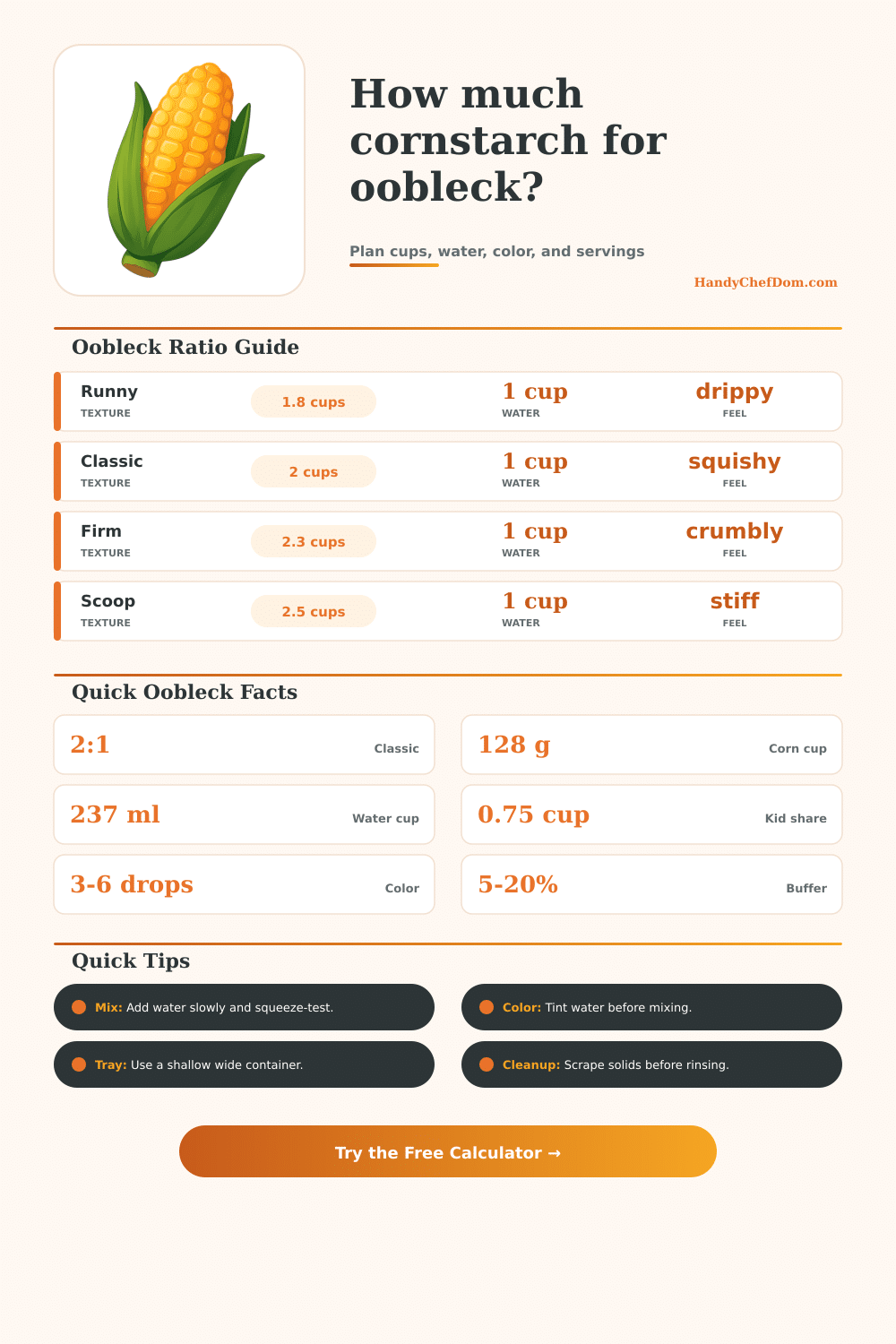
Common starting ratio: about 2 parts cornstarch to 1 part water by volume. Choose a texture, then adjust slowly because oobleck changes quickly as water is added.
Best for pouring, spoon trails, and showing how the mixture drips when left alone.
The usual squeeze-and-flow texture that firms under pressure and relaxes in the hand.
Better for fist squeezes, rolling clumps briefly, and less splashy group stations.
A stiffer tray mix that may need tiny water additions while kids play with it.
| Activity Size | Kids or Servings | Cornstarch | Water | Total Mix |
|---|---|---|---|---|
| Mini sensory cup | 1 child | 3/4 cup / 96 g | 3/8 cup / 89 ml | About 1.1 cups |
| Small table bowl | 2 children | 1 1/2 cups / 192 g | 3/4 cup / 177 ml | About 2.25 cups |
| Family tray | 4 children | 3 cups / 384 g | 1 1/2 cups / 355 ml | About 4.5 cups |
| Class station | 6 children | 4 1/2 cups / 576 g | 2 1/4 cups / 532 ml | About 6.75 cups |
| Party bin | 8 children | 6 cups / 768 g | 3 cups / 710 ml | About 9 cups |
| Large rotation | 12 children | 9 cups / 1152 g | 4 1/2 cups / 1065 ml | About 13.5 cups |
| Target Texture | Cornstarch to Water | Water for 2 Cups Starch | Best Sensory Cue | Adjustment Cue |
|---|---|---|---|---|
| Runny pour demo | 1.8 parts starch to 1 part water | 1.11 cups water | Drips from fingers and spoon | Add starch by tablespoons if too watery |
| Classic squeeze-and-flow | 2 parts starch to 1 part water | 1 cup water | Turns firm when squeezed, then flows | Add water by teaspoons if crumbly |
| Firm squeeze test | 2.3 parts starch to 1 part water | 0.87 cup water | Holds clumps briefly under pressure | Add a splash of water as it dries |
| Scoopable stiff batch | 2.5 parts starch to 1 part water | 0.8 cup water | Scoops thickly and resists stirring | Use for low-splash trays only |
| Cornstarch Cups | Approx Grams | Classic Water Cups | Classic Water ml | Estimated Mix Volume |
|---|---|---|---|---|
| 1/2 cup | 64 g | 1/4 cup | 59 ml | About 3/4 cup |
| 1 cup | 128 g | 1/2 cup | 118 ml | About 1 1/2 cups |
| 2 cups | 256 g | 1 cup | 237 ml | About 3 cups |
| 3 cups | 384 g | 1 1/2 cups | 355 ml | About 4 1/2 cups |
| 4 cups | 512 g | 2 cups | 473 ml | About 6 cups |
| 6 cups | 768 g | 3 cups | 710 ml | About 9 cups |
| Activity Plan | Best Batch Style | Container Fit | Color Plan | Cleanup Buffer |
|---|---|---|---|---|
| Single child sensory cup | Classic or runny | 2 cup bowl or cup | 3 to 5 drops | 5 percent |
| Sibling tray play | Classic | Shallow 6 cup tray | 8 to 12 drops | 10 percent |
| Classroom station | Firm squeeze | Wide 8 to 12 cup bin | 15 to 30 drops | 15 percent |
| Party rotation | Firm or scoopable | Large lidded bin | 30 to 50 drops | 20 percent |
| Science demonstration | Runny pour | Clear bowl or tray | Optional color | 10 percent |
Oobleck are a substance that display properties of both a solid and a liquid. When a person puts pressure on the oobleck, it transform into a solid. When a person stops applying the pressure to the oobleck, it transform into a liquid again.
Many peoples use cornstarch and water to create oobleck. The ratio of cornstarch to water impact the texture of the oobleck. People have to use the proper ratio of cornstarch to water; otherwise, the oobleck will be either too runny or too stiffly.
How to Make Oobleck
The calculator provide the amount of cornstarch and water needed based on the number of people that will use the oobleck. People can use the calculator to enter the number of peoples who will use the oobleck, the texture they would like for the oobleck, and a buffer percentage. This buffer percentage is the amount of cornstarch and water that will be added to the oobleck to account for any that may spill or stick to the sides of a container.
People use a buffer percentage for the oobleck so that they will have enough to finish the activity in the event that some of the oobleck are spilled. One of the main variable with making oobleck is the texture of the oobleck, which is dependent upon the amount of water that is added to the cornstarch. Oobleck that has a runny texture has more water then cornstarch and can be useful for demonstrating the dripping properties of the oobleck.
Oobleck that is stiff has less water than cornstarch and can be useful for those who would like to squeeze the oobleck into different shape. People should of use the calculator to determine the texture that they would like for the oobleck prior to adding water to the cornstarch. When too much water is added to the cornstarch, it can be difficult to fix the oobleck.
People must also consider the size of the container in which the oobleck will be prepared. The container must be large enough to hold all of the oobleck that will be prepared. It is best to ensure that the oobleck does not fill the container more than three-quarters of the way.
If the oobleck fill too much of the container, it will be difficult for the individual to mix the oobleck. Furthermore, if the oobleck fills too much of the container, there is a chance of spill the oobleck. People can use the calculator to determine whether or not the container is large enough for the oobleck that the calculator determined that the number of people will require.
A larger container can be selected if the amount of oobleck is too high for the current container. People can also add color to the oobleck by adding the color to the water before adding it to the cornstarch. Adding color to the water will ensure that the color is evenly distributed throughout the oobleck.
Furthermore, adding color to the water will allow for fewer drop of food coloring to be added. In addition to making the oobleck, people must also clean up after the activity. The buffer of extra cornstarch and water will help people with the cleanup because it will account for the amount of oobleck that will dry on the surfaces.
People should also consider the environmental factor when preparing the oobleck. Humidity levels can have an effect upon the texture of the oobleck. Furthermore, the way in which the cornstarch is packed in its packaging can also have an effect upon how the oobleck behave.
These environmental and packaging factors can change the outcome of making the oobleck. People should test the texture of the oobleck after the first time that they mix the ingredients. People can add more cornstarch if the texture of the oobleck is too soft or more water if the texture of the oobleck is too stiff.
People can use the calculator so as to avoid guessing at the proper amount of cornstarch or water that should be combine. Thus, using the calculator allow people to ensure that the texture of the oobleck will be correct on the first attempt.