🧀 Cheddar Protein Calculator
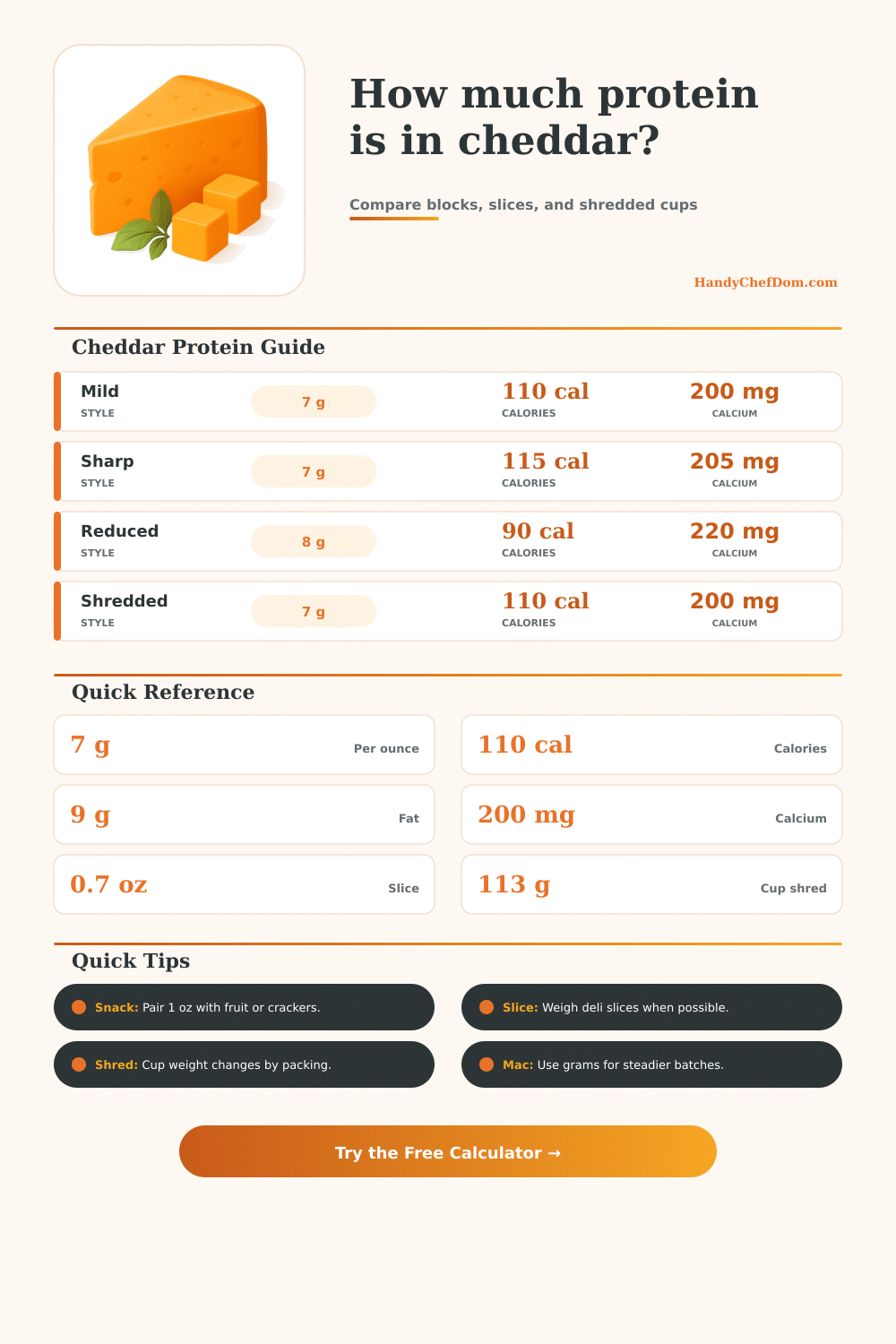
Estimate protein, calories, fat, and calcium for cheddar blocks, slices, shredded cups, snack portions, sandwich stacks, and mac portions.
Choose the cheddar label, form, and amount. The calculator converts block ounces, deli-style slices, shredded cups, and meal portions into estimated protein and nutrition totals.
| Cheddar label | Protein per oz | Calories per oz | Fat per oz | Calcium per oz |
|---|---|---|---|---|
| Mild cheddar, full fat | 7.0 g | 110 cal | 9.0 g | 200 mg |
| Medium cheddar | 7.1 g | 112 cal | 9.1 g | 202 mg |
| Sharp cheddar | 7.0 g | 115 cal | 9.4 g | 205 mg |
| Extra sharp cheddar | 7.2 g | 118 cal | 9.6 g | 205 mg |
| White sharp cheddar | 7.0 g | 115 cal | 9.3 g | 204 mg |
| Aged cheddar | 7.3 g | 120 cal | 9.8 g | 210 mg |
| Reduced fat cheddar | 8.0 g | 90 cal | 6.0 g | 220 mg |
| Pre-shredded cheddar | 7.0 g | 110 cal | 9.0 g | 200 mg |
| Form | Typical measure | Approx weight | Protein estimate | Best use |
|---|---|---|---|---|
| Block cheddar | 1 oz cut | 28 g | 7 g | Snacks |
| Thin slice | 1 slice | 14 g | 3.5 g | Small melts |
| Deli slice | 1 slice | 19 g | 4.7 g | Sandwiches |
| Thick slice | 1 slice | 28 g | 7 g | Grilled cheese |
| Shredded loose | 1 cup | 100 g | 25 g | Toppings |
| Shredded standard | 1 cup | 113 g | 28 g | Mac portions |
| Shredded packed | 1 cup | 132 g | 33 g | Casseroles |
| Meal use | Cheddar per serving | Protein | Calories | Fat style note |
|---|---|---|---|---|
| Snack plate | 1 oz | 7 g | 110 cal | Classic cube |
| Lunch sandwich | 1.5 oz | 10.5 g | 165 cal | Two deli slices |
| Grilled cheese | 2 oz | 14 g | 220 cal | Melty stack |
| Mac bowl | 1.25 oz | 8.8 g | 138 cal | Shredded mix |
| Family mac | 1.75 oz | 12.3 g | 193 cal | Rich serving |
| Board nibble | 0.75 oz | 5.3 g | 83 cal | Small cube |
| Batch amount | Ounces | Grams | Protein | Snack portions |
|---|---|---|---|---|
| Quarter block | 2 oz | 57 g | 14 g | 2 |
| Half block | 4 oz | 113 g | 28 g | 4 |
| Small block | 8 oz | 227 g | 56 g | 8 |
| One pound | 16 oz | 454 g | 112 g | 16 |
| Party board | 24 oz | 680 g | 168 g | 24 |
| Mac tray | 32 oz | 907 g | 224 g | 32 |
The nutrition facts found on packages tell us everything we should of known about Cheddar cheese, but only if you know how to read them rightly. Because cheese comes in different forms, understanding those variations help you keep better track of your food intake. That’s where the calculator (above) come in: It eliminates guesswork and shows exactly what you’re consuming by style.
You do not need a spreadsheet. Just use it and trust it.
How to Read Cheddar Cheese Labels
Density may be the largest variable you’re not accounting for. When you measure in volumes (cups), you’re realy measuring both dairy AND air. That’s why it’s better to switch over to weight (or simply go with standard portion sizes such as deli slices). You’ll get a consistent reading each time.
It also helps that the tool adjust its protein and calorie values depending on the type of cheese you’ve got… Compressed or fluffy. Why? Thirty grams of packed cheese contain almost twice as much protein than the same amount of cheese served loose. This shifts your day macronutrients if you’re counting those calories.
Nutrition-wise, age matters too. Because water evaporates during curing process, sharp cheddar contains more nutrients (calories, protein) per ounce than a similar amount of mild cheddar. An ounce of extra-sharp aged cheddar contain more calories and protein than an ounce of mild cheddar. Calcium increases somewhat with age, and fat content rise just a bit, as the reference tables demonstrate. Know this: Older cheese is more concentrated, meaning small servings count more in your nutrition log… But there’s no need to memorize any specific numbers.
Meal prepping also benefits from knowing how much goes into each serving. I can easily eyeball a handful of shreds into my pot of macaroni and cheese. However, when comparing a single serving bowl to family sized pan, one might use two ounces of cheese per person while the other use only about an ounce. That adds up quickly if you’re eating this way for a week. Having standard portion inputs such as sandwich slice lets you maintain those numbers consistantly so that “some cheese” becomes something more concrete; a gram count that fits into your overall diet plan.
There’s also more when it comes to lower-fat varieties. Because the fat is removed, these usually end up having a higher percentage of protein by weight, but they will cook different and melt strangely in recipes. Though the tool will spit back accurate nutrients for the reduced-fat versions, it won’t say, “Hey! Don’t expect this to turn into cream; it’ll be all rubbery!” Taste remains the last word from your tongue.
To get a precise guess at the number of calories, protein or calcium, just plug-in exactly how it came (style and form) so you can make an informed decision on what will work with your goals. That’s not a restriction; it’s tracking. Because when you track cheese, you know what’s realy going into your body.
And if the cheese is cheddar, it is a powerful ingredient that works well in small portions. Knowing this lets you find ways to offset other parts of your day. It becomes a controlled part of your routine instead of an unpredictable factor. Instead of vague guesses, you know exactly what that golden wedge is bringing to table, and you eat with greater confidence because of it.
The numbers aren’t there to police the pleasure. They’re there to back up the habit.