🍇 Grape Calorie Calculator
Estimate grape calories, carbs, sugar, fiber, snack portions, cups, counts, grams, and cluster yield for red, green, black, and specialty grapes.
Choose the grape measurement you actually have. Count mode uses average grape weights by variety, cup mode uses level-cup kitchen weights, grams mode uses edible fruit directly, and cluster mode estimates edible yield after stems.
| Grape type | Calories per 100 g | Carbs | Sugar | Fiber |
|---|---|---|---|---|
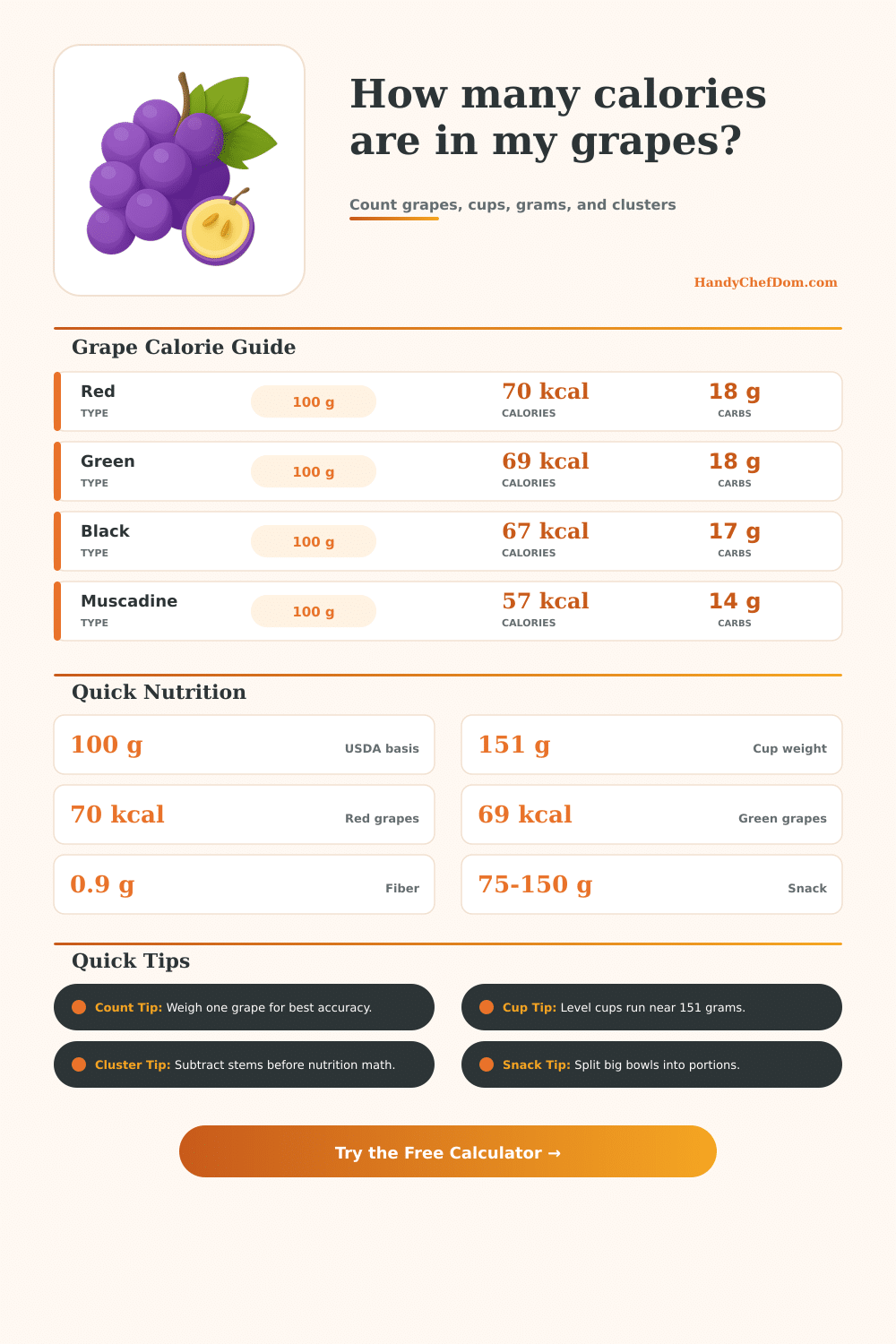
| Red seedless grapes | 70 kcal | 18.0 g | 15.5 g | 0.9 g |
| Green seedless grapes | 69 kcal | 18.1 g | 15.5 g | 0.9 g |
| Black seedless grapes | 67 kcal | 17.2 g | 15.0 g | 0.9 g |
| Cotton candy grapes | 72 kcal | 18.7 g | 16.3 g | 0.9 g |
| Concord grapes | 67 kcal | 17.2 g | 15.5 g | 0.9 g |
| Moon drop grapes | 69 kcal | 18.0 g | 15.6 g | 0.9 g |
| Champagne grapes | 69 kcal | 18.1 g | 15.5 g | 0.9 g |
| Muscadine grapes | 57 kcal | 13.9 g | 10.5 g | 3.9 g |
| Kitchen measure | Typical weight | Calories | Carbs | Best use |
|---|---|---|---|---|
| 1/2 cup seedless grapes | 76 g | 52 kcal | 13.7 g | Kids snack |
| 1 cup seedless grapes | 151 g | 104 kcal | 27.3 g | Lunch side |
| 1.5 cups seedless grapes | 227 g | 157 kcal | 41.1 g | Hearty snack |
| 100 g edible grapes | 100 g | 69 kcal | 18.1 g | Nutrition label basis |
| 1 ounce edible grapes | 28.35 g | 20 kcal | 5.1 g | Small garnish |
| Cluster size | Before stems | Stem loss | Edible yield | Snack portions |
|---|---|---|---|---|
| Small cluster | 85 g | 7% | 79 g | 0.8 standard |
| Medium cluster | 140 g | 7% | 130 g | 1.3 standard |
| Large cluster | 250 g | 8% | 230 g | 2.3 standard |
| Platter bunch | 450 g | 9% | 410 g | 4.1 standard |
| Two bunches | 900 g | 9% | 819 g | 8.2 standard |
| Snack portion | Edible weight | Approx count | Calories | Fiber |
|---|---|---|---|---|
| Kids snack | 50 g | 10 grapes | 35 kcal | 0.5 g |
| Light snack | 75 g | 15 grapes | 52 kcal | 0.7 g |
| Standard snack | 100 g | 20 grapes | 69 kcal | 0.9 g |
| Hearty snack | 150 g | 30 grapes | 104 kcal | 1.4 g |
| One cup snack | 151 g | 30 grapes | 104 kcal | 1.4 g |
Are grapes a food with too much sugar or too little? It’s a good question that comes up frequently. On the one hand, yes, grapes are sweet. But do they make for a healthy snack? It sounds easy, and yet, depending on which grape variety (cotton candy, dark Concord, red seedless) you consume, those calories pack different punch. While that number might not be big enough to notice initially it can add up if you’re trying to reach certain nutritional targets.
The majority of us assume all types of grapes is the same in terms of nutrition. That isn’t exactly true. How do you measure your portion? This matters most. Volume isn’t reliable, a cup filled with tight-packed grapes will weigh more then one that’s loose. The weight is what tells truth. This is because grapes themselves change size, and the stems are also structured differently.
Why You Should Weigh Your Grapes
The problem is that many people don’t use any gram measurement; they use a “handful,” which creates big errors when estimating daily intake. You can get good at gauging serving size using your eyes after you use a kitchen scale once. Until then, common serving sizes will be to imprecise to avoid skewing your weeks’ worth.
In other words: Not all grapes are created equal, and there’s a reason beyond calorie count why you might choose certain varieties if you’re watching your blood sugar. First of all, the type of grape does make a difference, more so than most consumers realize: Per 100-gram serving, common table varieties like seedless green and red grapes comes in around 70 calories. But certain types of grapes, such as muscadines, are much lower in overall calories. They also pack more fiber. That fiber is slower-digesting and lowers the blood-sugar spike relative to regular seedless varieties. If you’re tracking your body’s glycemic response, this makes a difference.
Select the variety you’re going to eat and use this calculator to get exact number. Don’t assume something will be good for you based off what seems logical, you might be surprised.
Clumps make things more complicated: Stemmed vegetables have theoretical value (technically you could eat them), but they has no practical value because they get thrown away. Throwing away stems is like buying a big bunch of something and only getting close to 90% of it, meaning that if you’re not tracking wasted food, you think you’re eating more than you really are. By accounting for stems as a percentage of each item, and then correcting for stem percentage, you turn a vague eyeballing exercise into a precise measurement of what got onto the plate vs. What ended up in your belly.
Snack portion size is bridge between the two. When you are hungry, a normal serving size can be underwhelming. If you are grazing, it might feel like too much. Pre-portioning a big bowl into smaller bowls stops mindless eating when you are looking at the fruit. It also helps you understand how much 100 grams of food looks like in your actual bowl, before digging in.
The chart below provides a visual reference for common snack sizes, from tiny half-servings to full grown-up portions. Don’t panic about the sugar content, but do pay attention. Naturaly, grapes gets their carbohydrate sources from two sugars: Glucose and Fructose. These aren’t bad sugars added for preservatives or texture; they are natural energy from whole foods. But, yes, there’s a little bit of variation in how concentrated they are by type.
Darker grape types (such as black seedless) tend to be less sugary than, say, cotton candy grapes. If you can find one that has a bit less sugar, it’ll make all the difference over time, without compromising flavor. But tracking how many grapes you eat isn’t really about restriction. It’s about awareness.
Savor the sweet treat, and appreciate its role in your overall diet. If you’re snacking randomly or meal prepping for the week, knowing those numbers makes your decisions more powerful. They transform that casual bowl-grab into a conscious choice. Count them if necessary, weigh them if possible, so you know precisely what you’re putting into your body. The worry of guessing goes out the window; measurement becomes the name of the game.
You should of remembered: a handful is just the start. But the scale shows the truth.