🌱 Chia Seeds Protein Calculator
Measure chia by teaspoons, tablespoons, cups, or grams, then estimate protein, calories, fiber, omega-3, and dry-to-soaked yield for common kitchen portions.
Choose a chia measure and portion style. Nutrition uses standard dry chia estimates per 100 g, then soaked yield is based on your liquid ratio and preparation choice.
| Measure | Dry Chia | Protein | Calories | Fiber |
|---|---|---|---|---|
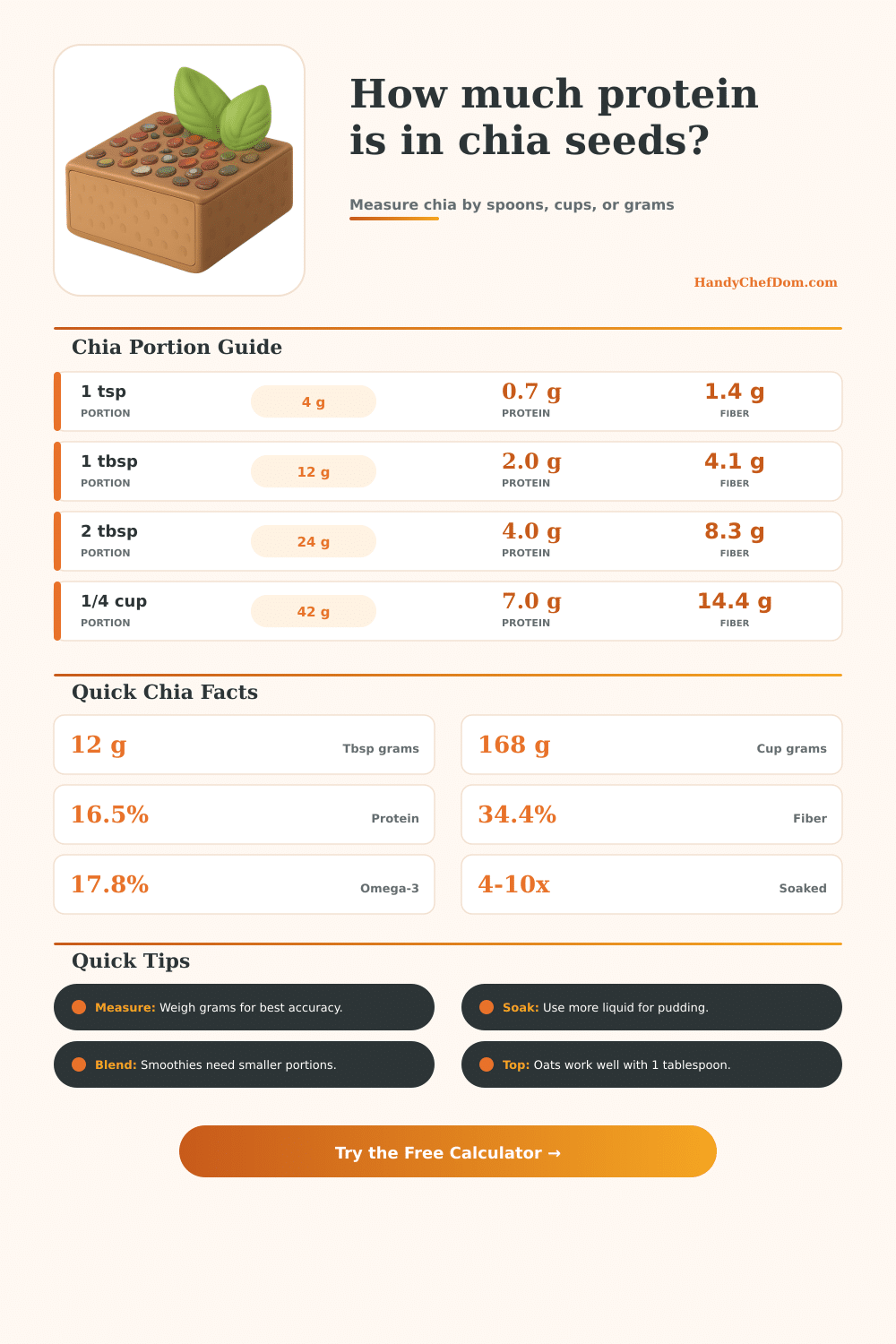
| 1 teaspoon | 4 g | 0.7 g | 19 kcal | 1.4 g |
| 1 tablespoon | 12 g | 2.0 g | 58 kcal | 4.1 g |
| 2 tablespoons | 24 g | 4.0 g | 117 kcal | 8.3 g |
| 3 tablespoons | 36 g | 5.9 g | 175 kcal | 12.4 g |
| 1/4 cup | 42 g | 6.9 g | 204 kcal | 14.4 g |
| 1/2 cup | 84 g | 13.9 g | 408 kcal | 28.9 g |
| Chia Label | Protein Factor | Fiber Factor | Best Fit | Texture Note |
|---|---|---|---|---|
| Black chia seeds | 1.00x | 1.00x | Pudding | Classic gel |
| White chia seeds | 0.99x | 1.00x | Yogurt | Light color |
| Milled chia seeds | 1.03x | 0.98x | Smoothies | Thicker blend |
| Organic chia seeds | 1.00x | 1.00x | Oats | Same math |
| Sprouted chia seeds | 1.02x | 0.97x | Bowls | Softer bite |
| Golden chia blend | 0.98x | 0.99x | Toppings | Mild look |
| Pre-soaked chia gel | 1.00x | 1.00x | Drinks | Use dry weight |
| Chia protein blend | 1.18x | 0.85x | Protein jars | Label varies |
| Portion Style | Typical Dry Amount | Protein Range | Soaked Yield | Use Case |
|---|---|---|---|---|
| Oat topping | 1 tbsp | 1.8-2.2 g | Dry to 1/3 cup | Breakfast bowl |
| Smoothie boost | 1-2 tbsp | 2.0-4.0 g | Blended thick | Drink texture |
| Yogurt bowl | 1.5 tbsp | 3.0 g | Soft topping | Snack bowl |
| Chia pudding | 2-3 tbsp | 4.0-5.9 g | 3/4 to 1 cup | Jar portion |
| Baking mix-in | 2 tbsp | 4.0 g | Minimal soak | Muffin batter |
| Hydrated drink | 1 tsp | 0.7 g | 1/4 cup gel | Light add-in |
| Dry Amount | Light Soak 4x | Standard Soak 6x | Pudding Soak 8x | Loose Gel 10x |
|---|---|---|---|---|
| 1 tsp, 4 g | 16 g gel | 24 g gel | 32 g gel | 40 g gel |
| 1 tbsp, 12 g | 48 g gel | 72 g gel | 96 g gel | 120 g gel |
| 2 tbsp, 24 g | 96 g gel | 144 g gel | 192 g gel | 240 g gel |
| 1/4 cup, 42 g | 168 g gel | 252 g gel | 336 g gel | 420 g gel |
| 1/2 cup, 84 g | 336 g gel | 504 g gel | 672 g gel | 840 g gel |
| 1 cup, 168 g | 672 g gel | 1008 g gel | 1344 g gel | 1680 g gel |
Sometimes it’s just some oatmeal in the mornings, or a blender jar full. But throw in some chia seeds? Then it gets interesting.
Chia seeds have gotten lots of press over the years for being good for you. How much do you add? When does enough become too much? How do you get to the right balance of protein, say, without ending up with sludge instead of a smoothie? A measure of nutrition is what this page is all about.
How to Use the Chia Seed Calculator
The chia seed calculator calculate precise information from kitchen measurements you provide. That’s because there is always variables you don’t think about. For example, you have to consider how much water you use versus how runny you want your finished product. Chia seeds alter the texture of foods, they are an afterthought in many recipes but can transform them. When soaked in water, the dry seed expand into a gel. The amount of seed needed depends on amount of water used. So if you’re starting with a half cup of milk and adding two tablespoons of chia, the resulting mixture will be thicker then the initial ingredients alone.
That’s why the app lets you choose type of prep (think: from very light for drinks to a thick, pudding-like consistency), which changes estimated yield. You’ll always know just how many serving you’ve prepared. All that liquid means you won’t overeat or undereat based off how much food you see.
Chia seeds get attention for protein (and they’re loaded with it), but why do they make you feel full? It’s because of the fiber. Chia seeds includes soluble fiber… Fiber that doesn’t break down during digestion and makes you feel full longer. According to the reference table, a single serving of just one tablespoon have large amounts of fiber (and protein). White and black seeds are nearly identical nutritionally speaking, so it comes down to appearance. Milling chia, though, is another story; it breaks down the outer shell, which alter its properties.
If you pick a particular seed from the dropdown list, the calculator take those changes into account so that what you estimate represents what you have on hand, not some average. Chia seeds are used by some (particularly those non-fish eaters) because they contain omega-3 fatty acids. This include plant-based alpha-linolenic acid; your body converts it into something usable. There’s no way to know how much your particular body absorbs, though, but knowing the raw amount help you plan. However, knowing the base number allows you to plan a diet with sufficient amounts across all meals. Enter the serving size you’re aiming for in the inputs, then find out if you’ve met your goal, or come up short. Additionally, since these dense seeds adds a lot of energy to an already hefty dish, it’s good to track the number of calories as well, to keep things in check.
The usefulness of it comes down to adding the seeds into your life. It’s simple to just put a spoonful atop some oatmeal, but if you’re looking to make chia pudding, that involves paying attention to the ratio of liquid:chia. Too little liquid? Hard, chewy beads. It is hard. Too little? Watery disaster. So the calculator has pre-sets to get you started based off typical situations (like meal prep, or smoothie, etc). This eliminates guessing and allows you to scale up recipes to family size servings. And you can tune it based on whether you use level or heaped spoons, because that matters over time. Accurate measuring lead to repeatable results, which helps you stick to those health routines.
Protein isn’t the only thing chia seeds do. Chia seeds add nutrition, but they also add texture if used carefully. Knowing how much each nutrient is in a certain amount of dry seeds will help you dial in your bowl of cereal. It’ll give you the math behind your food, so you can play around and know where you stand before it’s too late.
You start modestly. Every time you try something new, tweak until it’s right. With each dish, you’ll learn to trust yourself. And then, eventually, you won’t have any doubt about what you’re putting in your body. Because knowing what you put in there makes every spoonful count. You should of tried them sooner.